






SPR, BLI and ELISA: Comparison of the Advantages and Disadvantages of Three Major Antibody Detection Methods
Antibody-antigen interaction studies are a core component in life sciences, drug development, and immunodiagnostics. Choosing the appropriate detection technology is crucial for the accuracy of experimental results and data interpretation. Surface Plasmon Resonance (SPR), Bio-Layer Interferometry (BLI), and Enzyme-Linked Immunosorbent Assay (ELISA) are currently the three most commonly used antibody detection methods. Each has its unique advantages and certain limitations.
I. Technical Principles of the Three Antibody Detection Methods
1. Surface Plasmon Resonance (SPR)
SPR is a label-free, real-time monitoring physical optical method for studying molecular interactions. By detecting changes in the electron density on a metal surface, SPR can dynamically measure association rate (ka), dissociation rate (kd), and affinity constant (KD).
2. Bio-Layer Interferometry (BLI)
BLI is also a label-free real-time detection technology based on the principle of light interference. It quantitatively analyzes molecular binding processes by measuring changes in the interference pattern of light reflected from the probe surface. Its operation is simpler, maintenance costs are lower, making it suitable for medium to high throughput screening.
3. Enzyme-Linked Immunosorbent Assay (ELISA)
ELISA is the most classical antibody detection technology. It is based on the specific binding of antigens and antibodies followed by enzyme-labeled reactions to produce detectable signals. Although labeling is required, its high sensitivity and strong specificity make it one of the most widely used detection methods in clinical and research applications.
II. Comprehensive Comparison of Advantages and Disadvantages
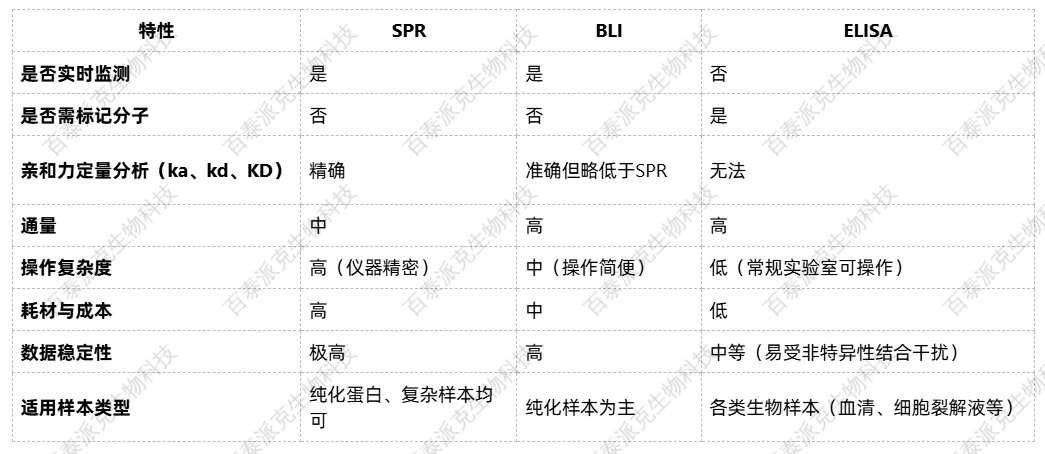
III. Technical Selection Recommendations for Different Application Scenarios
1、Drug Screening and Antibody Affinity Evaluation
Recommended Technologies: SPR or BLI
SPR provides the highest precision kinetic parameters, making it very suitable for quantitative screening of candidate antibody affinities. BLI, as an alternative, offers higher efficiency in high throughput screening scenarios and is suitable for early pipeline evaluation.
2、Biomarker Validation and Immunological Research
Recommended Technology: ELISA
ELISA has high sensitivity and good reproducibility, suitable for large-scale sample detection, such as serum antibody level monitoring and vaccine efficacy evaluation. Its mature kit system also significantly lowers the experimental threshold.
3、Protein Interaction Mechanism Studies
Recommended Technology: SPR
When exploring complex kinetic relationships between proteins or between proteins and small molecules, SPR can reveal complete binding curves and provide millisecond resolution data support, making it an ideal choice for biophysical studies.
IV. Key Factors to Consider When Selecting Detection Technology
1. Research Objective:Is the focus solely on binding signals or are precise kinetic parameters required?
2. Sample Conditions:Does the sample need purification or contain complex backgrounds?
3. Budget and Throughput Requirements:Is there a need for high throughput screening? Are there budget constraints?
4. Experimental Cycle and Reproducibility:Are there specific requirements for delivery cycle or data reproducibility?
V. Technical Advantages of BioTech Pioneer
In antibody screening and protein interaction analysis services, BioTech Pioneer integrates the advantages of SPR, BLI, and ELISA multi-platform technologies to establish a standardized, high-throughput data acquisition process:
1. High Precision SPR Detection:Using Biacore T200, providing 1:1, bivalent, and other model fittings to meet the needs of complex system research;
2. Automated BLI Platform:Supports 96/384 well plate operations, quickly evaluating hundreds of antibody affinities and specificities;
3. Customized ELISA Development Service:Adaptable to different targets, supporting the full process from antigen design to data delivery.
SPR, BLI, and ELISA each have their strengths. Researchers should make informed decisions based on their research needs, sample characteristics, and budget conditions when selecting a detection platform. As a professional provider of protein interaction research services, BioTech Pioneer is committed to offering flexible, accurate, and reliable detection solutions. If you are looking for high-quality antibody affinity measurement or protein interaction research services, please contact BioTech Pioneer for technical support and a free evaluation plan.
BioTech Pioneer - A Premium Service Provider for Bioproduct Characterization and Multi-Omics Biomolecular Mass Spectrometry
Related Services:
How to order?




