






Standard CUT&Tag Experimental Procedure
CUT&Tag (Cleavage Under Targets and Tagmentation) is an emerging chromatin analysis technology that, due to its high resolution, extremely low background, and minimal cell number requirements, is replacing ChIP-seq as the mainstream method in epigenetic research. This technique uses a Protein A/G fusion transposase Tn5 to mediate in situ cleavage and adapter ligation, allowing precise capture of protein-DNA interactions such as transcription factors and histone modifications. Compared to ChIP-seq, CUT&Tag is not only simpler to perform but also more efficient in library construction, making it particularly suitable for precious samples and single-cell level studies. A detailed outline of the standard CUT&Tag experimental procedure helps researchers quickly understand and implement this technique in practical projects.
I. Overview of Experimental Principle
CUT&Tag uses antibodies targeting specific proteins together with the Tn5 transposase fused with Protein A/G (pA-Tn5) to perform in situ cleavage and adapter ligation around the DNA of bound proteins. Subsequently, library amplification and sequencing are directly carried out to achieve high-throughput analysis.
II. Standard CUT&Tag Experimental Procedure
1. Cell Fixation and Preparation (Optional)
(1) To fix or not?
Cross-linking fixation (such as with 1% formaldehyde) is optional, but CUT&Tag usually uses unfixed cells to preserve the native state of chromatin.
(2) Cell Type and Quantity
It is recommended to use 5,000 to 100,000 cells, making it very friendly for rare cell populations.
(3) Cell Coating with Magnetic Beads
Coat cells with Concanavalin A magnetic beads to facilitate subsequent washing steps.
2. Cell Permeabilization
Use Digitonin or NP-40 to mildly permeabilize the cell membrane, allowing antibodies to bind to chromatin targets.
3. Primary Antibody Incubation
Add specific primary antibodies (targeting proteins such as H3K27me3, CTCF, etc.) and incubate at 4°C for 2 hours or overnight for specific binding.
4. Secondary Antibody Incubation
Add secondary antibodies suitable for the host of the primary antibody (such as anti-Rabbit IgG for rabbit antibodies) to enhance subsequent pA-Tn5 binding.
5. pA-Tn5 Transposase Incubation
Add the Protein A/G-Tn5 transposase complex pre-loaded with adapters and incubate at 4°C to ensure Tn5 localization at the antibody binding regions.
6. Initiate Cleavage and Adapter Ligation Reaction
Add Mg²⁺ buffer to activate Tn5 enzymatic activity, performing in situ cleavage and adapter integration (tagmentation) in target regions, typically for 1 hour.
7. DNA Extraction
Use Proteinase K to lyse proteins and extract DNA fragments using phenol/chloroform extraction or purification columns.
8. Library Amplification and Quality Control
(1) Use PCR to amplify adapter-integrated fragments, commonly for 10-15 cycles;
(2) Use Agilent Bioanalyzer or Qubit to check fragment distribution and concentration.
9. High-Throughput Sequencing
Illumina platform can be used for paired-end sequencing (PE50 or PE75); usually yielding millions of effective reads with high data quality and low background noise.
III. Brief Data Analysis Workflow
1. Data Quality Control (FastQC, Trim Galore for adapter trimming)
2. Alignment (Bowtie2, allowing few mismatches)
3. Peak Calling (MACS2)
4. Annotation and Visualization (ChIPseeker, deepTools)
5. Differential Analysis (DiffBind, etc.)
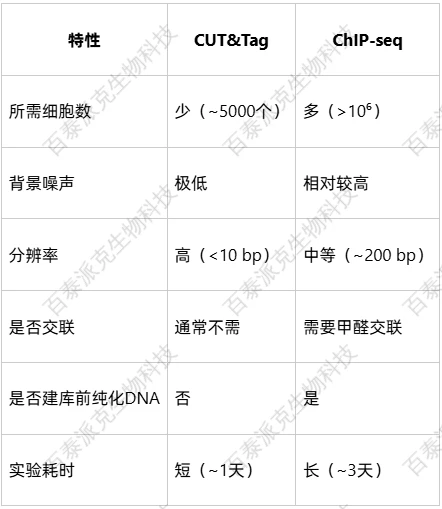
IV. CUT&Tag vs. ChIP-seq: Advantage Comparison
V. BioPacket Biotechnology CUT&Tag Service Advantages
At BioPacket Biotechnology, we provide comprehensive CUT&Tag experimental and sequencing services, including:
1. High-quality sample processing (supporting extremely low cell quantities)
2. High-throughput Illumina platform sequencing
3. Multiple epigenetic protein target antibodies available
4. Full-process data analysis and visualization report
5. Customizable differential analysis and integrated transcriptome, multi-omics exploration
Compared to ChIP-seq, CUT&Tag has advantages such as requiring fewer samples, high signal-to-noise ratio, low background, and high resolution, making it one of the mainstream methods in epigenetic research. BioPacket Biotechnology adopts an optimized CUT&Tag process to ensure data reproducibility and analytical depth, suitable for constructing epigenetic modification maps, transcriptional regulatory network analysis, tumor epigenetic heterogeneity research, and other cutting-edge application scenarios. If you are exploring epigenetic regulatory mechanisms or constructing high-precision chromatin maps, feel free to contact BioPacket Biotechnology for more detailed service plans and technical information. We are committed to assisting your research breakthroughs through advanced multi-omics platforms.
BioPacket Biotechnology—Biological Product Characterization, Multi-omics Biological Mass Spectrometry Quality Service Provider
Related Services:
How to order?




