






What are the methods for measuring the thermal stability of proteins
Measuring the thermal stability of proteins is an important aspect of biochemical and molecular biological research. This stability provides information about how proteins resist the effects of temperature changes and their stability and function at different temperatures. Below are some common methods used to measure protein thermal stability:
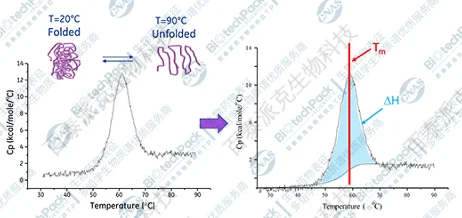
Figure 1
1. Differential Scanning Calorimetry (DSC)
- DSC is one of the gold standard methods for assessing protein thermal stability. It determines the protein's melting temperature (Tm), the temperature at which the protein loses its structure, by measuring the heat absorbed by the protein during heating.
- This method provides detailed information about the thermodynamic stability of proteins.
2. Fluorescence Spectroscopy
- Fluorescence spectroscopy is often used to monitor structural changes in proteins during heating, particularly changes in intrinsic fluorescence (such as tryptophan and tyrosine fluorescence) or fluorescence changes of bound fluorescent probes.
- Fluorescence enhancement or reduction is generally related to the folded or unfolded state of the protein.
3. Circular Dichroism (CD)
- CD spectroscopy can be used to monitor the secondary structure of proteins and observe structural changes as the temperature gradually increases. By analyzing changes in secondary structure, one can infer the thermal stability of proteins.
- CD provides detailed information about protein structural changes.
4. Static Light Scattering (SLS)
- SLS can be used to monitor the extent of protein aggregation under high-temperature conditions. Protein aggregation is often accompanied by instability and denaturation.
- This method is particularly useful for understanding protein behavior under thermal stress.
5. Isothermal Titration Calorimetry (ITC)
Although ITC is typically used to measure molecular interactions, by measuring the thermodynamic properties of proteins at different temperatures, calorimeters can also be used to assess protein thermal stability.
6. Differential Scanning Fluorimetry (DSF)
- Involves the use of environment-sensitive fluorescent dyes that enhance fluorescence when bound to partially folded protein regions.
- By monitoring fluorescence changes during heating, the melting point and relative stability of proteins can be determined.
BiotechPack, A Biopharmaceutical Characterization and Multi-Omics Mass Spectrometry (MS) Services Provider
Related Services:
Thermal Stability Analysis (DSC)
Disulfide Bond/Free Cysteine Detection
Protein Circular Dichroism Analysis
How to order?




