






Dynamic Light Scattering Particle Size Analyzer: Principles and Applications
Dynamic Light Scattering (DLS), also known as laser light scattering, is a technique used to measure the size of small particles (such as proteins, nanoparticles, polymers, or lipid vesicles) in solution or suspension. Here are the basic principles of dynamic light scattering particle size analyzers:
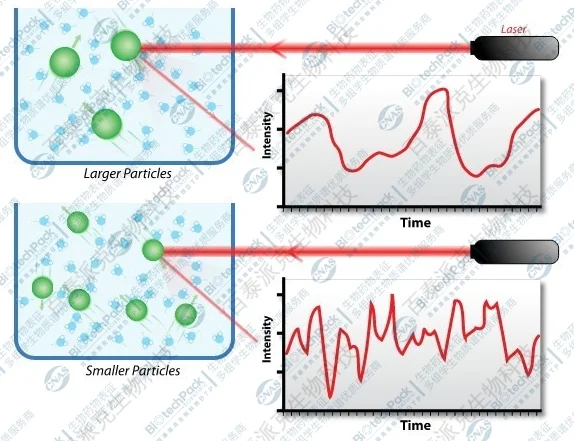
Figure 1
DLS is based on analyzing the fluctuations in the intensity of scattered light from particles in a solution over time. When a laser beam is directed at a sample, the particles within the sample scatter light. Due to the continuous Brownian motion (i.e., random motion) of particles in the solution, the phase and intensity of light scattered by each particle change over time. These time-dependent scattered light variations create interference effects, leading to fluctuations in the intensity of light received by the detector. These fluctuations vary with particle size: larger particles fluctuate more slowly while smaller particles fluctuate more quickly.
By measuring the time correlation of the light intensity, an autocorrelation function is obtained. The autocorrelation function describes the similarity of scattered light intensity changes over different time intervals. Using appropriate mathematical models (such as the Perrin equation), the diffusion coefficient of particles can be extracted from the autocorrelation function, and subsequently, the hydrodynamic diameter of the particles is calculated.
DLS can provide the size distribution of particles in a solution. It is a non-invasive, fast method that typically does not require large sample volumes. However, it should be noted that for very heterogeneous samples, DLS may not be the best choice due to potential limitations in resolution.
Biaopai Biotech - A premier service provider for biopharmaceutical characterization and multi-group biological mass spectrometry analysis.
Related Services:
Dynamic Light Scattering Analysis (DLS)
Disulfide Bond/Free Cysteine Detection
Protein Circular Dichroism Analysis
How to order?




