






Circular Dichroism Measurement of Protein Triple Helix Structure
Circular Dichroism (CD) is a technique commonly used to study protein structures, particularly useful for determining the relative content of α-helices, β-sheets, β-turns, and random coils in proteins. The triple helix structure of proteins, especially that of collagen, can also be analyzed using circular dichroism. In the triple helix structure of collagen, each helix is composed of three intertwined polypeptide chains that interact through hydrogen bonds and other non-covalent interactions, forming a stable structure. The triple helix structure exhibits specific spectral characteristics in circular dichroism:
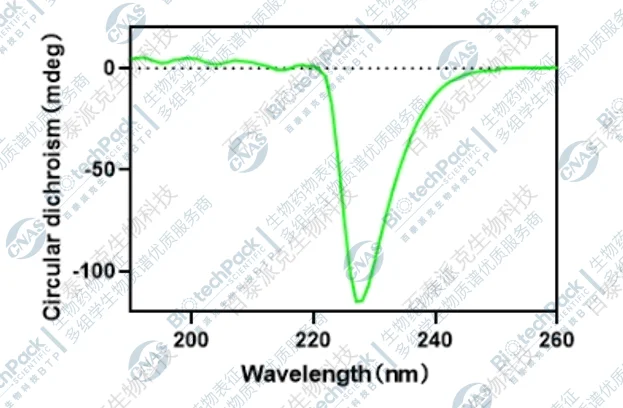
Figure 1
1. Wavelength Characteristics:
The triple helix structure typically shows absorption peaks in the near-ultraviolet region (approximately 190 to 240 nm). Specifically, the triple helix structure of collagen exhibits a distinct negative absorption peak around 220 nm.
2. Structural Sensitivity:
Circular dichroism signals are highly sensitive to structural changes in proteins, making it possible to monitor the effects of environmental factors such as temperature, pH, and solvents on the triple helix structure.
By analyzing circular dichroism spectra, the presence and stability of triple helix structures in proteins can be qualitatively and quantitatively assessed. This is of significant importance in studying the structure and function of collagen and other proteins containing triple helix structures.
BiotechPack, A Biopharmaceutical Characterization and Multi-Omics Mass Spectrometry (MS) Services Provider
Related Services:
Circular Dichroism Analysis (CD)
How to order?




