






Exploring the Potential of HDX-MS in Drug Development
In the field of biopharmaceuticals, there is a continuous quest for more effective methods to develop and evaluate drugs. Among these methods, mass spectrometry plays a crucial role in drug development. One technique, known as hydrogen/deuterium exchange mass spectrometry (HDX-MS), has gained significant attention in recent years. By studying the structural and dynamic changes of proteins, HDX-MS provides a unique perspective for drug research and development. This article will explore the potential of HDX-MS in drug development and its applications in drug research, efficacy evaluation, and formulation optimization.
1. HDX-MS Technology
Hydrogen/deuterium exchange mass spectrometry (HDX-MS) is a high-resolution mass spectrometry technique used to study the structure and dynamic changes of proteins. This technique is based on the exchange reaction between hydrogen in proteins and deuterium in the solution. After exposing proteins to a deuterium-containing buffer solution for a certain period, the exchanged protein samples are measured using a mass spectrometer. HDX-MS can provide information about protein structure, conformational changes, and ligand binding, offering vital data support for drug development.
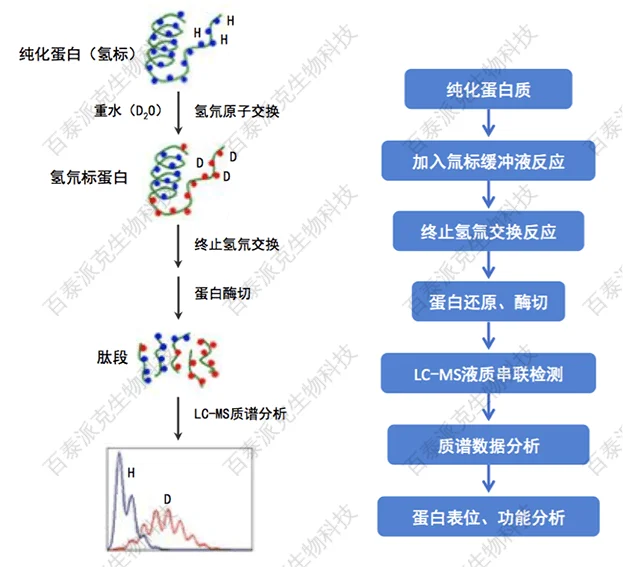
Figure 1
2. Applications of HDX-MS in Drug Research
HDX-MS has wide-ranging applications in drug research. Firstly, it can help researchers understand the interactions between proteins and drugs. By studying the hydrogen/deuterium exchange patterns of proteins in the presence of different ligands, the binding sites, binding strength, and dynamic changes between drugs and proteins can be revealed. This is crucial for drug design and optimization. Additionally, HDX-MS can be used to study the stability and dynamic behavior of drug-protein complexes and the relationship between changes in protein structure and drug effects.
3. Applications of HDX-MS in Drug Efficacy Evaluation
Efficacy evaluation is a critical phase in the drug development process. HDX-MS can provide information about the interactions between drugs and target proteins, aiding in the assessment of drug effectiveness and selectivity. By comparing HDX-MS data of drugs with different target proteins, the binding affinity and stability of a drug toward specific target proteins can be determined. Furthermore, HDX-MS can be used to study the binding kinetics between drugs and target proteins, revealing the mechanism and effects of drugs.
4. Applications of HDX-MS in Formulation Optimization
Optimizing drug formulations is crucial for drug efficacy and patient experience. HDX-MS can be used to study the structure and stability of drugs in different formulations. By comparing HDX-MS data of drugs in various formulations, the impact of formulation on drug structure and stability can be evaluated. This helps in selecting the most suitable formulation and optimizing the delivery and release characteristics of the drug, enhancing bioavailability and efficacy.
As an advanced mass spectrometry technique, HDX-MS shows tremendous potential in drug development. It can provide information on protein structure, conformational changes, and interactions with ligands, offering important data support for drug research, efficacy evaluation, and formulation optimization. By gaining a deeper understanding of protein structure and dynamic changes, HDX-MS has the potential to accelerate the drug development process and promote the research and marketing of new drugs.
Bionovate Biotech -- A leading service provider in bioproduct characterization and multi-omics mass spectrometry analysis
Related Services:
Hydrogen/Deuterium Exchange Mass Spectrometry (HDX-MS)
Protein Interaction Analysis
Protein Structure Identification
Circular Dichroism Spectroscopy Analysis
Native Mass Spectrometry Analysis
How to order?




