






In-depth Analysis of the Workflow and Analytical Strategies for Determining Amino Acids Using High-Performance Liquid Chromatography
Amino acids are the basic building blocks of proteins in living organisms and are essential for life activities. Therefore, accurately determining the content and composition of amino acids is one of the important research topics in the biopharmaceutical field. High-performance liquid chromatography (HPLC), a widely used analytical technique in the field of bioanalysis, offers advantages such as high resolution, high sensitivity, and high efficiency, making it a common method for determining amino acids. This article will provide an in-depth analysis of the workflow and analytical strategies of HPLC for determining amino acids, helping readers to fully understand the application of this technology in amino acid analysis.
1. Principle of HPLC in Determining Amino Acids
The principle of HPLC in determining amino acids is based on the reaction of amino acids with specific reagents to produce chromatographically active products, which are then separated and detected using a chromatographic column. The pre-column derivatization method is usually adopted, where amino acids react with derivatizing agents to form compounds with fluorescence or ultraviolet absorption properties to enhance detection sensitivity. The HPLC system consists of a solvent pump, injector, chromatographic column, detector, and data processing system. By controlling parameters such as flow rate, column temperature, and detection wavelength, separation and quantification of amino acids can be achieved.
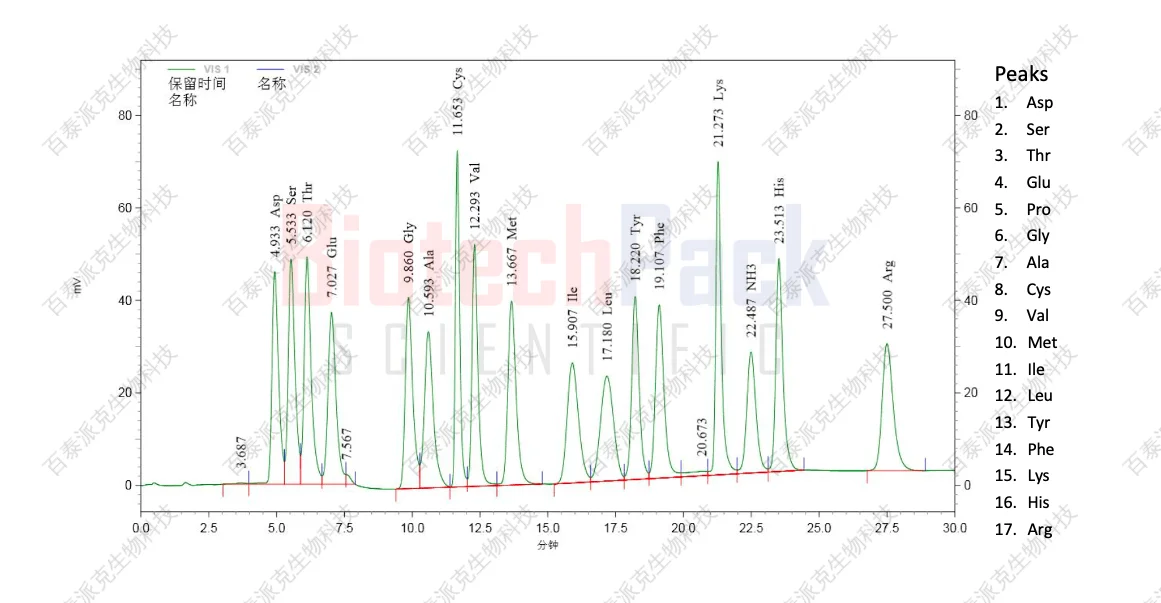
Figure 1
2. Workflow of HPLC in Determining Amino Acids
The workflow of HPLC in determining amino acids includes sample preparation, optimization of chromatographic conditions, injection and separation, detection, and data processing. Sample preparation usually involves protein hydrolysis, derivatization, and purification to obtain samples suitable for HPLC analysis. Optimizing chromatographic conditions involves selecting the appropriate chromatographic column, solvent system, and temperature to achieve efficient separation of amino acids. The injection and separation steps involve controlling the sample injection volume and flow rate to separate the amino acids in the sample on the chromatographic column. The detector selects the appropriate detection wavelength according to different chromatographic columns and derivatizing agents to record and analyze chromatographic peaks. Data processing includes peak area integration and quantitative calculation to obtain the amino acid content.
3. Analytical Strategy of HPLC in Determining Amino Acids
The analytical strategy of HPLC in determining amino acids includes selecting appropriate chromatographic columns, derivatizing agents, and detection wavelengths. The selection of the chromatographic column should be optimized according to the types of amino acids to be analyzed and the desired separation effect. The choice of derivatizing agent should consider the selectivity and sensitivity of the derivatization reaction. Different derivatizing agents are typically detected at different wavelengths to achieve optimal analysis results. In addition, the rationality and accuracy of sample preparation are also key to ensuring reliable analysis results.
4. Advantages and Applications of HPLC in Determining Amino Acids
HPLC in determining amino acids has the advantages of high resolution, high sensitivity, and high efficiency, and is widely used in the biopharmaceutical field. It can be used to analyze amino acids from different sources, assess protein quality and purity, monitor changes in amino acid metabolism, and study protein composition and structure. The accuracy and precision of HPLC in determining amino acids are of great significance for ensuring the compliance of biopharmaceutical quality.
As a highly efficient and accurate analytical technique, HPLC is widely used in amino acid analysis. By thoroughly analyzing the workflow and analytical strategies of HPLC in determining amino acids, we can better understand its application in the biopharmaceutical field. Accurately determining the content and composition of amino acids is crucial for the control and research of biopharmaceutical quality. Further advancement and optimization of HPLC technology will provide more accurate and efficient methods for amino acid analysis, promoting research and development in the biopharmaceutical field.
BioTek Biotech--Characterization of Bioproducts, Multi-Omics Mass Spectrometry Detection Quality Service Provider
Related Services:
Amino Acid Composition Analysis
Amino Acid Composition Analysis for Biopharmaceuticals
Amino Acids and Their Derivatives
How to order?




