






Circular Dichroism Spectroscopy Protein Secondary Structure Analysis: Revealing the Secrets of Protein Folding
Deciphering the secondary structure of proteins is crucial for uncovering the mysteries of their folding process. In the field of biopharmaceutical protein structure, circular dichroism spectroscopy is widely used for analyzing protein secondary structures and unveiling the secrets of protein folding through interpreting circular dichroism spectra. This article will provide a detailed introduction to the importance of circular dichroism spectroscopy in protein secondary structure analysis, with a focus on how it reveals the mysteries of protein folding.
1.Circular Dichroism Spectra and Protein Secondary Structure
Circular dichroism spectra are obtained by measuring the absorption and optical rotation of proteins when exposed to circularly polarized light. The secondary structure of a protein consists of elements such as α-helix, β-sheet, and random coil, each of which has specific absorption and optical rotation effects on the circular dichroism spectrum. Therefore, by analyzing circular dichroism spectra, information about the protein's secondary structure can be obtained.
2.The Role of Circular Dichroism Spectra in Protein Folding
Protein folding is a complex process that involves the formation and stabilization of secondary structures. Circular dichroism spectra can reveal crucial information during the protein folding process. For instance, during folding, the content and spatial distribution of different secondary structure elements can change, and these changes can be monitored and interpreted through circular dichroism spectra. Additionally, circular dichroism spectra can help researchers understand the dynamics and thermodynamics of protein folding.
3.Interpreting Key Information from Circular Dichroism Spectra
Interpreting circular dichroism spectra requires considering multiple factors. First, the experimental circular dichroism spectra need to be compared with known reference spectra to determine the protein's secondary structure components. Secondly, by analyzing the shape, position, and intensity of absorption and rotation peaks in the circular dichroism spectra, the stability and structural characteristics of the protein's folding state can be inferred. Lastly, it is necessary to combine other experimental data and computational methods to further verify and interpret the results of the circular dichroism spectra.
4.Application Fields of Circular Dichroism Spectra
Circular dichroism spectra have widespread applications in the field of biopharmaceutical protein structure. They can be used to study protein folding and stability, assess protein purity, and evaluate structural integrity. Additionally, circular dichroism spectra can be applied in drug development, biopharmaceutical production, and quality control, providing strong support for research and applications in related fields.
5.Conclusion
Circular dichroism spectroscopy holds significant application value in protein secondary structure analysis, and interpreting these spectra can reveal the mysteries of protein folding. It provides crucial information for in-depth understanding of protein structure and function, and is of great importance for research and applications in the field of biopharmaceutical protein structure.
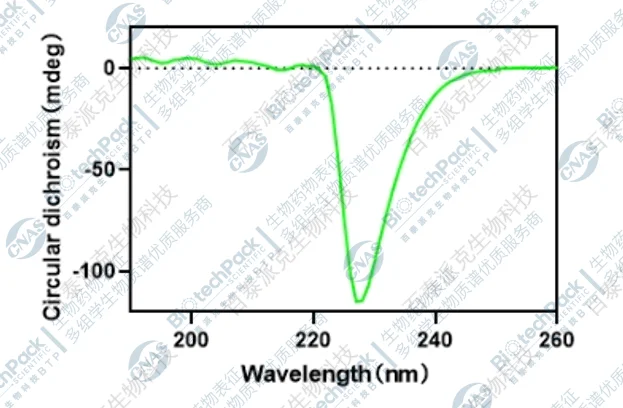
Figure 1
Biotech Biopharmaceuticals -- BiologicalProductsCharacterization, a high-quality service provider for multi-group biological mass spectrometry detection
Related Services:
How to order?




