






Function Analysis of Sumo Protein Modification in Cell Signal Transduction
Cells are the basic units of life, coordinating and regulating cellular functions through complex signal transduction networks. Intracellular signaling involves various protein interactions and modification processes, among which Sumo protein modification plays a crucial role as an important modification mechanism. This article will delve into the functions of Sumo protein modification in cell signaling and analyze its significant roles in protein localization, subcellular localization, transcriptional regulation, and protein interactions.
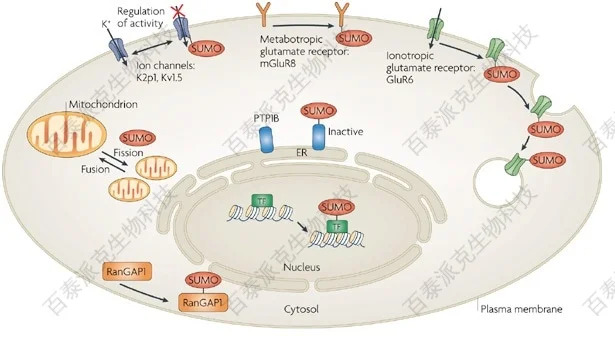
Figure 1
I. Basic Concept of Sumo Protein Modification
Sumo (Small Ubiquitin-like Modifier) protein modification is a covalent modification mechanism similar to ubiquitination, which changes the function or stability of target proteins by covalently attaching to them. Sumo modification usually occurs on the lysine residues of target proteins, forming Sumo-protein conjugates. The Sumo modification process involves the coordinated action of several enzymes, including Sumo activating enzyme, Sumo conjugating enzyme, and Sumo deconjugating enzyme.
II. Role of Sumo Protein Modification in Protein Localization
Sumo modification can regulate protein localization, affecting their distribution within the cell. On one hand, Sumo modification can lead to nuclear localization of proteins, thereby influencing nuclear events such as transcription and DNA repair. On the other hand, Sumo modification can also regulate subcellular localization of proteins, such as modulating signaling pathways in the cytoplasm.
III. Role of Sumo Protein Modification in Transcriptional Regulation
Sumo modification plays an important role in gene transcription regulation. It can affect gene expression by regulating the activity, stability, and interactions of transcription factors. Sumo modification can make transcription factors more stable, preventing their degradation and thus enhancing their function. Additionally, Sumo modification can influence interactions between transcription factors and other co-regulatory factors, further modulating gene expression.
IV. Role of Sumo Protein Modification in Protein Interactions
Sumo modification can regulate interactions between proteins and other proteins. By altering the Sumo modification status of proteins, it can enhance or suppress protein interactions. This modification can affect signal transduction pathways, protein functions, and cellular responses. By regulating the level of Sumo modification, cells can rapidly respond to different environmental stimuli.
Sumo protein modification plays an important role in cell signal transduction. By regulating protein localization, subcellular localization, transcriptional regulation, and protein interactions, Sumo modification can influence the establishment and regulation of intracellular signaling networks, thereby having profound effects on cellular functions and adaptability. Further research into the regulatory mechanisms of Sumo protein modification will help reveal fundamental principles of cell biology and provide important theoretical foundations for research and applications in the field of biopharmaceuticals.
Biotech-Peak Biotech--Characterization of Bioproducts, a Premium Service Provider for Multi-Omics Mass Spectrometry Analysis
Related Services:
Identification of Protein SUMOylation
Quantitative Proteomics Study of Ubiquitination
Post-Translational Modification Proteome Analysis
Histone Post-Translational Modification Analysis
Protein Identification
Protein Disulfide Bond Identification and Quantitative Analysis
S-Nitrosylation Analysis
How to order?




