






HDX-MS Data Interpretation: From Exchange Curves to Structural Insights Revealed
The ion beam is a familiar type of electromagnetic wave, and the famous mass spectrometry technology uses it for experiments. What we want to introduce to you this time is an ultra-cutting-edge mass spectrometry technology—HDX MS. "You ask, what does this have to do with biopharmaceuticals?" Well, there's a lot to explore!
1. An Introduction to HDX MS
1. What is HDX MS?
Hydrogen/Deuterium Exchange Mass Spectrometry (HDX-MS) is used to analyze changes in the three-dimensional structure of protein molecules in solution by measuring the hydrogen-deuterium exchange rates of proteins or peptides in aqueous solution. This leads to profound insights into protein efficacy, behavior, and even drug action.
Deuterium is an isotope of hydrogen, having one more neutron than hydrogen, making it heavier, though their chemical properties are nearly identical. When you dissolve a protein in deuterium oxide, the hydrogen atoms on the protein surface are gradually replaced by deuterium. This process is known as hydrogen-deuterium exchange (HDX). By placing the protein samples into a mass spectrometer and measuring the change in the mass of the protein, it is possible to determine which regions have undergone deuterium exchange.
2. How is HDX MS used?
HDX MS can reveal the interactions between biopharmaceuticals and their targets, thus optimizing drug design and enhancing therapeutic efficacy. Changes in protein conformation (such as conformational changes, aggregation, and dissociation) critically impact drug efficacy and safety. Therefore, revealing the dynamic topology of protein materials or optimizing the matching degree between drug molecules and protein molecules is a key step in biopharmaceutical development, and HDX MS plays a pivotal role in this step.
2. Interpreting HDX-MS Data: From Exchange Curves to Structural Information
In reality, the process of HDX-MS is not straightforward. It requires complex data processing and interpretation to reveal the structural information of proteins.
1. Plotting the Exchange Curve
First, the experimenter obtains a series of mass spectrometry data that show the deuterium exchange at different time points for the protein. These data are plotted into graphs called deuterium exchange curves. This is the most basic data form in HDX-MS, and at this stage, the exchange dynamics of different regions of the protein can be observed.
2. Interpreting Structural Information
Next, after obtaining the deuterium exchange curves, the experimenter needs to compare the deuterium exchange curves under different protein states to interpret the structural information of the protein. For example, the deuterium exchange dynamics of a protein bound to a ligand may differ from that of the protein in a free state, suggesting that ligand binding may alter the protein's structure or dynamics.
However, interpreting structural information is not easy. The experimenter needs a deep understanding of the protein's structure and may also need to introduce computational models to aid interpretation. In some cases, further experiments are required to verify whether their interpretations are correct.
3. Conclusion
HDX-MS technology is an important tool in biopharmaceutical development. Through the unique hydrogen-deuterium exchange process, it reveals the structural dynamics information of proteins, providing valuable data support for drug molecule design.
However, the processing and interpretation of HDX-MS data still require in-depth research. We hope that in the future, more tools and technologies will serve this field, allowing us to interpret HDX-MS data more accurately and conveniently, providing stronger support for biopharmaceutical development.
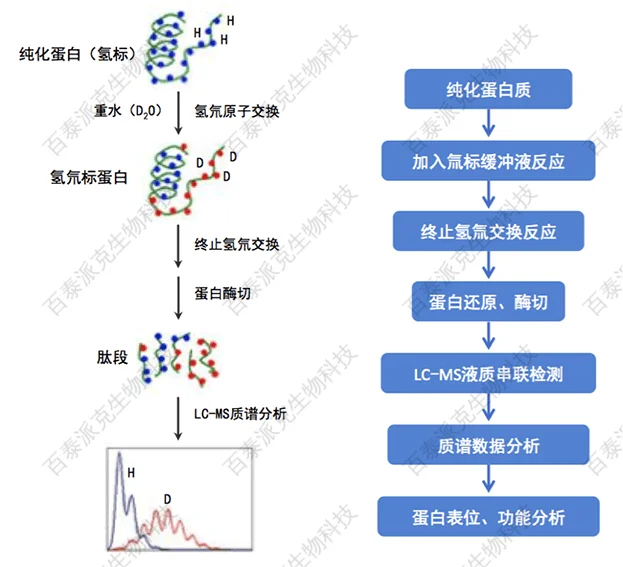
Figure 1
BiotechPack, A Biopharmaceutical Characterization and Multi-Omics Mass Spectrometry (MS) Services Provider
Related Services:
Hydrogen/Deuterium Exchange Mass Spectrometry (HDX MS)
Protein Structure Identification
How to order?




