






Far Western Blotting: A New Perspective for Protein Interaction Research
Far Western Blotting is an important experimental technique used to study protein interactions. By combining traditional Western Blotting techniques with the principles of protein interaction research, Far Western Blotting can help scientists gain a deeper understanding of the interactions between proteins. This article will provide a detailed introduction to the principles, steps, and applications of Far Western Blotting in protein interaction research.
1. Principle of Far Western Blotting
Far Western Blotting is based on Western Blotting but differs in the detection of target proteins. Traditional Western Blotting is primarily used to detect the presence and expression levels of specific proteins, whereas Far Western Blotting is used to study interactions between proteins.
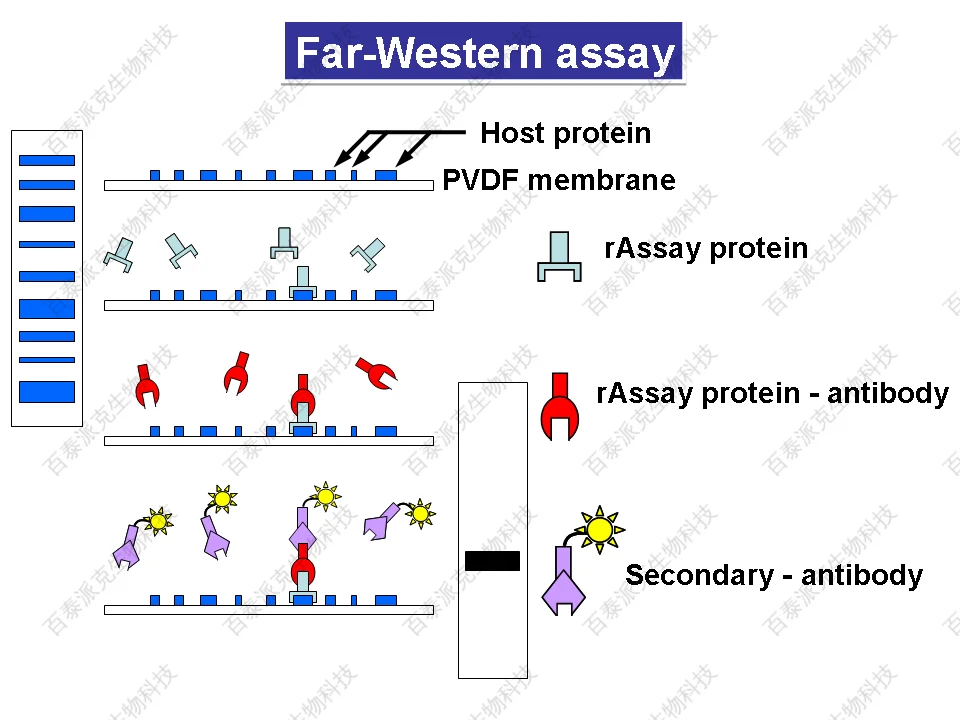
Figure 1
The principle of Far Western Blotting is to use the interaction of a target protein with other proteins to detect its binding partners. First, the target protein is separated and transferred onto a membrane, where it can interact with other proteins. Next, specific probes, such as antibodies or other binding proteins, are used to detect the interactions between the target protein and its binding partners.
2. Steps of Far Western Blotting
The key steps of Far Western Blotting include:
1. Protein Separation: First, the target protein needs to be extracted from cells or tissues and separated using methods such as electrophoresis.
2. Transfer: The separated proteins are transferred onto a membrane, typically using polyacrylamide gel electrophoresis (SDS-PAGE) or other electrophoresis methods.
3. Protein Fixation: The proteins on the membrane are fixed, usually using formaldehyde or other cross-linking agents.
4. Probe Binding: Specific probes, such as antibodies or other binding proteins, are used to bind to the proteins on the membrane.
5. Detection of Target Protein: Using Western Blotting methods, specific detection techniques (such as chemiluminescence or fluorescence) are used to detect the interactions between the target protein and its binding partners.
3. Applications of Far Western Blotting in Protein Interaction Research
Far Western Blotting is widely used in protein interaction research and holds significant application value. It can help scientists reveal the interaction relationships between proteins, thereby gaining a deeper understanding of important biological processes such as cell signal transduction, metabolic regulation, and disease occurrence.
1. Identification of Interacting Proteins: Far Western Blotting can be used to screen proteins that interact with a target protein and further identify the functions and mechanisms of these proteins.
2. Signal Pathway Research: It can be used to study protein interactions in cellular signaling pathways, helping to reveal the regulatory mechanisms of signal transduction.
3. Drug Development: Far Western Blotting can be used to screen and evaluate the effects of drugs on specific protein interactions, providing important reference data for drug development.
Far Western Blotting is an important method for protein interaction research. By combining traditional Western Blotting techniques with the principles of protein interactions, it can help scientists gain a deeper understanding of the interactions between proteins. In protein interaction research, Far Western Blotting has significant application value and can reveal mechanisms of important biological processes such as cell signal transduction, metabolic regulation, and disease occurrence. As technology continues to develop and improve, Far Western Blotting will play an increasingly important role in biomedical research.
Biotech Biotech - Characterization of Biological Products, High-Quality Multi-Omics Mass Spectrometry Service Provider
Related Services:
Protein Interaction Mass Spectrometry Analysis
Co-Immunoprecipitation (Co-IP) Combined with Mass Spectrometry for Protein Interaction Analysis
GST Fusion Protein Pull-Down Combined with Mass Spectrometry for Protein Interaction Analysis
SILAC and Co-Immunoprecipitation Combined with Mass Spectrometry for Protein Interaction Analysis
Cross-Linking Method for Protein Interaction Analysis
How to order?




