






Comparison of Quantification Methods for Phosphorylated Proteins: Analysis of the Advantages and Disadvantages of SILAC, TMT, and Label-Free Strategies
In proteomics studies of protein phosphorylation, merely identifying modification sites is insufficient; quantitative information is the true driver of biological discoveries: which site shows significant expression changes before and after stimulation? Which pathway is most actively regulated by phosphorylation? All of these depend on precise, repeatable quantitative strategies. Quantitative phosphoproteomics can not only discover potential biomarkers but also help screen therapeutic targets, advancing precision medicine. Additionally, this technology can be used for drug mechanism research and efficacy evaluation, making it a key tool in new drug development. With advances in mass spectrometry and enrichment techniques, the sensitivity and coverage of phosphoprotein quantification continue to improve, making research deeper and broader. Therefore, quantitative phosphoproteomics has become an indispensable technique in systems biology research, playing a vital role in understanding complex life phenomena and disease mechanisms. The current mainstream quantitative methods include SILAC (Stable Isotope Labeling), TMT (Tandem Mass Tag), and Label-Free Quantification (LFQ).
I. Overview of Phosphoproteomics Quantification Methods: Principle Summary
1. SILAC — Labeling from the Source of Cell Culture
SILAC (Stable Isotope Labeling by Amino acids in Cell culture) is a metabolic labeling method. By adding light/heavy isotope-labeled amino acids (e.g., Lys-0 vs Lys-8) to the cell culture medium, cells integrate these labeled amino acids endogenously into proteins, achieving accurate, endogenous quantitative comparison.
(1) Advantages:
① Endogenous labeling provides high quantitative accuracy, suitable for detecting subtle changes;
② Excellent repeatability when combined with phosphopeptide enrichment;
③ Simple operation, avoiding labeling efficiency bias.
(2) Limitations:
① Only applicable to cell lines that can be cultured in vitro;
② Limited sample quantity (usually comparing 2-3 groups);
③ Not applicable to tissue or clinical samples.
2. TMT — Multiplex Labeling to Enhance Throughput
TMT (Tandem Mass Tag) is a chemical labeling method that uses isobaric labels to tag peptides after digestion. Multiple samples are labeled separately and then combined for analysis. Quantification is achieved through reporter ions released during the MS/MS stage.
(1) Advantages:
① High throughput (can simultaneously label 6~18 samples);
② Suitable for tissues, cells, clinical samples from various sources;
③ Mature data processing workflow and well-established commercial services;
④ Suitable for phosphoproteomics quantification, especially when unified enrichment and analysis reduce batch biases.
(2) Limitations:
① Higher cost;
② Presence of 'ratio compression' phenomenon affecting true fold changes;
③ Requires precise sample quantification and analysis strategy.
3. Label-Free Quantification — Flexible but Highly Dependent on Platform
Label-Free Quantification involves separate mass spectrometry analysis of different samples, using peptide intensity or spectral counts for quantitative comparison. This strategy avoids labeling operations, providing a simple workflow, especially suitable for high-throughput sample screening.
(1) Advantages:
① No need for labeling, flexible operation, suitable for complex or rare samples;
② Can be expanded to compare dozens of samples;
③ Relatively low cost.
(2) Limitations:
① Samples need separate analysis, large batch effects;
② Requires high stability of mass spectrometry instruments and robust data normalization algorithms;
③ Not suitable for stable detection and quantification of ultra-low abundance phosphopeptides.
II. Key Comparison Indicators for Phosphoproteomics Quantification
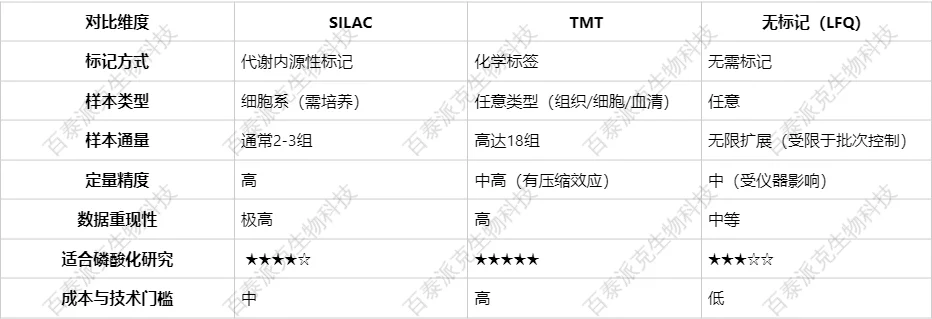
III. How to Choose the Right Phosphoproteomics Quantification Strategy for Your Research?
1. Research Purpose-Oriented Selection
(1) Mechanism Exploration/Signal Pathway Research: Recommend SILAC or TMT, with the former suitable for precise quantification at the cellular level and the latter for broad sample comparison.
(2) Clinical Sample Differential Analysis/Biomarker Screening: Prefer TMT or LFQ, suitable for tissue sources and high-throughput needs.
(3) High Sensitivity Phosphorylation Site Screening: TMT combined with tandem phosphopeptide enrichment (e.g., IMAC+TiO₂) is the current mainstream solution.
2. Budget and Sample Acquisition Method
(1) Sufficient budget and need for high throughput: Prefer TMT.
(2) Limited budget/sample difficult to unify processing: Consider label-free quantification combined with bioinformatics for post-optimization.
(3) Controllable cell line modeling experiment: SILAC remains one of the most accurate quantification methods.
In proteomics studies of protein phosphorylation, the choice of phosphoproteomics quantification method not only affects data quality but also directly relates to the depth of experimental design and biological discovery. If you need suggestions on quantitative strategy design in project planning, feel free to consult with Biotech-Pack BioTechnology. We will provide the most suitable phosphoproteomics quantitative solution based on your sample type, research goals, and budget.
Biotech-Pack BioTechnology — Characterization of Bioproducts, High-Quality Service Provider for Multi-Omics Mass Spectrometry Detection
Related Services:
How to order?