
Analysis of the Role of Phosphoproteomics in Multi-Omics Integration
In the post-genomic era, life science research is moving from 'single-point breakthroughs' to 'systematic integration.' Transcriptomics, proteomics, metabolomics, epigenomics, single-cell omics... Each omics technology provides snapshots of different levels of biological systems, but only multi-omics integration can truly restore the dynamic panorama of life activities. Within this multi-omics framework, phosphoproteomics plays a crucial intermediary role. It not only acts as a bridge between 'gene expression' and 'functional execution,' but also reveals the immediate response of cells to external stimuli and signaling regulation mechanisms. As one of the most common and critical forms of post-translational modifications, phosphorylation directly regulates various life processes such as cell signal transduction, metabolic pathways, and the cell cycle. In multi-omics integration, combining phosphoproteomics with genomics, transcriptomics, and metabolomics data can not only reveal how gene mutations affect protein activity through signaling pathways, but also further clarify key regulatory sites and their functional consequences. This integration strategy is particularly crucial for understanding complex biological processes, disease mechanisms, and drug target screening.
1. Phosphoproteomics in the Omics Puzzle: What is its unique value?
1. Temporal Dimension: Earliest Reflection of Cellular State Changes
Unlike gene mutations or expression fluctuations, phosphorylation modification is an instantaneous, reversible post-translational regulatory mechanism that often occurs within seconds to minutes after the activation of signaling pathways. It can immediately reflect what the cell perceives:
(1) Drug stimulation
(2) Stress response
(3) Growth factor signaling
(4) Inflammation or immune activation
Therefore, in multi-omics research, phosphoproteomics is one of the earliest levels to exhibit dynamic changes, providing researchers with regulatory information with higher temporal resolution.
2. Mechanistic Dimension: Revealing Functional Switches in Pathways
In classic pathways such as PI3K/AKT/mTOR, MAPK, JAK-STAT, most key nodes (such as kinases, transcription factors) determine their activity switches through changes in phosphorylation status. Transcriptomics can only observe changes at the mRNA level and cannot perceive functional states. Phosphoproteomics can be used to analyze how drugs act on 'adjustable nodes' in signaling pathways, serving as a core tool for mechanistic research.
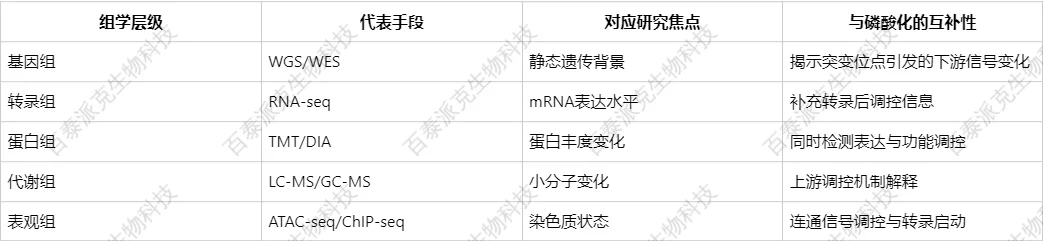
3. Systemic Dimension: Naturally Compatible with Other Omics
2. Typical Scenarios in Multi-Omics Collaborative Research
1. Tumor Signaling Pathway Analysis
In cancer research, transcriptomics alone cannot predict drug sensitivity. For example, in multiple tumor subtypes, the gene expression levels of the PI3K pathway might be similar, but only the subtype with significantly upregulated p-AKT responds to AKT inhibitors.
Integration Strategy:
(1) Transcriptomics: Assess expression background of pathway members
(2) Phosphoproteomics: Determine kinase activity and functional activation
(3) Targeted Metabolomics: Evaluate end-pathway metabolic changes
(4) Outcome: Construct a complete model of 'Signal Regulation → Phenotypic Output'
2. Drug Screening and Mechanism Research
During the development of small molecule drugs or antibody drugs, researchers often need to understand: Which signaling pathways does the drug specifically regulate? What biological processes are affected?
Integration Strategy:
(1) After drug treatment, conduct integrated analysis of phosphoproteomics + proteomics + metabolomics
(2) From changes in kinase activity → downstream effector protein regulation → comprehensively evaluate drug efficacy from the cellular metabolic state
3. Clinical Molecular Typing and Biomarker Discovery
Phosphoproteomics is often used to assist in typing, such as:
(1) Classifying the same type of cancer into subtypes according to phosphorylation patterns like p-ERK/p-AKT
(2) Establishing highly predictive multi-omics biomarker models in collaboration with expression and mutation omics
3. Data Integration Methods: Making Phosphoproteomics 'Speak Clearly'
1. Pathway-Based Hierarchical Integration
Utilize databases (such as Reactome, KEGG) to define signaling pathways and map different omics data onto the pathway structure:
(1) Identify which pathways are activated (significant phosphorylation)
(2) Which pathway members exhibit abnormal expression (mRNA/protein upregulation)
(3) Which terminal products accumulate (metabolomics)
Thus, obtaining an integrative understanding at the systems biology level.
2. Network Analysis + Machine Learning
Construct a multi-omics regulatory network (multi-omics network), combining:
(1) Kinase-substrate prediction (PhosphoSitePlus + motif analysis)
(2) Protein interaction networks (STRING)
(3) Multidimensional feature extraction + classification model construction (such as LASSO, SVM, RF)
Can assist in disease subtype classification, drug response prediction, or key regulatory node identification.
Phosphoproteomics is not just an upgraded version of functional proteomics; it is also an indispensable signal decoder in multi-omics research. It provides 'live broadcasting' of functional dynamic changes, breathing life into static gene expression data. In future disease research, drug development, and personalized treatment, only by connecting the complete chain of 'gene → expression → regulation → phenotype' can we truly understand the essence of life's complexity. If you are planning to conduct multi-omics research, especially focusing on signaling pathways, kinase activity, or dynamic regulatory mechanisms, feel free to contact Biotyper Biotech. We will empower your research projects with a systematic perspective and engineering platform.
Biotyper Biotech—Characterization of Bioproducts, High-Quality Multi-Omics Mass Spectrometry Detection Service Provider
Related Services:
How to order?