





Analysis of Common Questions in Phosphoproteomics
Phosphoproteomics is an important field that studies protein phosphorylation modifications and their roles in cellular biological functions. Phosphorylation is regulated by protein kinases and phosphatases, affecting protein activity, localization, stability, and interactions with other molecules. This modification is widely involved in biological processes such as cell signal transduction, cell cycle regulation, metabolic regulation, gene expression, and apoptosis. Phosphoproteomics uses mass spectrometry to detect phosphorylation sites on a large scale, serving as a powerful tool for researching signal pathway regulation mechanisms. Additionally, as mass spectrometry and bioinformatics continue to advance, phosphoproteomics is increasingly applied in drug target discovery, research on resistance mechanisms, and biomarker screening, becoming one of the key tools in modern life science research. However, due to the low abundance, high dynamics, and complexity of data interpretation of phosphorylation modifications, many researchers often face various questions in actual projects.
1. What are the special requirements for samples in phosphoproteomics analysis?
Sample preparation needs to be rapid, at low temperatures, and involve the addition of phosphatase inhibitors. Phosphorylation modifications are easily removed during cell lysis, so it is necessary to:
1. Immediately freeze or rapidly lyse to prevent protein degradation;
2. Use a mixture of phosphatase inhibitors (such as Na₃VO₄, NaF, β-glycerophosphate);
3. Ensure the total protein amount is no less than 1-2 mg to ensure enrichment efficiency;
4. Homogenize animal tissue samples thoroughly and remove lipid components to reduce nonspecific adsorption.
2. Why enrich phosphorylated peptides?
1. Phosphopeptides account for a very low proportion (<2%) of the total protein digestion products, without enrichment:
(1) They are difficult to be identified by mass spectrometry;
(2) They are easily affected by interference signals, leading to inaccurate quantification;
(3) Critical low-abundance events related to regulatory signals cannot be captured.
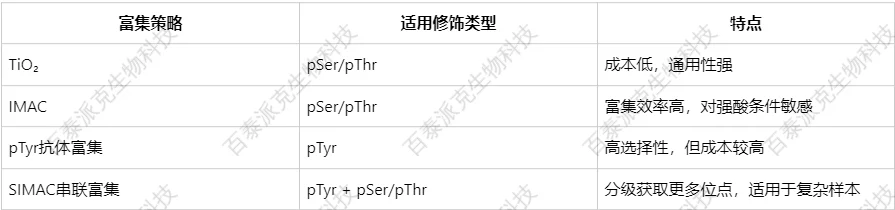
2. The enrichment method determines the experimental depth
3. Which mode should be chosen for phosphorylation projects, DDA or DIA?

4. How to determine if the data quality is reliable?
High-quality phosphoproteomics data should have the following characteristics:
1. Number of peptides > 5000, phosphorylation sites > 8000;
2. Localization Probability > 0.75 for accurate site localization;
3. Pearson correlation > 0.85 between replicate samples;
4. Clear kinase enrichment signals or pathway enrichment patterns;
5. Significant quantitative differences consistent with biological phenomena.
5. How to mine biological significance from the data?
The value of phosphorylation data lies in reconstructing regulatory logic. Common analysis methods include:
1. Kinase-substrate network construction
Tools like KSEA and KinMap can predict changes in kinase activity, suggesting drug targets or resistance mechanisms.
2. Pathway enrichment analysis
Using KEGG and Reactome to identify upregulated/downregulated regulatory modules.
3. Multi-omics joint analysis
Combine with proteomics/transcriptomics/metabolomics to reveal whether phosphorylation drives functional phenotypes (such as changes in metabolic flux, proliferation rate, etc.).
4. Machine learning clustering/feature extraction
Can be used for screening phosphorylation biomarkers, supporting personalized treatment exploration.
Phosphoproteomics is a highly technical but information-rich method. Only by fully understanding each of its aspects can one design scientifically reasonable experimental strategies and uncover truly meaningful signal regulatory mechanisms. Bio-Techne is dedicated to supporting your phosphoproteomics research with professional technology and extensive experience.
Bio-Techne - A premium service provider in biological product characterization and multi-omics mass spectrometry testing
Related services:
How to order?