






Detailed Explanation of Phosphoprotein Analysis Principles: How to Reveal Cellular Signaling Pathways?
The precise transmission of signals inside and outside cells relies on a complex set of regulatory mechanisms. Protein phosphorylation, as one of the most critical post-translational modifications, acts like a language of communication between cells, controlling core biological processes from metabolic regulation to cell division, apoptosis, migration, and more. Protein phosphorylation is catalyzed by protein kinases, which covalently attach phosphate groups (PO₄³⁻) to specific sites (commonly Ser/Thr/Tyr residues) and can be removed by protein phosphatases, forming a highly reversible regulatory mechanism. In research on cancer, immunity, autoimmune diseases, and even neurodegenerative diseases, researchers increasingly rely on phosphoprotein analysis to reconstruct the true dynamics of cellular signaling pathways. Phosphorylation is both fast and precise, playing a central role in signal transduction pathways.
I. Analysis Principle: How to recognize phosphorylation signals among billions of peptides?
The core goal of phosphoprotein analysis is to identify and quantify phosphorylation sites from complex samples and map them to regulatory networks through bioinformatics tools. The entire process can be divided into five core steps:
1. Protein Extraction and Enzymatic Digestion
Use lysis buffer containing phosphatase inhibitors to quickly extract total proteins, then use trypsin to digest them into short peptides for mass spectrometry analysis preparation.
2. Phosphopeptide Enrichment
Since phosphopeptide content is usually <2%, enrichment is necessary before entering the mass spectrometry detection phase.
Common methods include:
(1) TiO₂ Enrichment: Capture through electrostatic interactions between metal oxides and phosphate groups;
(2)IMAC(Immobilized Metal Affinity Chromatography);
(3) pTyr Antibody Affinity Purification: Specific for tyrosine phosphorylation sites, high specificity but higher cost;
(4) Sequential Enrichment (SIMAC): Grade according to the number of phosphorylations to improve the identification of low-abundance multiphosphorylated peptides.
3. LC-MS/MS Analysis
Enriched phosphopeptides are separated by liquid chromatography and then enter high-resolution mass spectrometry (such as Orbitrap) for fragmentation scanning, recording their mass-to-charge ratio (m/z) and retention time, and identifying their amino acid sequences and modification sites.
DDA vs. DIA Mode
(1) DDA (Data-Dependent Acquisition): Suitable for exploratory projects and database construction
(2) DIA (Data-Independent Acquisition): Suitable for multi-sample quantification, high reproducibility
4. Data Processing and Localization
Import mass spectrometry data into analysis platforms (such as MaxQuant, Spectronaut), match theoretical peptides, and calculate the localization probability of phosphorylation sites, retaining only high-confidence sites for subsequent analysis.
5. Bioinformatics Interpretation
(1) Map kinase-substrate relationships (such as using KSEA, PhosphoSitePlus database)
(2) Signal Pathway Enrichment Analysis (KEGG/Reactome)
(3) Differential Site Clustering, Functional Annotation, Network Construction
(4) Combined Analysis with Proteomics/Transcriptomics/Metabolomics
II. Phosphorylation vs Proteomics vs Transcriptomics: What are the unique advantages?
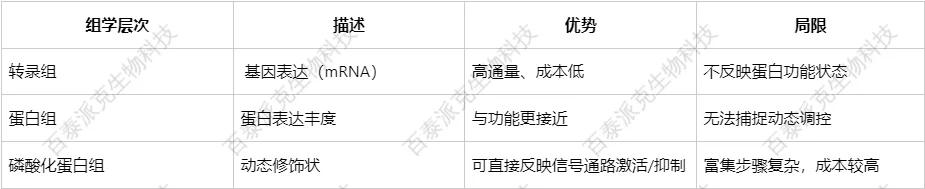
Phosphoprotein analysis can serve as an early signal event monitoring tool, especially in research on tumors, inflammation, autophagy, stem cell differentiation, and more, having irreplaceable value.
Phosphoprotein analysis is not just a technique but a decoding tool for understanding the dynamic regulatory logic of life systems. Through this technology, scientists can accurately locate key nodes in signal pathways, guide targeted therapy, biomarker development, and disease mechanism research. If you are facing bottlenecks in signaling pathway research or wish to construct a high-resolution map of cellular regulation, welcome to contact Biotech Pack Corporation, and explore the limitless possibilities of the world of phosphorylation with us.
Biotech Pack Corporation - Characterization of Bioproducts, High-quality Service Provider of Multi-omics Mass Spectrometry Detection
Related Services:
How to order?




