






CD vs NMR vs X-ray: Which Structural Analysis Method is Right for You?
Deciphering the structures of biomacromolecules is crucial in life sciences research and drug development. Circular Dichroism (CD), Nuclear Magnetic Resonance (NMR), and X-ray Crystallography are the three most widely used structural biology tools, each with its own advantages suitable for different research scenarios. This article aims to provide researchers with guidance on choosing the right tool based on core criteria such as resolution, sample requirements, applicable scope, and experiment duration.
1. CD: The Ideal Choice for Rapid Assessment of Secondary Structures
CD is a method that infers molecular conformations based on the optical activity differences of chiral molecules, particularly suitable for analyzing the secondary structures of proteins and nucleic acids (such as α-helices and β-sheets).
✅Advantages:
-
Fast and high-throughput: Data can be obtained in a few hours, suitable for preliminary screening.
-
Low sample consumption: Suitable for micro-scale samples (in the microgram range) with low concentration and purity requirements.
-
Environmental response analysis: Allows observation of conformational changes under different pH, temperature, and salt concentration conditions, suitable for protein stability evaluation or ligand binding studies.
⚠️ Limitations:
-
Low resolution: Provides only overall conformational trends without atomic-level detail.
-
Limited structural information: Not suitable for constructing detailed three-dimensional models.
Is it suitable for you?
If your research goal is to screen conformational changes, optimize buffer systems, or evaluate protein folding states, CD is a cost-effective tool of choice.
2. NMR: Observing 'Living' Molecular Structures in Solution
NMR relies on the resonance behavior of nuclear spins in a magnetic field, providing three-dimensional structures, dynamic information, and interaction sites of molecules under near-physiological conditions.
✅ Advantages:
-
Atomic resolution: Suitable for detailed structure analysis of small to medium-sized proteins (typically < 30 kDa).
-
Dynamic structure observation: Allows study of conformational changes, molecular flexibility, binding mechanisms, and other dynamic properties.
-
No need for crystallization: Conducted directly in solution, retaining physiological relevance.
⚠️Limitations:
-
High sample requirements: Requires high concentration (typically in the mM range) of purified protein with strict stability requirements.
-
Molecular weight limitations: Severe signal overlap for large molecules, increasing the difficulty of analysis.
-
High equipment and analysis threshold: Equipment is expensive, and data analysis requires experienced personnel.
Is it suitable for you?
If you are focusing on small proteins, peptides, nucleic acids, or protein-ligand interaction mechanisms, especially wishing to understand their conformational dynamics under physiological conditions, NMR is an ideal platform for structural and functional research.
3. X-ray: The 'Gold Standard' for Three-Dimensional Structure Analysis
X-ray crystallography is one of the core technologies for high-resolution structure analysis of proteins, nucleic acids, and other biomacromolecules, supporting numerous breakthroughs in structural biology.
✅ Advantages:
-
Ultra-high resolution: Capable of resolving three-dimensional structures at atomic precision.
-
Wide applicability: Can be used for protein complexes, large molecular assemblies, enzyme-substrate complexes, etc.
-
Extensive database support: A large number of reference structures are available, accelerating homology modeling and functional annotation.
⚠️ Limitations:
-
Difficult crystallization: Optimizing crystallization conditions requires extensive experimental exploration, especially for flexible and membrane proteins.
-
Long experimental cycle: From sample preparation to structure analysis may take weeks or even longer.
-
'Static' structures: Typically, only crystallized conformations can be observed, making it difficult to capture dynamic behavior.
Is it suitable for you?
If your research focuses on obtaining precise three-dimensional structural information, especially for structure analysis, drug target design, and molecular docking, X-ray is an indispensable key tool.
4. How to Choose? A Comparison Table Summarizes the Core Points:
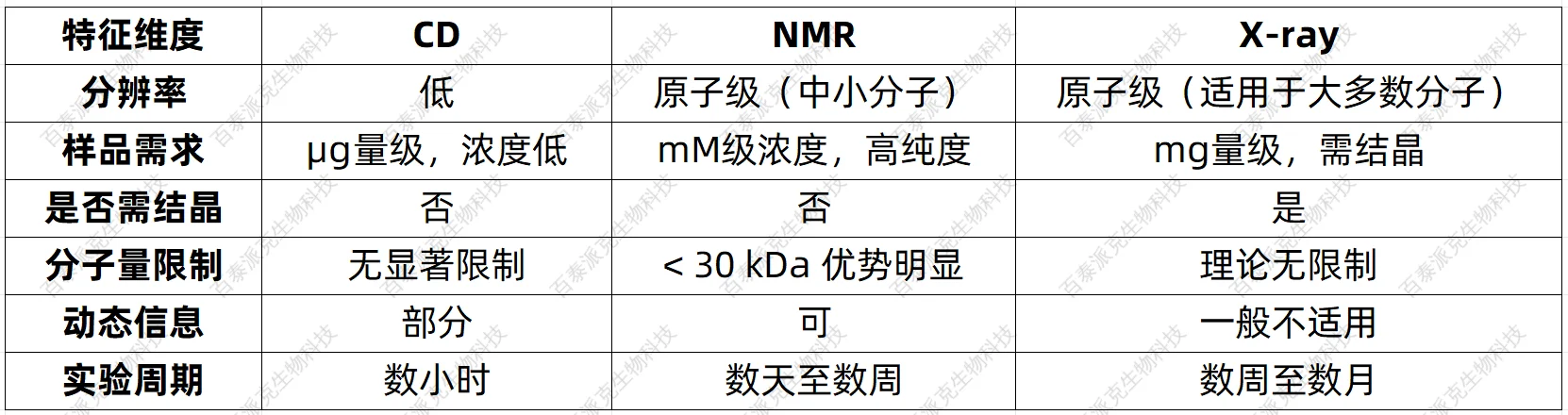
In structural biology research, choosing the right technology is the first step towards success. Biotech Pack BioScience offers systematic services in protein expression, purification, and structural analysis, assisting numerous clients in making critical breakthroughs from conformation screening to atomic-level analysis. Whether you focus on basic research, target validation, or new drug discovery, we provide personalized technical solutions and high-quality data delivery.
Biotech Pack BioScience - A Premium Provider of Bioproduct Characterization and Multi-Omics Mass Spectrometry Services
Related Services:
How to order?




