






SDS-PAGE and HPLC: Which Method is More Suitable for Your Protein Purity Assessment?
In proteomics research and biopharmaceutical development, protein purity assessment is a core step to ensure experimental reproducibility and product quality. SDS-PAGE (sodium dodecyl sulfate-polyacrylamide gel electrophoresis) and HPLC (high-performance liquid chromatography) are two commonly used and complementary analytical methods, each with its own advantages and limitations. This article focuses on their applicable scenarios, core technical features, and pros and cons in protein purity analysis to assist researchers in their development decisions.
1. SDS-PAGE: Electrophoretic Separation Based on Molecular Weight
SDS-PAGE uses SDS to impart similar negative charge density to proteins, allowing them to be separated by molecular weight in a gel, presenting clear bands. This technique has the following characteristics:
-
Simple operation, widely applicable: No complex pretreatment is required, suitable for various protein samples.
-
Intuitive results, convenient for initial screening: Quickly assesses purity and major impurities through Coomassie blue or silver staining.
-
Low cost, minimal equipment requirements: Suitable for routine laboratory testing and small-scale sample analysis.
However, SDS-PAGE has limited resolution, especially for samples with similar molecular weights or disparate abundances. Additionally, its quantitative ability is limited, as staining efficiency and sample loading can affect result accuracy. For applications requiring high precision quantification and low-abundance impurity analysis, SDS-PAGE is often insufficient.
2. HPLC: High-Resolution Separation Based on Physicochemical Properties
HPLC relies on the interaction between the stationary phase and the mobile phase to achieve efficient separation of protein mixtures. Key advantages include:
-
Excellent resolution and sensitivity: Capable of distinguishing proteins with similar molecular weights or structures, suitable for complex biological samples.
-
High precision quantification: Achieves accurate quantification of protein components by combining UV, fluorescence, or mass spectrometry detection.
-
Method extensibility: By optimizing chromatographic conditions (such as reverse phase, ion exchange, size exclusion), it accommodates different types of proteins and analytical needs.
The disadvantages of HPLC mainly include strict sample handling and instrument maintenance requirements, as well as high cost investment. Additionally, some proteins may denature or lose activity under high pressure and organic solvent conditions, requiring targeted optimization solutions.
3. Technical Comparison: Selecting the Optimal Solution Based on Needs
In protein purity analysis, choosing between SDS-PAGE and HPLC requires comprehensive consideration of sample complexity, analysis objectives, and precision requirements:
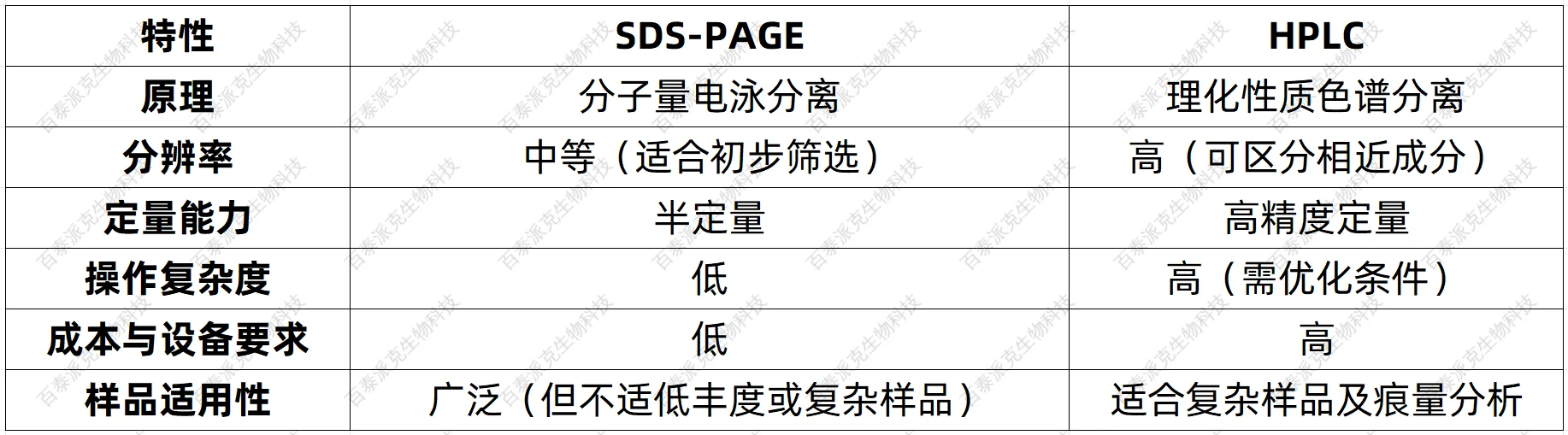
-
Preliminary scientific screening: When the goal is to quickly assess purity or optimize expression conditions, SDS-PAGE has a clear advantage due to its simplicity and intuitiveness.
-
High-standard purity testing: In the stages of biopharmaceutical quality control, protein drug development, and regulatory submission, HPLC is indispensable due to its high resolution and quantification capabilities.
-
Combined application strategy: In practice, SDS-PAGE and HPLC are often used in conjunction. SDS-PAGE is used for rough screening, followed by HPLC to confirm purity and impurity composition, providing multidimensional data support for experimental design and product quality.
Protein purity not only concerns experimental reproducibility but also directly affects product safety and efficacy. Choosing the appropriate purity assessment method depends not only on sample complexity and analytical needs but also on the support of professional technical platforms. Biotomics BioTech is committed to providing high-quality protein analysis services. With advanced liquid chromatography systems and high-resolution mass spectrometry platforms, we can achieve high-precision separation and quantification of complex protein samples and tailor personalized analysis solutions according to customer needs.
Biotomics BioTech—A Quality Service Provider for Bioproduct Characterization and Multi-Omics Mass Spectrometry Detection
Related Services:
How to order?




