






The Impact and Comparison of Different Enrichment Strategies on Acetylated Protein Detection Results
Protein AcetylationAs one of the important post-translational modifications in eukaryotes, it is widely involved in regulating various biological processes such as gene expression, metabolic homeostasis, and the cell cycle. In recent years, with the continuous advancement of mass spectrometry technology, proteomics research on acetylation has gradually deepened. However, because acetylation modifications usually occur at low abundance levels, direct mass spectrometry detection often faces the challenge of signals being masked by high-abundance proteins. Therefore, selecting an appropriate enrichment strategy becomes a key step in successfully deciphering the acetylated protein profile.
I. Introduction to Common Acetylation Enrichment Strategies
1. Anti-acetyllysine Antibody Enrichment
This method utilizes monoclonal or polyclonal antibodies that specifically recognize acetylated lysine to perform immunoaffinity purification on digested peptides.
(1) Advantages
① Simple operation, suitable for various sample types
② Commercial antibodies offer stable quality and good reproducibility
③ High specificity, suitable for large-scale studies
(2) Limitations
① Variable recognition efficiency for different acetylation sites
② Antibody affinity affects enrichment depth
③ Possibility of non-specific binding
2. Chemical Labeling + Affinity Purification Strategy
This method involves chemically derivatizing acetylation sites and introducing affinity tags such as biotin, followed by capture using streptavidin magnetic beads.
(1) Advantages
① High enrichment specificity
② Suitable for low starting amount samples
③ Better recognition efficiency for certain novel acetylation modifications (e.g., N-terminal acetylation)
(2) Limitations
① Stringent chemical modification conditions can introduce background
② Complex operation steps, limited applicability
3. Tandem Enrichment Strategy
This usually involves combining multiple enrichment techniques (e.g., antibody + TiO₂ column or strong cation exchange) for tandem enrichment to improve the capture efficiency of modified peptides.
(1) Advantages
① Enhances enrichment depth and coverage
② Suitable for complex samples or large-scale proteomic analysis
(2) Limitations
① Long experimental process, significant sample loss
② High requirements for equipment and experimental operation
II. Comparative Analysis of Different Enrichment Strategies in Mass Spectrometry Detection
For ease of understanding, the following compares the impact of three strategies on acetylated protein detection results through typical experimental parameters:
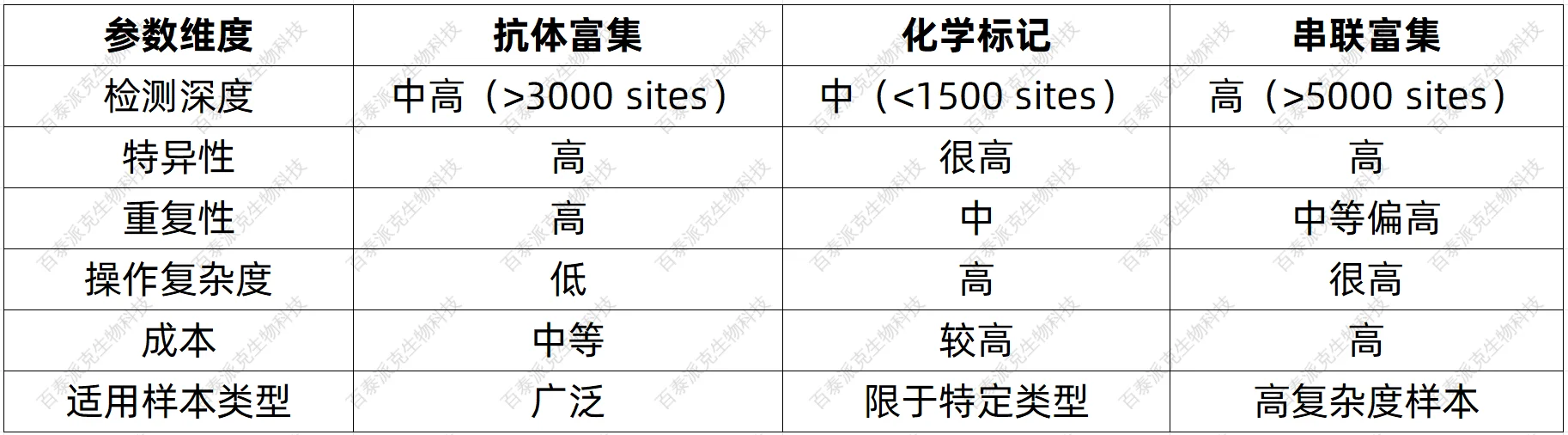
Overall, for conventional large-scale acetylomics research, anti-acetylation antibody enrichment remains the mainstream choice due to its balanced efficiency, specificity, and operational simplicity. For researchers needing higher coverage or analysis of special modification sites (such as N-terminal acetylation), chemical labeling and tandem strategies offer more flexible options.
III. How to Choose the Appropriate Acetylation Enrichment Strategy?
Different project objectives and sample characteristics determine the choice of enrichment method:
1. Large-scale Modification Profiling:Prioritize high-specificity, high-reproducibility antibody enrichment methods.
2. Mechanism Research (Specific Site Verification):Chemical labeling methods can be used for targeted analysis.
3. Tissue or Clinical Sample Analysis:Tandem enrichment strategy is recommended to improve detection rates of low-abundance peptides.
4. Projects with Limited Budget:Choosing mature antibody enrichment processes + DDA mode is the most cost-effective solution.
IV. BGI-PTM Biotech's Advantageous Solutions
At BGI-PTM Biotech, we offer one-stop solutions for acetylation modification research, including:
1. High-affinity anti-acetylation antibody enrichment platform
2. Advanced Orbitrap Fusion Lumos and Exploris 480 mass spectrometry systems
3. DIA quantitative analysis process based on Spectronaut
4. Dedicated bioinformatics analysis team to assist in acetylation pathway and function exploration
As epigenetic modification research continues to deepen, the precise capture and analysis of the acetylated proteome has become a core method for deciphering cellular function networks. Reasonable selection and optimization of enrichment strategies not only directly determine the quality of mass spectrometry detection but also relate to the depth and reliability of biological discoveries. BGI-PTM Biotech is always centered on customer research needs, combining cutting-edge platforms and accumulated experience to safeguard your acetylated protein research. If you have related project needs, feel free to contact us for a customized solution!
Baitai Parker Biotechnology - Leading Provider of Bioproduct Characterization and Multi-Omics Mass Spectrometry Services
Related Services:
How to order?




