






How to Achieve High-Throughput Shotgun Proteomics Identification through LC-MS/MS?
To achieve high-throughput Shotgun proteomics identification, LC-MS/MS (liquid chromatography-tandem mass spectrometry) is currently one of the most mainstream and effective strategies. It can rapidly resolve thousands of proteins in complex samples and is widely used in basic research, disease mechanism analysis, drug target discovery, and other fields.
1. What is Shotgun Proteomics?
Shotgun proteomics, also known as 'bottom-up proteomics,' is a method where proteins are first digested into peptides, followed by mass spectrometry analysis. This approach avoids the difficulties of directly analyzing intact proteins and is particularly suitable for large-scale protein identification and quantification in complex biological samples.
2. The Role of LC-MS/MS in Shotgun Proteomics Identification
1. Liquid Chromatography (LC) for Peptide Separation
The complexity of peptide mixtures after digestion is extremely high, leading to signal overlap and low recognition efficiency if directly introduced into the mass spectrometer. Therefore, the task of the LC part is to separate these peptides as much as possible based on retention time. Commonly used systems include:
(1) Nano-flow Reverse Phase Liquid Chromatography (nano-RPLC)
(2) High pH Reverse Phase Pre-fractionation System
Optimized separation strategies can significantly enhance the detection probability of low-abundance peptides, thereby increasing overall protein coverage.
2. Tandem Mass Spectrometry (MS/MS) for Peptide Sequencing and Quantification
After LC separation, peptides enter the mass spectrometer sequentially, undergoing the following processes:
(1) MS1 (First Stage Mass Spectrometry): Detection of precursor ion mass and abundance for all peptides.
(2) MS2 (Fragmentation Spectrum): Selected precursor ions are fragmented to obtain peptide structural information (sequence).
(3) Database Search: The obtained MS/MS spectra are matched with known protein databases to complete protein identification.
Current mainstream mass spectrometry platforms include Orbitrap, Q Exactive, TIMS-TOF, which perform excellently in terms of high resolution and fast scanning capabilities, suitable for large-scale high-throughput analysis.
3. Key Strategies for Achieving High-throughput Shotgun Proteomics Identification
1. Standardization and Automation of Sample Pre-processing
The first step in high throughput is the reproducibility and stability of the sample processing workflow. Key aspects include:
(1) Consistency in protein extraction (avoiding batch-to-batch variation);
(2) Optimization of digestion efficiency (such as FASP, S-Trap rapid digestion techniques);
(3) Incorporating automated platforms (such as KingFisher, AssayMAP) can enhance throughput and reduce human error.
2. Multidimensional Separation Strategies to Improve Peptide Coverage
A single-dimensional LC separation is difficult to cover the entire proteome. Common multidimensional strategies include:
(1) Online 2D-LC (high pH × low pH reverse phase);
(2) Offline high pH fractionation combined with DDA/DIA analysis.
By increasing the 'dimensionality reduction' of sample complexity, the detection capability of low-abundance peptides is improved, thereby increasing the overall identification count.
3. Optimization of Data Acquisition Modes: DDA vs DIA
(1)DDA(Data-Dependent Acquisition):
-
Conventional methods select precursor ions for fragmentation based on MS1 intensity;
-
Susceptible to interference from low-abundance signals, lower reproducibility.
(2)DIA(Data-Independent Acquisition):
-
All precursor ions are fragmented by averaging across windows, providing comprehensive unbiased acquisition;
-
Suitable for high-throughput reproducible experiments when used with spectral libraries.
At Biotech Pack, we combine the latest DIA-NN and Spectronaut algorithm platforms to provide highly reproducible, low-missing value data acquisition solutions for large-scale protein samples.
4. Selection of High-performance Mass Spectrometry Platforms
The performance of the mass spectrometry system determines the detection depth and throughput. Recommended configurations:
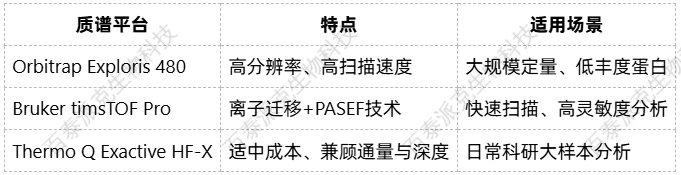
Biotech Pack has fully deployed mainstream mass spectrometry platforms, supporting customized Shotgun proteomics identification for various sample types.
4. Data Processing and Bioinformatics Analysis
After protein identification, strong bioinformatics support is still required to transform findings into biologically meaningful conclusions:
1. Quantitative Analysis: LFQ, iBAQ, TMT, etc.;
2. Functional Annotation: GO/KEGG pathway enrichment, protein interaction networks;
3. Differential Analysis: Statistical screening of differential proteins, discovering potential biomarkers.
Biotech Pack provides one-stop data analysis services, covering everything from raw data quality control to visualization chart generation, assisting researchers in efficiently publishing results.
By optimizing sample processing workflows, introducing multidimensional separation strategies, choosing suitable data acquisition modes, and high-performance mass spectrometry platforms, LC-MS/MS technology can efficiently complete Shotgun proteomics identification, meeting the demands of high-throughput life science research. Biotech Pack focuses on proteomics and multi-omics platform construction, having provided high-quality mass spectrometry services to hundreds of universities and companies. If you are planning to conduct a large-scale proteomics project, please contact us for free program evaluation and customized service suggestions.
Biotech Pack - High-quality service provider for biological product characterization and multi-omics mass spectrometry detection
Related Services:
How to order?




