






How to Optimize Sample Preparation and Digestion Strategies for Shotgun Proteomics?
In Shotgun proteomics, while the performance of mass spectrometers is crucial,the upfront sample processing and proteolysis strategiesare often the first critical checkpoint that determines the quality of the experiment. Especially when dealing with complex samples with high biological heterogeneity (such as tissues, body fluids, clinical samples), the appropriateness of sample pretreatment strategies directly affects protein extraction efficiency, peptide coverage, and the final number of protein identifications.
I. Sample Pretreatment
1. Sample Lysis: Maximizing Total Protein Release
The lysis conditions required for different sample types in Shotgun proteomics vary significantly:
(1) Cell Samples: Typically, lysis buffers containing SDS or urea are used, supplemented by sonication or mechanical homogenization.
(2)Tissue Samples: Require initial cryogenic grinding, combined with strong lysis buffers (such as RIPA or 8 M urea) to disrupt cell structures.
(3)Serum/Plasma: Due to interference from high-abundance proteins, it is recommended to include steps for albumin/globulin removal and enrichment.
Optimization Suggestions:
-
Maintain low temperature throughout the process to prevent protein degradation.
-
Add protease inhibitors and phosphatase inhibitors to preserve post-translational modifications (PTMs).
-
Using filter-aided sample preparation (FASP) or magnetic bead-based methods (SP3) can significantly improve lysis efficiency and subsequent compatibility.
2. Protein Quantification: Accurate Input Ensures Batch Consistency
(1) Recommended MethodBCA Assayfor quantification, compatible with most lysis buffer components.
(2) Recommended input for each sample group is50-100 μg of proteinto avoid overloading or underloading, which may affect proteolysis efficiency.
II. Proteolysis Strategy Optimization
1. Choosing the Appropriate Protease and Cleavage Method
The most commonly used protease in Shotgun proteomics isTrypsin, which recognizes sites at K/R (except after P), with advantages such as:
(1) High specificity
(2) Resulting peptides are suitable for MS analysis (500-3000 Da)
To increase coverage, combined proteolysis strategies can be employed:
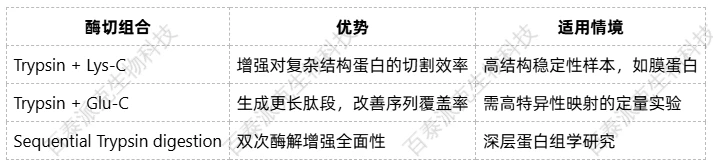
2. Controlling Proteolysis Parameters: Balancing Time, Temperature, and Enzyme Ratio
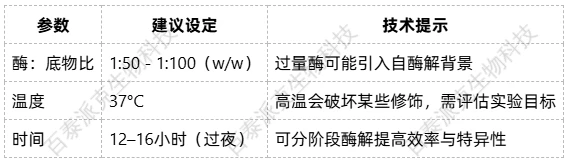
Note:
-
Use MS-grade high purity trypsin to avoid non-specific cleavage contamination.
-
Proteolysis can be conducted in ion exchange buffers or AmBic buffers to enhance subsequent MS compatibility.
III. Peptide Purification and Desalting
1. After proteolysis, the following interfering factors need to be removed:
(1) Salt ions (Na⁺, Cl⁻)
(2) Colloidal impurities (SDS, urea)
(3) Small molecule metabolites or buffer components
2. Common Methods:
(1) C18 Reversed Phase Solid Phase Extraction Column (SPE): Retains peptides, removes salts.
(2)StageTiporOMIX tips: Efficient desalting for small samples.
(3) Magnetic Bead Enrichment Method (e.g., SP3): Good automation compatibility, suitable for high-throughput experiments.
(4) Recommended concentration for desalted peptides:0.5-1 μg/μL, suitable for nano-flow liquid chromatography injection concentration range.
Baitaike Biotech Shotgun Proteomics Sample Processing Solutions
Biotech Pack has developed modular preprocessing workflows for different sample types (tissues, cells, serum, exosomes, etc.) to ensure maximum protein extraction, stable enzymatic digestion efficiency, and achieve the following key quality controls:
✅ Automated sample lysis platform, compatible with 96-well processing mode, enhancing large-scale project efficiency
✅ Utilizes high-purity MS-grade proteases and dual enzyme digestion systems, improving coverage by more than 15%
✅ Standardized enzymatic digestion QC process, including quality assessments such as peptide length distribution and digestion efficiency ratios
✅ The entire sample processing workflow is compatible with various quantification strategies such as Label-Free, TMT, DIA
✅ Provides preprocessing + mass spectrometry one-stop service, avoiding cross-platform errors, ensuring more consistent data quality
The success of shotgun proteomics depends not only on the performance of the mass spectrometry platform but also on the scientific design and rigorous execution of sample preprocessing and enzymatic cleavage strategies. By optimizing lysis solutions, precisely controlling enzymatic digestion parameters, and effectively removing interferences, we can significantly enhance protein identification quantity, data reproducibility, and the credibility of downstream bioinformatics analysis. Biotech Pack is dedicated to providing stable, reliable, traceable, and quantifiable shotgun proteomics analysis services. Contact us for project evaluation, process recommendations, or standard operating procedures for sample preprocessing to help you easily step into high-quality proteomics research.
Biotech Pack - Characterization of biological products, premium service provider for multi-omics mass spectrometry detection
Related Services:
How to order?




