






How to Conduct Shotgun Proteomics Database Search and FDR Control?
In shotgun proteomics experiments, what the mass spectrometer acquires are merelythe m/z signals of peptide fragments, and these data themselves cannot directly inform us about which proteins are present in the samples. The key step for actual protein identification isshotgun proteomicsdatabase searching, which involves using algorithms to compare mass spectrometry spectra with theoretical peptide sequences to deduce the original protein composition. However, database matching is not 'absolutely correct' due to the complexity of spectra, measurement errors, and biological background interference.False positive identifications are inevitable.Therefore, implementing effectiveFDR control(False Discovery Rate) becomes the core guarantee for the reliability of proteomics data.
1. Database Search
1. Basic Process of Database Search
The typical process of Shotgun proteomics database search includes the following steps:
(1) Input the MS/MS spectra obtained from experiments (usually in .mgf, .raw, or .mzML formats) into the search engine;
(2) Calculate the theoretical peptide fragmentation spectra based on the specified protein database (such as UniProt, human reference protein database, etc.);
(3) Match the experimental spectra with the theoretical spectra one by one, and score them;
(4) Determine the reliability of the matches based on the scores, and output the list of candidate peptides and proteins.
2. Common database search engines
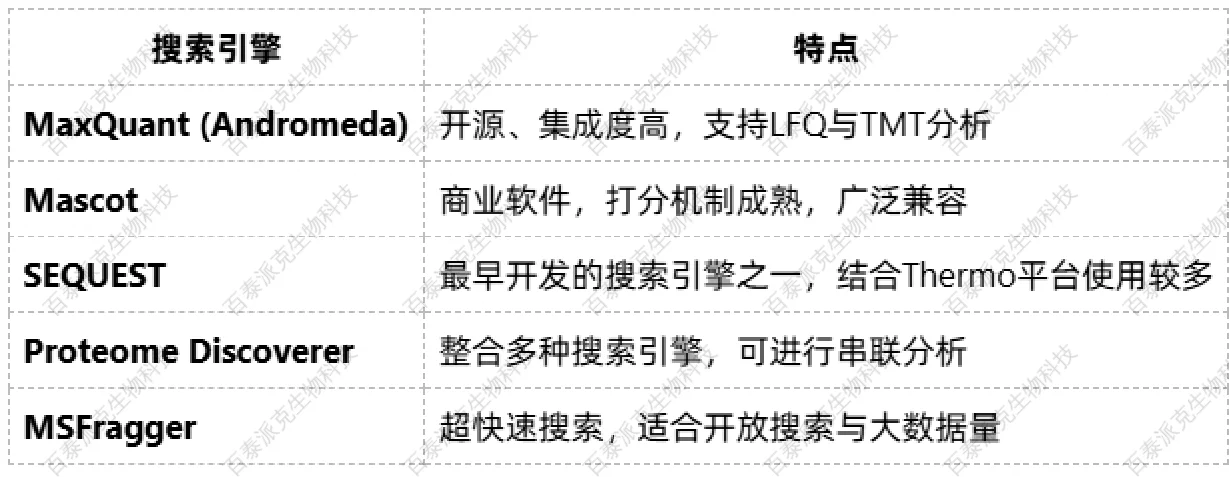
3. Shotgun ProteomicsDatabase SearchSelection Principles
(1) Recommended UsageSpecies-specific databases(e.g., Human Uniprot FASTA) to ensure search efficiency;
(2) Add a contaminant database to identify common background introduced during the experimental process (such as trypsin, keratin);
(3) ProceedConstruct a Decoy or Randomized Databaseto Support FDR Calculation.
II. FDR Control
1. What is the False Discovery Rate (FDR)?
FDR (False Discovery Rate) refers to the proportion of incorrectly identified peptides or proteins among those identified as 'positive' (i.e., successfully identified).In other words, it is the proportion of incorrect matches.For example: If 1000 peptides are identified and the FDR is 1%, it means that there may be 10 false positives.
2. Why is controlling the FDR crucial?
(1) To avoidData Pollutionand Over-interpretation;
(2) Enhancingthe Reproducibility of Research Results and Credibility of Publications;
(3) Meeting the Requirements of SCI Journals forReview Requirements for Mass Spectrometry Identification Quality。
3. How to Achieve FDR Control?
(1)Target-Decoy Search Strategy
This is currently the most commonly used method for FDR estimation.
Principle:
-
Artificially add 'false' protein sequences in the database (e.g., reverse the real proteins) as decoys;
-
Perform 'target+decoy' database searches on the experimental data;
-
Assume the frequency of decoy sequence matches represents the false positive rate;
-
Estimate the FDR by statistically comparing the number of target matches to decoy matches.
Implementation tool:
-
MaxQuant, Mascot, and Proteome Discoverer all have this strategy automatically built-in;
-
You can set FDR thresholds at 1%, 5%, or a more stringent level (generally recommended to be less than 1%).
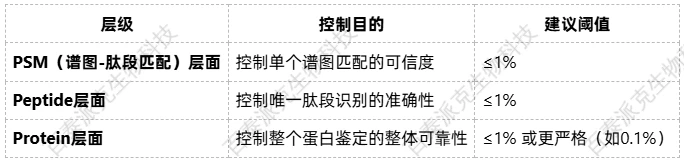
(2)Peptide-level vs. Protein-level FDR
FDR control can be executed at different levels:
(3) Scoring strategies and filtering criteria
Different search engines have different scoring systems:
-
Mascot: Ion Score, Expect value
-
MaxQuant:Posterior Error Probability(PEP)、Score
-
SEQUEST: Xcorr, DeltaCn value
It is recommended to combine multiple scoring metrics to set filtering thresholds, while also usinga minimum number of identified peptides ≥ 2As a standard for protein identification, enhance reliability.
3. Common Issues and Optimization Suggestions in Shotgun Proteomics Database Search and FDR Control

Practices and Experiences of Biotech-Pack in Database Search and FDR Control
Biotech-Pack, utilizing high-resolution mass spectrometry platforms (such as Orbitrap Exploris 480, timsTOF Pro 2), provides customers with standardized and traceable protein identification data:
✅ Construct using UniProt+Contaminant+DecoyThree-tier Database, ensuring a balance between identification coverage and accuracy;
✅ Default execution of PSM, Peptide, and Protein levels1% FDR control, ensuring publication-grade data quality;
✅ Can be performed according to project requirementsOpen SearchandPost-Translational Modification (PTM);
✅ Provide detailedDatabase matching report, FDR curve graph, proteomics information matrixWaiting for bioinformatics results.
Shotgun proteomics database search is the key step in converting mass spectrometry data into scientific conclusions, and FDR control is the quality gatekeeper of this step. A good proteomics experiment should not only 'identify more' but also 'identify accurately'. Biotech Pack Bio insistson a data-driven, quality-first approachfrom database construction, search parameter optimization to FDR layered control, striving to deliverHigh reliability, high reproducibility, and high publication valueproteomics data.
Biotech-Pack Biotech -- Characterization of Biologics, High-Quality Mass Spectrometry Services for Multi-Omics
Related services:
How to order?




