






Shotgun Proteomics vs. Targeted Proteomics: A Guide to Research Choices
In proteomics research, mass spectrometry has become an essential tool for deciphering the complexity of life systems. Especially inShotgun Proteomics (discovery-based proteomics) and Targeted Proteomicsare two mainstream strategies, each with distinct technical principles, application scenarios, and data characteristics, directly influencing experimental design and result interpretation. This article will systematically compare these two methods to assist researchers in making informed choices at different research stages.
I. Shotgun Proteomics: The Preferred Strategy for Systematic Exploration
Shotgun Proteomics is a bottom-up full-spectrum scanning method. The experimental process includes protein digestion, peptide separation (LC), mass spectrometry acquisition (MS/MS), and database search identification. This strategy can detect hundreds to thousands of proteins in a single experiment, suitable forexploring unknown mechanisms, biomarker screening, and comparing complex samplesand other scenarios.
※ Its main features include:
-
High throughput: Can cover most detectable proteins;
-
Database-dependent: Identification efficiency is closely related to database quality;
-
Relative quantification: Common methods include Label-free or TMT/iTRAQ for relative expression analysis;
-
Complex data: Requires advanced mass spectrometry platforms and bioinformatics analysis.
Although its sensitivity and reproducibility are not as high as targeted methods, its broad spectrum and information advantages are irreplaceable in the discovery phase.
II. Targeted Proteomics: A Precise Tool for Verification and Quantification
Targeted Proteomics is a precise quantification strategy focusing on specific proteins/peptides, with common modes including SRM/MRM, PRM, etc. Researchers determine target peptides before the experiment and achieve high sensitivity and specificity through directed monitoring, particularly suitable forcandidate target verification, clinical sample quantification, and method developmentand other needs.
※ Its core advantages:
-
Accurate quantification: Absolute quantification can be achieved when combined with internal standards;
-
Strong reproducibility: High consistency across batch experiments;
-
Low detection limit: Suitable for precise measurement of low-abundance proteins;
-
Standardized processes: Facilitates method transfer between different platforms.
Targeted methods rely heavily on early method development, requiring detailed information on target protein sequences, peptide characteristics, and ion transitions. However, once established, they can be widely applied in high-throughput clinical translational research.
III. Core Technology Comparison
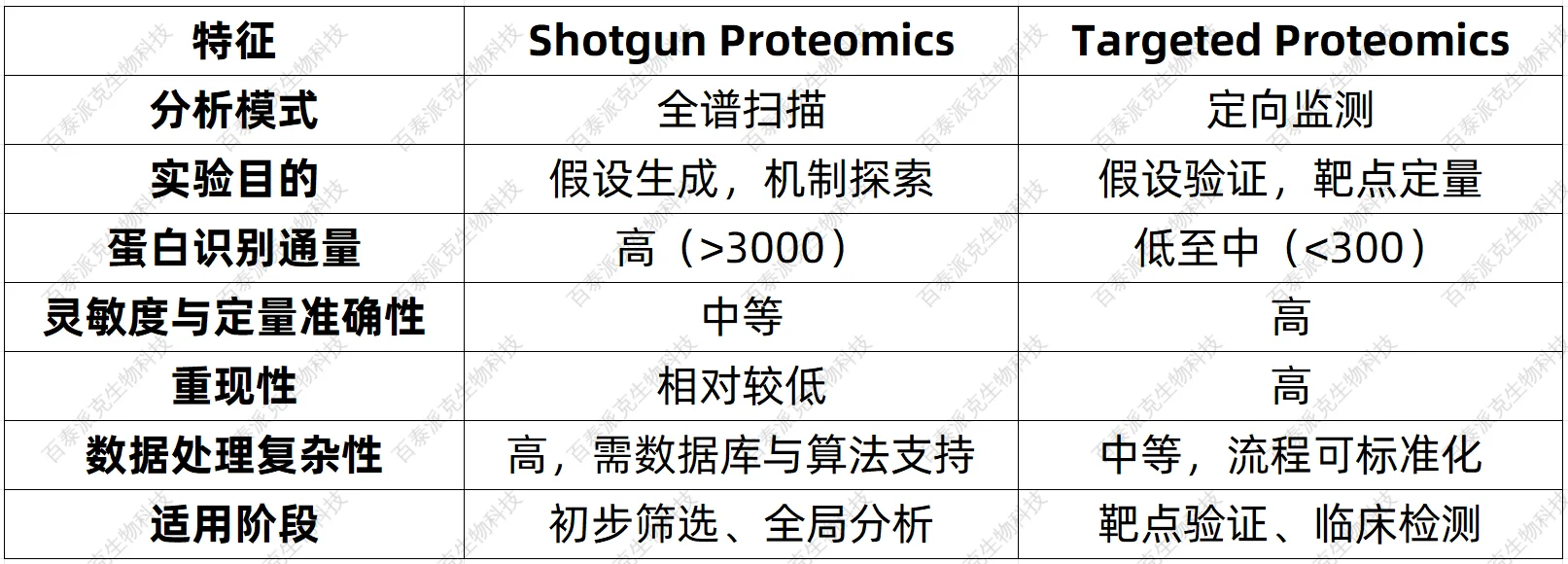
IV. Strategy Selection: Based on Research Objectives and Resource Conditions
※ Preliminary exploration and mechanism construction: Prefer Shotgun
When research goals are unclear and require comprehensive screening of differential proteins or network construction in samples such as tissues, cells, or fluids, Shotgun Proteomics can providemaximum information coverage. Its characteristic of not relying on prior knowledge makes it the first choice for discovering new biomarkers and generating mechanism hypotheses.
※ Target verification and quantitative research: Recommend Targeted
If candidate proteins are already identified, and precise quantification of their expression levels is needed across multiple sample groups, or their biological stability and diagnostic potential are being evaluated, Targeted Proteomics is more advantageous. Especially in biomedical translational research, thehigh consistency and absolute quantification capabilityoffered by targeted methods can meet the stringent requirements of clinical validation.
※ Combined Use: Effective Integration of Exploration and Verification
In systems biology research, the combined strategy ofShotgun screening + Targeted verificationis commonly adopted. The former completes differential protein identification and pathway analysis, while the latter conducts quantitative verification of key targets, achieving a closed-loop evidence chain from discovery to verification.
V. Practical Suggestions: Optimize Design Based on Needs
-
Complex sample types with unclear targets: Prefer Shotgun for full-spectrum analysis;
-
Limited research cycle but clear targets: Directly conduct targeted quantification, skipping full-spectrum analysis;
-
Sufficient resources and in-depth research: Recommend integrating both strategies to enhance research depth and reliability.
Shotgun and Targeted Proteomics each have their advantages, suitable for different research stages and scientific goals. Understanding the principles and application differences of both is the premise of conducting precise proteomics research. Rational integration of these strategies in experimental design can significantly enhance data interpretability and research impact. In proteomics services,Biotech Pack Biological Technologyoffers various technical platforms including DIA, TMT, PRM, combined with automated sample pre-processing and high-resolution mass spectrometry equipment, providing an integrated service process from 'broad discovery' to 'precise verification.' We assist clients in efficiently bridging basic research and clinical translation through standardized processes and customized analysis. For personalized solution suggestions or collaboration inquiries, please contact us.
Biotech Pack Biological Technology - Quality Service Provider of Bioproduct Characterization and Multi-Omics Mass Spectrometry Detection
Related Services:
How to order?




