






Shotgun Proteomics vs 2D Electrophoresis: A Comparison of Protein Identification Techniques
Protein identification is a crucial step in proteomics research, essential for understanding biological processes, discovering biomarkers, and developing new targets. Currently, Shotgun Proteomics and 2D Electrophoresis are two mainstream technical approaches. Each has its own emphasis in terms of experimental processes, data output, and applicable scenarios. Choosing the appropriate method is critical for experimental design and data interpretation.
Shotgun Proteomics: A High-throughput Mass Spectrometry-driven Systematic Analysis Strategy
Shotgun Proteomics is a gel-free proteomics analysis method based on 'whole-protein digestion-liquid chromatography-tandem mass spectrometry' (LC-MS/MS). Its name originates from the strategy similar to a shotgun 'wide-netting,' suitable for large-scale protein identification and quantification without prior protein separation.
※ Technical Advantages
-
High-throughput coverage: Capable of identifying thousands to tens of thousands of proteins in a single experiment, suitable for comprehensive omics analysis of complex biological samples (such as tissues, plasma, cell lines).
-
Excellent sensitivity and dynamic range: Capable of detecting low-abundance proteins, further extending identification depth by combining multi-stage mass spectrometry and enhanced ion trap technology.
-
Compatible with multiple quantification strategies: Supports both labeled (TMT/iTRAQ) and label-free quantification, meeting the needs for differential protein screening and large sample parallel comparison.
-
Suitable for PTM analysis: Can be used for site-level analysis of post-translational modifications like phosphorylation and acetylation, promoting in-depth exploration of signaling pathways.
※ Limitations
-
Missing protein integrity information: The digestion step makes it difficult to retain spatial structure and isoform information of proteins, limiting research on certain protein features.
-
Dependence on database matching: Data analysis relies on sequence databases, and the identification efficiency decreases if new or variant proteins are present in the sample.
2D Electrophoresis: A Classic Protein Separation and Visualization Method
2D Electrophoresis separates proteins based on their isoelectric point and molecular weight through two-dimensional separation processes - Isoelectric Focusing (IEF) and SDS-PAGE. This method allows direct observation of protein expression differences and was an important technological support in early proteomics.
※ Technical Advantages
-
Strong ability to separate isoforms and modified forms: Different subtypes or modification states of proteins often appear as independent spots, helpful for exploring post-translational changes.
-
Low dependence on databases: Proteins are directly detected through electrophoresis spots, and combined with mass spectrometry, can identify unknown or variant proteins, suitable for exploratory research.
-
Intuitive image visualization: Changes in protein expression profiles can be observed through staining, facilitating rapid assessment of differential expression.
※ Limitations
-
Low throughput and sensitivity: A single experiment only separates hundreds to thousands of proteins, making it difficult to capture low-abundance or membrane proteins.
-
Limited reproducibility: The experiment is highly dependent on operational skills, with significant variability between different batches.
-
Complicated subsequent identification process: Identifying proteins requires individual gel cutting and digestion before analysis, which is time-consuming and inefficient.
2D Electrophoresis still holds value in focusing on specific protein expression changes and phenotype difference validation but has gradually given way to the more automated and systematic Shotgun Proteomics approach.
Comparison of Shotgun Proteomics and 2D Electrophoresis Techniques
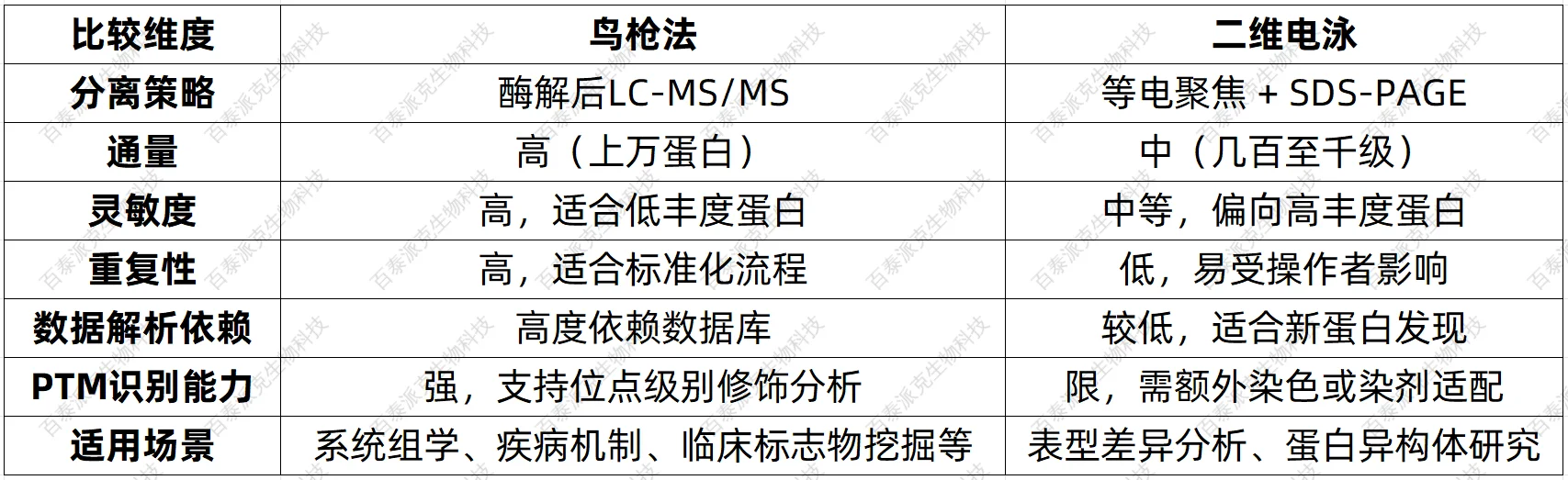
Technical Selection Recommendations
The choice of protein identification strategy should be based on research objectives and sample characteristics:
-
If the goal is to systematically mine differential proteins and conduct high-throughput, high-precision omics research, Shotgun Proteomics is more advantageous.
-
If the focus is on changes in specific protein expression states, subtype structures, or modified variants, 2D Electrophoresis remains a viable supplementary tool.
Moreover, the two can be used complementarily: initially screening differential protein spots with 2D Electrophoresis, then using Shotgun Proteomics to deeply analyze molecular mechanisms, thereby constructing a complete chain from discovery to mechanism.
Biotai PacBio Technology specializes in high-quality proteomics services, covering the complete process from sample pretreatment, protein digestion, LC-MS/MS analysis, to multi-dimensional data mining. Relying on an independent mass spectrometry platform and an experienced technical team, we offer diverse protein identification strategies to our clients. For technical information or project consultation, feel free to contact us!
Biotai PacBio Technology - A premium service provider for bioproduct characterization, multi-omics mass spectrometry detection
Related Services:
How to order?




