






SWATH-MS vs DDA-MS: Which Technology is Right for Your Research?
In proteomics research, selecting the appropriate mass spectrometry acquisition method is key to obtaining high-quality data. Currently,SWATH-MSSequential Window Acquisition of all Theoretical fragment ion spectra (SWATH) andDDA-MSData-Dependent Acquisition (DDA) are two mainstream data acquisition techniques, each with its own advantages. For researchers, understanding the principles, applicable scenarios, and technical limitations of these two methods will help formulate more reasonable experimental strategies.
1. What is DDA-MS?
DDAData-Dependent Acquisition (DDA) is one of the most widely used mass spectrometry acquisition strategies. Its working principle is: after an MS1 scan, the mass spectrometer selects the strongest precursor ions for MS/MS fragmentation analysis based on a preset intensity threshold.
✅ Advantages:
-
High-quality MS/MS spectra: For high-abundance ions, high-resolution and high signal-to-noise ratio fragment spectra can be obtained.
-
Mature database search tools: Widely supported by tools such as Mascot, SEQUEST, MaxQuant, etc.
-
Suitable for new protein identification: particularly excellent in exploratory research.
⚠️ Limitations:
-
Acquisition bias: Easily overlooks low-abundance proteins or secondary ions in complex samples.
-
Poor reproducibility: Since different precursor ions are selected for each acquisition, comparability between biological replicates is poor.
-
Severe data missing: Leads to incomplete protein quantification, affecting the robustness of downstream analysis.
2. What is SWATH-MS?
SWATH-MSSWATH-MS is a data acquisition method based on the DIA (Data-Independent Acquisition) strategy. It divides the m/z range into continuous windows (usually 20–25 Da) and simultaneously fragments and records all ions within each window.
✅ Advantages:
-
High reproducibility: The full scan mode ensures consistent data with each run, facilitating cross-omics comparisons.
-
Comprehensive coverage of low-abundance proteins: Not limited by ion intensity selection, improving detection rate.
-
Suitable for large-scale quantitative research: Such as biomarker screening and multi-batch sample analysis.
⚠️ Limitations:
-
Severe spectral overlap: Complex fragmentation ion sources make resolution difficult.
-
Strong dependence on spectral libraries: Requires high-quality, complete reference spectral libraries to support analysis.
-
Complex initial method setup: Involves multiple steps such as window setting and standard selection.
3. Sample types and research objectives: How should you choose?
1. Exploratory vs. Validation Research
-
If the goal is to discover new proteins or pathways, DDA-MS is recommended for its stronger identification capabilities for new proteins.
-
For large-scale, highly reproducible quantitative analysis of known proteins, such as candidate biomarker validation, SWATH-MS has more advantages.
2. Sample Complexity
-
For samples with low complexity (such as purified proteins and cell lines), DDA is sufficient;
-
While for tissue samples, body fluids, and trace starting materials, SWATH can provide more comprehensive quantitative coverage.
3. Budget and Time Factors
-
DDA method has a short analysis cycle and is easy to start;
-
SWATH requires the establishment of a spectral library beforehand, but once established, it can process a large number of samples in bulk, suitable for long-term projects.
※ Summary: Key to selecting technology is 'matching'
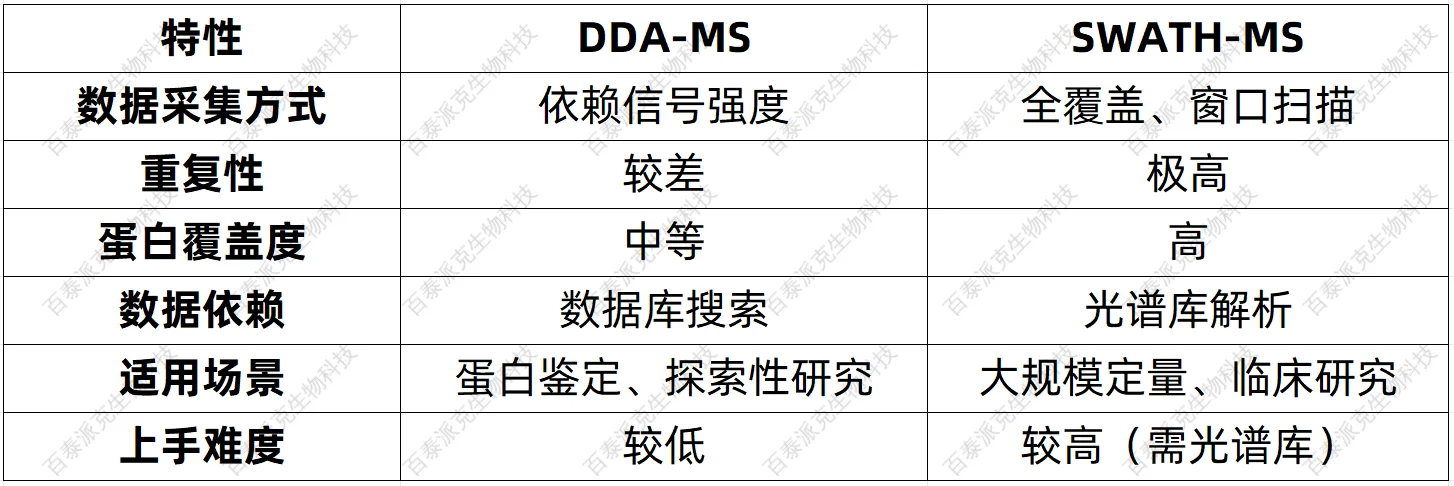
Whether you are conducting basic research or translational medicine projects, choosing the appropriate acquisition mode is crucial. The high throughput and reproducibility advantages of SWATH-MS are gradually becoming the mainstream trend of standardized protein quantification; whereas DDA-MS remains an irreplaceable exploratory tool. The best strategy is often to combine the two: establish the spectral library with DDA initially, then perform large-scale quantification with SWATH later. BioTech Pack offers one-stop SWATH quantitative proteomics solutions. For more information on proteomics project design, feel free to contact us for free project consultation and technical advice.
BioTech Pack - Characterization of Biological Products, High-Quality Multi-Omics Mass Spectrometry Services Provider
Related Services:
How to order?




