






Exploring Antibody Sequencing Service Technology: A Deep Dive into the Secrets of Immune Response
Antibody sequencing mainly involves analyzing the amino acid sequence of antibodies, including the precise determination of the variable (V) region and the constant (C) region. The variable region is often the focus of research as it contains the complementarity-determining regions (CDRs) that are crucial for the specific binding of antibodies to antigens. This information helps in understanding immune responses and how antibodies function by specifically recognizing and binding to antigens.
1. Why is antibody sequencing important?
Antibodies are key components of the immune system, responsible for recognizing and neutralizing external invaders like viruses and bacteria. Each antibody is specific, meaning it can only recognize and bind to a particular antigen. Understanding the exact sequence of an antibody can help researchers design more effective vaccines or therapies.
2. How is antibody sequencing performed?
1. Mass spectrometry-based methods
- Peptide mapping: In this method, the antibody is first digested (usually with trypsin), and the resulting peptides are analyzed using mass spectrometry.
- Tandem mass spectrometry: MS/MS is used to obtain more detailed information about peptide fragments, such as the m/z ratios, to further assist in sequence analysis.
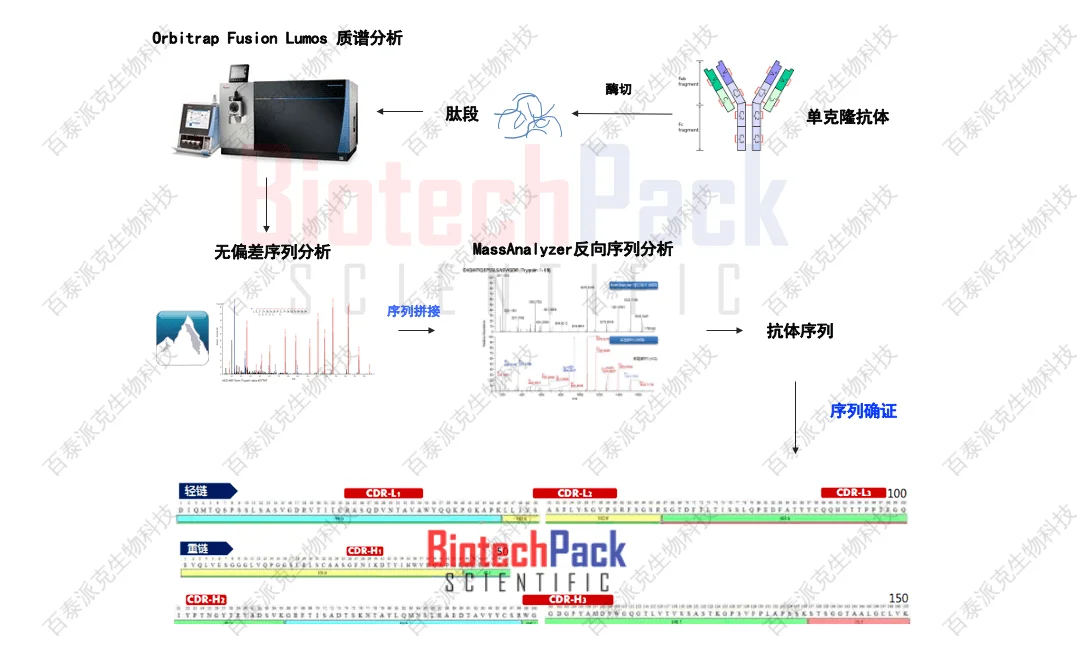
Figure 1
2. Molecular biology methods
- cDNA sequencing: First, mRNA is reverse transcribed into cDNA, followed by PCR amplification and subsequent DNA sequencing to obtain the sequence of the antibody gene.
- High-throughput sequencing: Used to simultaneously analyze the diversity and abundance of a large number of antibody clones.
3. Synthetic biology-based methods
- Antibody library construction and sequencing: Using synthesized antibody gene fragments to construct large-scale antibody libraries, followed by high-throughput sequencing to understand their diversity.
3. Applications
1. Vaccine development:
Antibody sequences obtained through sequencing can help researchers understand immune responses and provide insights for designing more effective vaccines.
2. Immunological disease research:
Sequencing can reveal the characteristics of antibodies that lead to autoimmune diseases.
3. Biopharmaceutical development:
Can be used to develop antibody drugs targeting specific targets.
Bio-tech Co., Ltd - A high-quality service provider for bioproduct characterization and multi-omics mass spectrometry detection.
Related services:
How to order?




