






How to Detect Protein Phosphorylation
Protein Phosphorylation is one of the most common and extensively studied post-translational modifications in organisms. The principle involves the transfer of a γ-phosphate group from ATP or GTP to an amino acid residue of the substrate protein under the catalytic action of protein kinase. This process affects the function of more than one-third of the proteins in human cells.

Figure 1 Schematic diagram of protein phosphorylation
The reversible process of protein phosphorylation and dephosphorylation regulates almost all life activities, including cell proliferation, development, differentiation, signal transduction, apoptosis, neural activity, muscle contraction, and tumorigenesis. Therefore, it is crucial to detect it. Common methods for detecting protein phosphorylation modifications include the following:
1. 32P Isotopic Radiolabeling Method
The 32P radiolabeling method is the most classic method for detecting phosphorylated proteins. It mainly involves in vitro labeling using purified kinase and [γ-32P], or in vivo labeling using [γ-32P]-ATP or 32PO43- (orthophosphate) to balance the intracellular ATP level. Proteins are then separated using one-dimensional or two-dimensional gel electrophoresis (1-DE or 2-DE) and detected using autoradiography or phosphorimaging.
2.Protein ImmunoblottingMethod (Western Blot)
After proteins are separated by SDS-PAGE, they form clear bands arranged by molecular weight on the gel. These proteins are then transferred to a PVDF (polyvinylidene fluoride) membrane or NC membrane (nitrocellulose membrane), bound with specific phospho-antibodies, and detected using enzyme or isotope-labeled secondary antibodies. Phosphorylated proteins are visualized through color development or autoradiography.
3.Fluorescent Staining Method
Pro-Q Diamond is a fluorescent dye specifically for labeling phosphorylated proteins. Using a fluorescence scanner, phosphorylated proteins separated on one-dimensional or two-dimensional gels can be directly visualized, showing low reactivity to non-phosphorylated proteins. The fluorescence intensity varies with the degree of protein phosphorylation. This dye can be used with other fluorescent dyes for total protein detection to simultaneously display the profiles of total proteins and phosphoproteins on the gel.
4.Flow Cytometry
Flow cytometry uses fluorescently labeled single-cell suspensions as detection samples. By measuring the fluorescence intensity of the labeled fluorescence, it determines the concentration of the detected cells or cytokines. Flow cytometry can accurately measure multi-parameter phosphorylation within single cells using fluorescently labeled phospho-specific antibodies. It can simultaneously analyze several signaling pathway components in different cell subpopulations, greatly increasing throughput.
5.Mass Spectrometry
The principle of mass spectrometry involves ionizing protein peptides, which then separate in the analyzer due to different mass-to-charge ratios. By measuring parameters of the separated peptide ions, software is used for protein identification and functional analysis. Phosphorylated peptide fragments are often unstable in mass spectrometry due to spontaneous metastable decomposition or collision-induced dissociation. After phosphatase treatment, phosphorylated peptide fragments tend to lose H3PO4 or HPO3, with phosphorylated serine or threonine losing 98 u in mass, while phosphorylated tyrosine loses only 80 u due to the phosphate group being connected to the benzene ring. Mass spectrometry uses these features for phosphorylated peptide identification.
6. Bio-Plex Suspension Array
The Bio-Plex Suspension Array System, developed by Bio-Rad Laboratories, is a powerful chip technology platform. It integrates software packages, system calibration tools, microsphere coupling reagents, and ready-to-use cytokine and phosphorylated protein assay kits. It can simultaneously analyze multiple biomolecules in a single sample, including enzyme substrates, receptors, antigens, or antibodies. Data obtained from multiplex suspension array assays help reveal the interrelationships and signal transduction pathways among biomolecules.
Table 1 Comparison of Advantages and Disadvantages of Different Protein Phosphorylation Detection Methods
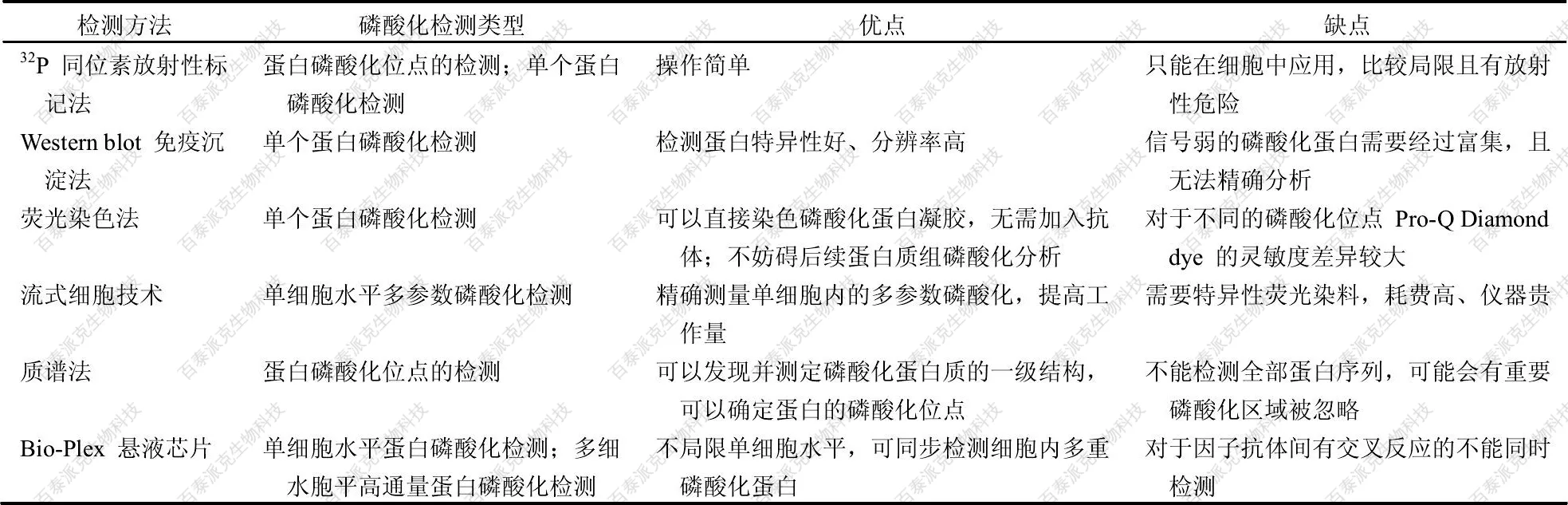
Identifying phosphorylation modifications of relevant proteins in protein complex samples is an important part of proteomics. Currently, there are various protein phosphorylation analysis methods, each with its own advantages and disadvantages, which can be selected according to experimental needs. Biotage provides a one-stop service for protein phosphorylation detection using the latest Obitrap Fusion Lumos mass spectrometer from Thermo combined with Nano-LC. Simply tell us your requirements and send your samples. Biotage handles all subsequent project procedures, including protein extraction, protease digestion, enrichment of phosphorylated or glycosylated peptide fragments, peptide separation, mass spectrometry analysis, raw data analysis, bioinformatics analysis, and provides detailed bilingual technical reports in Chinese and English. Feel free to consult us for free.
Biotage - A leading service provider for biopolymer characterization and multi-omics mass spectrometry analysis
Related Services:
Quantitative Phosphoproteomics Study
Multi-pathway Phosphoproteomics
Post-translational Modification Proteomics Analysis
Histone Post-translational Modification Analysis
Quantitative Proteomics Analysis
How to order?




