






What is the impact of adding DMSO to circular dichroism spectroscopy on protein structure?
In circular dichroism (CD) analysis, the choice of solvent is crucial for maintaining the structural integrity of proteins. Dimethyl sulfoxide (DMSO), as one of the commonly used solvents, has a certain impact on protein structure. This article will detail the mechanism of action of DMSO in CD analysis, its effects on protein structure, and precautions for using DMSO in experiments, to help readers fully understand the application of DMSO in CD analysis and its importance in protein structure research.
1. Mechanism of Action of DMSO
DMSO is a polar organic solvent with strong dissolving capacity and dehydration properties. In CD analysis, DMSO can be used to dissolve protein samples, helping to obtain better optical signals. Additionally, DMSO can interact with proteins, affecting their secondary structure and folding states.
2. Effects of DMSO on Protein Structure
Adding DMSO solvent may affect protein structure. The dehydration properties of DMSO may lead to structural changes in proteins, such as reducing the solvent shell and water molecules in protein solutions, thereby altering the folding state of proteins. Furthermore, DMSO can interact with hydrogen bonds and hydrophobic interactions in proteins, further affecting protein stability and structure.
3. Precautions for Using DMSO
When using DMSO for CD analysis, the following points should be noted. First, the concentration of DMSO should be appropriately controlled to avoid excessively affecting protein structure. Second, different proteins may respond differently to DMSO, so experimental conditions need to be optimized. Additionally, it is important to select suitable reference materials to correct for signal changes caused by DMSO.
4. Importance of DMSO in Protein Structure Research
Although DMSO has some effects on protein structure, its proper use can provide valuable information. It can help study protein folding states, stability, and conformational changes. Meanwhile, the addition of DMSO can simulate environmental conditions within biological systems, enhancing the understanding of protein behavior.
5. Conclusion
Adding DMSO solvent in CD analysis is of significant importance for protein structure research. By understanding the mechanism of action of DMSO, its effects on protein structure, and the precautions in experiments, DMSO can be correctly applied, and CD analysis results can be accurately interpreted.
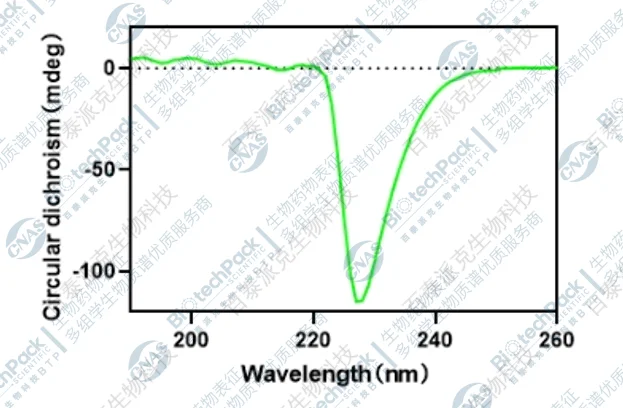
Figure 1
Bio-tech Co., Ltd. -- BioProductsCharacterization, a high-quality service provider for multi-group biological mass spectrometry detection
Related Services:
Protein Circular Dichroism Analysis
Protein Structure Identification
Protein Primary Structure Determination
Mass Spectrometry-Based Sequence Analysis
Protein Disulfide Bond Identification and Quantitative Analysis
Circular Dichroism Analysis (CD)
Protein Structure Identification
How to order?




