






Analysis of Next-Generation Sequencing Results for Antibody Sequence Discovery: Expanding New Horizons in Antibody Research
With the rapid development of next-generation sequencing technology, the analysis of antibody sequence discovery results from next-generation sequencing has become a powerful tool, bringing new perspectives and opportunities to antibody research.
I. Principle
The analysis of antibody sequence discovery results from next-generation sequencing involves using high-throughput sequencing technology to obtain a large amount of antibody sequence information and analyzing and interpreting the sequencing results. This method is based on next-generation sequencing platforms, such as Illumina or Ion Torrent, by amplifying, library construction, and sequencing the antibody genes to obtain large-scale antibody sequence data. These data can provide comprehensive information about antibodies, including variable regions, CDR sequences, and framework regions.
II. Steps
The analysis of antibody sequence discovery results from next-generation sequencing mainly includes the following steps:
1. Sample preparation and sequencing library construction:Extract RNA or DNA from the antibody source, and obtain the sequencing library of antibody genes through reverse transcription and PCR amplification.
2. High-throughput sequencing:Perform next-generation sequencing on the constructed sequencing library to generate a large amount of sequence data.
3. Data processing:Conduct quality control and preprocessing of sequencing data, including removing low-quality sequences and primer sequences.
4. Sequence assembly and alignment:Assemble the short sequence fragments obtained from sequencing into complete antibody sequences and align them to determine their positions on the reference sequence.
5. Sequence annotation:Annotate the antibody sequences, including determining variable sites, CDRs, and framework regions.
6. Result analysis:Perform functional and structural analysis of the antibody sequences based on annotation results, evaluating properties such as affinity, specificity, and stability.
III. Key Points
Key points to note when analyzing antibody sequence discovery results from next-generation sequencing include:
1. Data quality control:Ensure the quality and accuracy of sequencing data to avoid the impact of low-quality sequences.
2. Sequence alignment and annotation:Use appropriate alignment algorithms and databases for sequence alignment and annotation to accurately identify variable sites and functional regions.
3. Result interpretation and validation:Conduct comprehensive analysis and interpretation of results and verify the function and properties of antibody sequences through experiments.
IV. Application Prospects
The analysis of antibody sequence discovery results from next-generation sequencing has broad application prospects in the field of antibody research. It can help researchers rapidly obtain large-scale antibody sequence information, accelerating the discovery and development of novel antibodies. Moreover, by analyzing a large amount of antibody sequence data, it is possible to reveal the diversity of antibodies, evolutionary patterns, and sequence features related to diseases, providing new ideas and methods for disease treatment and diagnosis.
V. Conclusion
The analysis of antibody sequence discovery results from next-generation sequencing provides powerful tools and new perspectives for antibody research, accelerating the discovery and development of antibodies. By accurately obtaining large-scale antibody sequence information, we can better understand the functions and properties of antibodies, bringing more opportunities and hope for disease treatment and biological research.
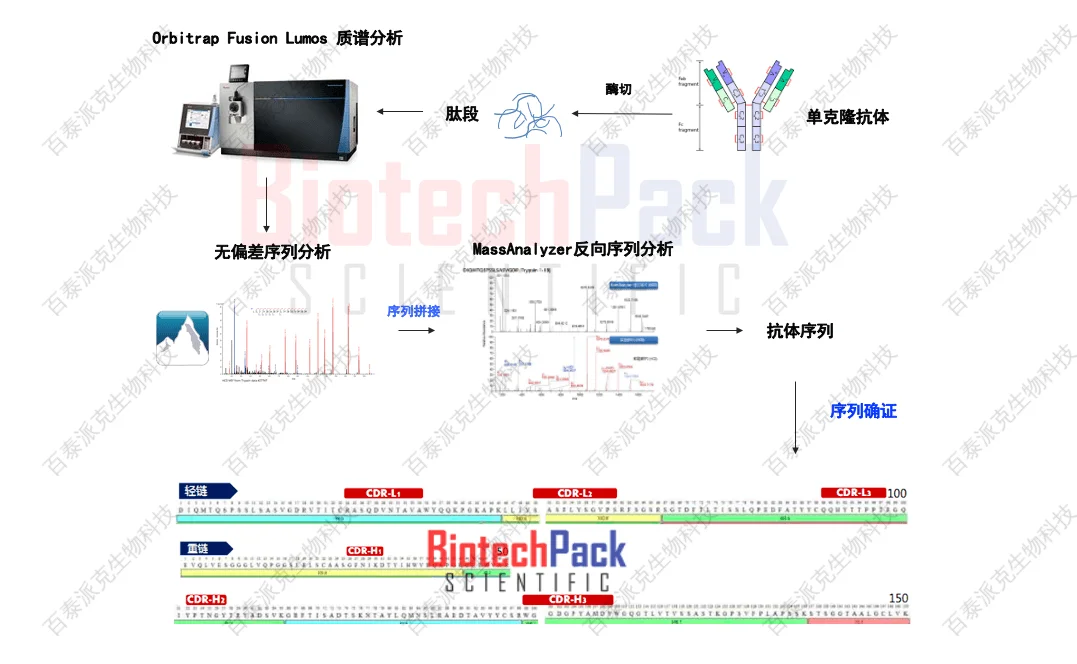
Figure 1
Bio-Techne Biotech -- A premium service provider for bioproduct characterization and multi-omics mass spectrometry analysis
Related Services:
Full-length Antibody Protein Sequence Analysis
De Novo Sequencing of Monoclonal Antibodies
Protein Sequencing
Peptide Sequencing
De Novo Sequencing
De Novo Protein Sequencing
De Novo Peptide Sequencing
How to order?




