






What are the preparation and experimental steps for Circular Dichroism (CD) spectroscopy?
1. Introduction
Circular Dichroism (CD) spectroscopy is an important biophysical technique used to study the structure and conformational changes of biomolecules. By measuring the differential absorption of left and right circularly polarized light, it provides information about the chirality and conformation of molecules. This article will introduce the preparation and experimental steps of CD spectroscopy.
2. Equipment and Reagents Preparation
Before conducting a CD spectroscopy experiment, we need to prepare the following instruments and reagents:
2.1 Circular Dichroism Spectrometer
The circular dichroism spectrometer is the key instrument for CD spectroscopy experiments. It can emit circularly polarized light and measure the differential absorption of the sample at different wavelengths. Choosing the appropriate spectrometer is crucial for obtaining accurate CD spectral data.
2.2 Sample Solution
Selecting an appropriate sample solution is essential for CD spectroscopy experiments. Typically, biomacromolecules such as proteins and nucleic acids need to be measured in buffer solutions to maintain their stability and activity.
2.3 Optical Cuvette
The optical cuvette is a container for holding the sample solution. It needs to have good optical transparency and chemical stability to ensure the accuracy and reproducibility of measurements.
3. Experimental Steps
The steps for conducting CD spectroscopy experiments are as follows:
3.1 Sample Preparation
First, prepare the required sample solution. Choose an appropriate buffer solution according to the experimental needs and dissolve the sample in it. Ensure that the concentration of the sample solution is appropriate to obtain clear CD spectral signals.
3.2 Sample Loading
Transfer the sample solution into the optical cuvette. Ensure the cuvette is clean and avoid generating bubbles or contaminants to prevent affecting the measurement results.
3.3 Instrument Calibration
Before actual measurement, the circular dichroism spectrometer needs to be calibrated. The calibration process usually includes blank measurements and reference substance measurements to ensure the accuracy and reliability of the measurement results.
3.4 Measurement Parameter Setting
Set appropriate measurement parameters according to experimental needs. This includes selecting the appropriate wavelength range, scan speed, and light intensity to obtain the optimal CD spectral signal.
3.5 Start Measurement
Place the optical cuvette into the circular dichroism spectrometer and start the measurement. The instrument will emit circularly polarized light and measure the differential absorption of the sample at different wavelengths. During the measurement, maintain the stability and temperature consistency of the sample solution.
3.6 Data Analysis
After the measurement is completed, export and analyze the obtained CD spectral data. Common data analysis methods include curve fitting, peak position, and peak shape analysis to obtain structural and conformational information about the sample.
4. Conclusion
Circular Dichroism (CD) spectroscopy is an important biophysical technique used to study the structure and conformational changes of biomolecules. By properly preparing experimental instruments and reagents and following the correct experimental steps for measurement and data analysis, we can obtain accurate and reliable CD spectral data, providing valuable information for biopharmaceutical research and development.
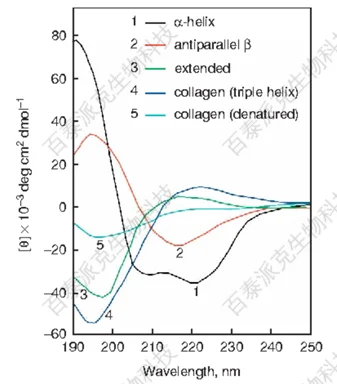
Figure 1
Bio-techne -- BiotechnologyProductsCharacterization, a high-quality service provider for multi-group biological mass spectrometry analysis
Related Services:
Protein Circular Dichroism Analysis
Circular Dichroism Analysis (CD)
Protein Structure Identification
How to order?




