






Comparison of Protein HPLC Detection Methods
Proteins are crucial functional molecules within biological organisms, playing a significant role in studying biological processes and developing biopharmaceuticals. The study of protein structure and function requires accurate identification methods. Among them, protein HPLC detection methods are commonly used techniques. This article compares different protein HPLC detection methods to help readers understand their advantages and disadvantages, assisting in choosing the method suitable for their research or application.
1. Ion Exchange Chromatography (IEC)
Ion exchange chromatography is a commonly used method for protein separation and purification. This method is based on the charge properties of proteins, achieving separation through interactions with ion exchange groups on the stationary phase. Ion exchange chromatography can selectively separate proteins based on their isoelectric points and charge states, making it suitable for analyzing and purifying proteins with different charge properties.
Advantages:
- Good separation efficiency, capable of obtaining high-purity protein samples.
- Simple operation, suitable for large-scale production.
Disadvantages:
- Separation speed is relatively slow, requiring longer analysis time.
- Less effective for separating hydrophobic proteins.
2. Reversed-phase High Performance Liquid Chromatography (RP-HPLC)
Reversed-phase high performance liquid chromatography is a commonly used method for protein separation and purification. This method achieves separation based on hydrophobic interactions between proteins and the stationary phase. Reversed-phase chromatography can selectively separate proteins based on their hydrophobic properties, making it suitable for analyzing and purifying highly hydrophobic proteins.
Advantages:
- Fast separation speed, short analysis time.
- Suitable for highly hydrophobic proteins.
Disadvantages:
- Separation efficiency is affected by the hydrophobicity and structure of proteins, potentially leading to less effective separation for certain proteins.
- Requires the use of organic solvents, placing high demands on equipment.
3. Size Exclusion Chromatography (SEC)
Size exclusion chromatography is a commonly used method for protein separation and purification. This method achieves separation based on the molecular size and shape of proteins. Size exclusion chromatography can selectively separate proteins based on their molecular size, making it suitable for analyzing and purifying proteins of different molecular sizes.
Advantages:
- Fast separation speed, short analysis time.
- Does not require organic solvents, has no significant effect on protein structure.
Disadvantages:
- Separation efficiency is influenced by molecular size and shape of proteins, potentially leading to less effective separation for certain proteins.
- Separation efficiency is affected by flow rate and column temperature, requiring optimization.
4. Affinity Chromatography
Affinity chromatography is a commonly used method for protein separation and purification. This method achieves separation based on specific binding between proteins and affinity ligands on the stationary phase. Affinity chromatography can selectively separate proteins based on specific binding, making it suitable for analyzing and purifying specific proteins.
Advantages:
- Good separation efficiency, capable of obtaining high-purity protein samples.
- Can selectively isolate target proteins.
Disadvantages:
- Requires specific affinity ligands, which may vary for different proteins.
- Complex operation, requires ligand immobilization and regeneration.
Conclusion
Each protein HPLC detection method has its own advantages and disadvantages. Choosing the appropriate method depends on the research objectives and sample characteristics. Ion exchange chromatography is suitable for analyzing and purifying proteins with different charge properties, reversed-phase high performance liquid chromatography is suitable for analyzing and purifying highly hydrophobic proteins, size exclusion chromatography is suitable for analyzing and purifying proteins of different molecular sizes, and affinity chromatography is suitable for analyzing and purifying specific proteins. In practical applications, appropriate methods can be selected or combined to achieve accurate and efficient results.
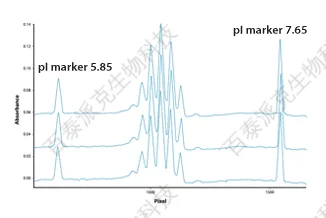
Figure 1
BiotechPack, A Biopharmaceutical Characterization and Multi-Omics Mass Spectrometry (MS) Services Provider
Related Services:
Protein Purity and Homogeneity Characterization
SDS-PAGE Protein Purity Analysis
Protein Purity Analysis (Size Exclusion/Reversed-phase Chromatography)
Protein Isoelectric Point Determination
Protein Structure Identification
How to order?




