






Phosphorylated Proteomics Label Free
Phosphoproteomics Label Free is a technique for quantitative phosphoproteomics analysis using label-free/non-labeled proteomics methods. Bio-Techne offers phosphoproteomics analysis services based on Label Free.
Phosphoproteomics is the analysis of phosphorylated proteins. Phosphorylated proteins are formed when proteins attach phosphate groups to the side chains of amino acids through phosphorylation. Phosphorylation is one of the most common post-translational modifications of proteins, involved in many signal transduction pathways and cellular metabolic processes. Abnormal protein phosphorylation is associated with many known diseases. Therefore, studying the phosphoproteome helps elucidate disease mechanisms and discover disease-related biomarkers.
Label Free refers to label-free proteomics, a mass spectrometry-based technique for quantitative proteomics research. This technique avoids the use of expensive stable isotope labels as internal standards and instead relies on the signal intensity of corresponding peptides in mass spectrometry data generated from large-scale protein identification to achieve relative quantification of proteins.
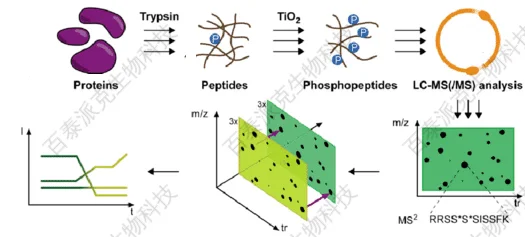
Phosphoproteomics Label Free
Quantitative analysis of the phosphoproteome can be done using either labeled or label-free mass spectrometry (MS). Phosphoproteomics Label Free utilizes label-free mass spectrometry to study the phosphoproteome. The general workflow for quantitative phosphoproteomics includes protein digestion, phosphopeptide enrichment, LC-MS/MS analysis, and bioinformatics analysis. Compared to labeled methods, the Label Free approach is cost-effective and avoids issues like low labeling efficiency, making it more suitable for large-scale analyses such as experiments or clinical screenings under various treatment conditions.
Related Services
Quantitative Phosphoproteomics Research
Label Free-based Quantitative Proteomics Analysis
Multi-pathway Phosphoproteomics
How to order?




