






How to determine the amino acid sequence of peptides?
Polypeptides are biological macromolecules composed of amino acids, and the determination of their amino acid sequences is of great significance for drug development in the field of biotechnology. This article will introduce methods for determining the amino acid sequences of polypeptides and their applications in drug development.
1. Edman Degradation Method
The Edman degradation method is one of the earliest methods used for determining the amino acid sequences of polypeptides. This method uses acidic reagents to partially hydrolyze the polypeptide, converting the N-terminal amino acid into a detectable derivative. The derivative is then separated and identified using techniques such as high-performance liquid chromatography, thereby determining the type of N-terminal amino acid. This process is repeated with subsequent amino acids, gradually determining the amino acid sequence of the polypeptide.
2. Mass Spectrometry
Mass spectrometry is a commonly used method for determining the amino acid sequences of polypeptides. The polypeptide is ionized and fragmented in a mass spectrometer, and the mass-to-charge ratio information of the fragments is obtained. Through analysis by the mass spectrometer, the amino acid sequence of the polypeptide can be inferred. Mass spectrometry offers the advantages of high sensitivity and high resolution, enabling the determination of complex polypeptide amino acid sequences.
3. Gene Sequencing Method
With the development of biotechnology, gene sequencing methods have also been applied to the determination of polypeptide amino acid sequences. By cloning and expressing the polypeptide-encoding gene, the gene sequence of the polypeptide is determined using DNA sequencing technology. Through transcription and translation, the amino acid sequence of the polypeptide is obtained. Gene sequencing offers high throughput and high accuracy, making it suitable for large-scale determination of polypeptide amino acid sequences.
4. Applications
The determination of polypeptide amino acid sequences has extensive applications in drug development. Firstly, by determining the amino acid sequence, the structure and function of the polypeptide can be identified, providing an important basis for drug design and optimization. Secondly, amino acid sequence determination can also be used for the identification and quality control of polypeptide components in drugs, ensuring drug quality and safety. Additionally, it can be used to study the biological activity and metabolic pathways of polypeptides, providing theoretical support for the clinical application of drugs.
5. Conclusion
The determination of polypeptide amino acid sequences is a crucial aspect of drug development in the field of biotechnology. Edman degradation, mass spectrometry, and gene sequencing are commonly used methods for determining polypeptide amino acid sequences. By determining these sequences, insights into the structure and function of polypeptides are obtained, providing a significant basis for drug development. The determination of polypeptide amino acid sequences holds broad application prospects in drug development and will provide strong support for the discovery and development of new drugs.
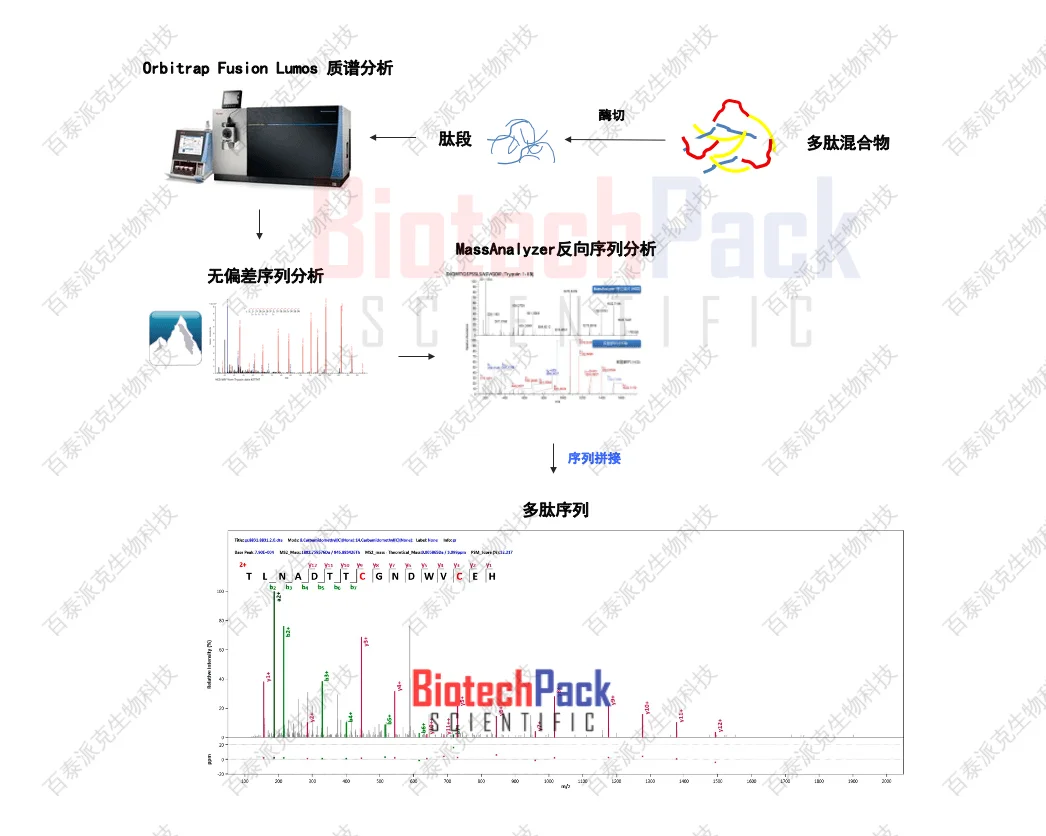
Figure 1
BiotechPack, A Biopharmaceutical Characterization and Multi-Omics Mass Spectrometry (MS) Services Provider
Related Services:
Protein N/C-terminal Sequencing
How to order?




