






Mass Spectrometry Analysis Strategies and Advances of Protein Modifications: Innovative Methods from Qualitative to Quantitative
Protein modification refers to the process of altering the structure and function of proteins by adding chemical groups or changing the chemical properties of amino acid residues. Different types of protein modifications play various regulatory roles within cells, such as phosphorylation, acetylation, and methylation. Mass spectrometry, as an efficient and accurate technical method, can achieve qualitative and quantitative analysis of protein modification types.
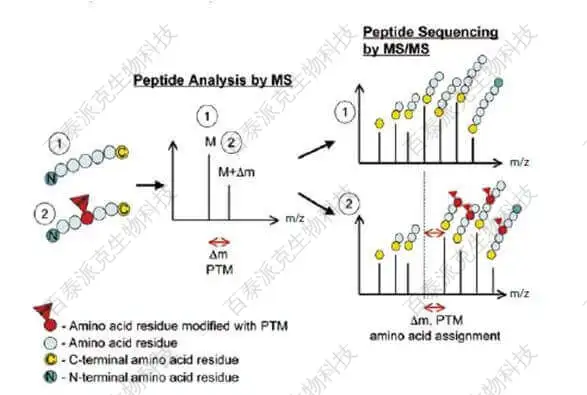
Figure 1
1. Mass Spectrometry Analysis Strategies for Protein Modification Types:
1. Qualitative Analysis Strategy:
Identifying protein modification types through mass spectrometry analysis, including spectrum interpretation, database matching, and bioinformatics tools.
2. Quantitative Analysis Strategy:
Combining labeled and label-free quantitative methods to achieve quantitative analysis of protein modifications, such as isotope labeling methods, enzymatic labeling methods, and quantitative mass spectrometry.
2. Advances in Mass Spectrometry Analysis of Protein Modification Types:
1. Application of High-Resolution Mass Spectrometry:
The development of high-resolution mass spectrometry techniques, such as high-resolution mass spectrometers and tandem mass spectrometers, has improved the identification accuracy and analytical sensitivity of protein modification types.
2. Development of Large-Scale Quantitative Mass Spectrometry Analysis:
Through the combination of proteomics and modification proteomics, comprehensive quantitative analysis of protein modifications is achieved, revealing their roles in cellular signal transduction and disease development.
3. Application of Innovative Methods:
1. Quantitative Analysis of Phosphorylation Modifications:
Introducing novel phosphorylation-specific enzymes and chemical labeling methods to achieve quantitative analysis of phosphorylation sites.
2. Qualitative Analysis of Acetylation Modifications:
Combining immunoenrichment and high-resolution mass spectrometry techniques to improve the accuracy of qualitative identification of acetylation sites.
3. Genome-Wide Analysis of Methylation Modifications:
Combining mass spectrometry analysis with methylation enzyme-specific recognition to achieve genome-wide quantitative analysis of methylation modifications.
Mass spectrometry analysis strategies and advances for protein modification types provide important tools and insights for understanding the function and regulatory mechanisms of protein modifications. From qualitative to quantitative, innovative methods continue to emerge, offering more options and possibilities for protein modification research. These innovative methods help reveal the important roles of protein modifications in cellular signal transduction, disease occurrence and development, and other life science fields.
BioTech Pack--Characterization of Biological Products, High-Quality Service Provider for Multi-Omics Mass Spectrometry Analysis
Related Services:
Post-Translational Modification Proteomics Analysis
Quantitative Proteomics Analysis
Label-Free Based Quantitative Proteomics Analysis
Label-Based Protein Quantification Technology - iTRAQ, TMT, SILAC
TMT/iTRAQ/MultiNotch Quantitative Proteomics Analysis
How to order?




