






Exploring the Value of Acetylation Level Detection in Drug Development: Developing Innovative Drugs Targeting Protein Modifications
Acetylation is an important protein modification method that influences cellular physiological processes by regulating protein structure and function. In recent years, as proteomics technology has continued to develop, acetylation level detection has become a highly focused research direction in drug development. This article will introduce the principles and methods of acetylation level detection, focusing on how it is used to develop innovative drugs targeting protein modifications, and elucidating its significant value in drug development.
1. Principles and Methods of Acetylation Level Detection
Acetylation modification usually occurs on the ε-amino group of the N-terminus and lysine residues of proteins. The level of acetylation can be assessed by measuring the number of acetylation modifications in specific proteins. Currently, the main methods for acetylation level detection include mass spectrometry, antibody detection, and gene knockout. Mass spectrometry is the most commonly used method for acetylation level detection, revealing changes in acetylation levels by quantitatively measuring the abundance of acetylation modification sites in proteins.
2. Development of Innovative Drugs Targeting Protein Modifications through Acetylation Level Detection
Acetylation modification plays an important regulatory role in cells and is closely associated with the occurrence and development of various diseases. Through acetylation level detection, researchers can understand the abnormal changes in acetylation modification in different diseases and identify potential therapeutic targets related to diseases. For example, in cancer research, the role of acetylation modification in the tumor suppressor gene p53 has been extensively studied. Acetylation level detection helps discover drugs targeting p53 acetylation modification, thereby developing innovative drugs for cancer treatment.
3. The Important Value of Acetylation Level Detection in Drug Development
Acetylation level detection holds significant value in drug development. Firstly, it helps researchers gain a deep understanding of the biological functions of protein modifications, providing a theoretical basis for the design and optimization of innovative drugs. Secondly, acetylation level detection can be used to evaluate the effects of drugs in regulating acetylation modifications, thus guiding the progress of drug development. Finally, acetylation level detection can also be used to screen and optimize drug candidate compounds, accelerating the speed and efficiency of drug discovery.
4. Conclusion
Acetylation level detection has important application value in drug development. By understanding the dynamic changes in acetylation modifications, we can uncover the associations between protein modifications and diseases, and develop innovative drugs targeting protein modifications. In the future, acetylation level detection will continue to play an important role in drug development, bringing new breakthroughs in disease treatment.
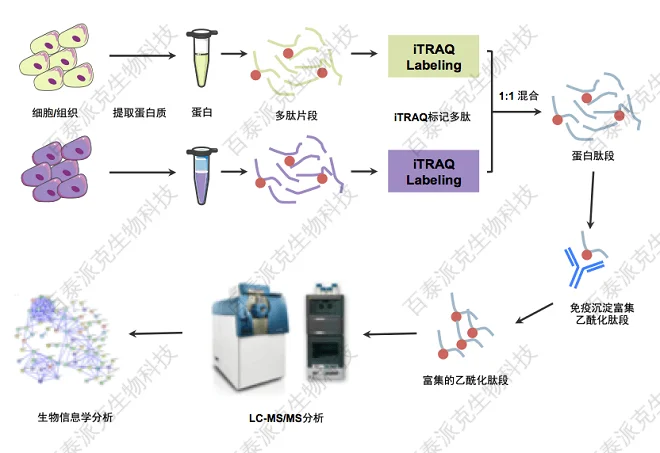
Figure 1
Biotech-Peak Biotech Co., Ltd. -- Characterization of Bioproducts, Premium Service Provider for Multi-omics Mass Spectrometry Detection
Related Services:
Protein Acetylation Modification Analysis
Post-translational Modification Proteomics Analysis
Quantitative Phosphorylation Proteomics Study
Quantitative Ubiquitination Proteomics Study
Protein Disulfide Bond Identification and Quantitative Analysis
Quantitative Glycosylation Proteomics Study
Multi-pathway Phosphorylation Proteomics
How to order?




