






Can peptide sequence identification accurately assess the structure and function of peptides?
Peptides are important bioactive molecules in living organisms, and analyzing their structure and function is crucial for understanding life activities and disease mechanisms. Peptide sequence identification, as a key technical approach, is widely used in peptide research and the biopharmaceutical field. This article will discuss in detail the process and methods of peptide sequence identification and explore its significance in accurately assessing the structure and function of peptides.
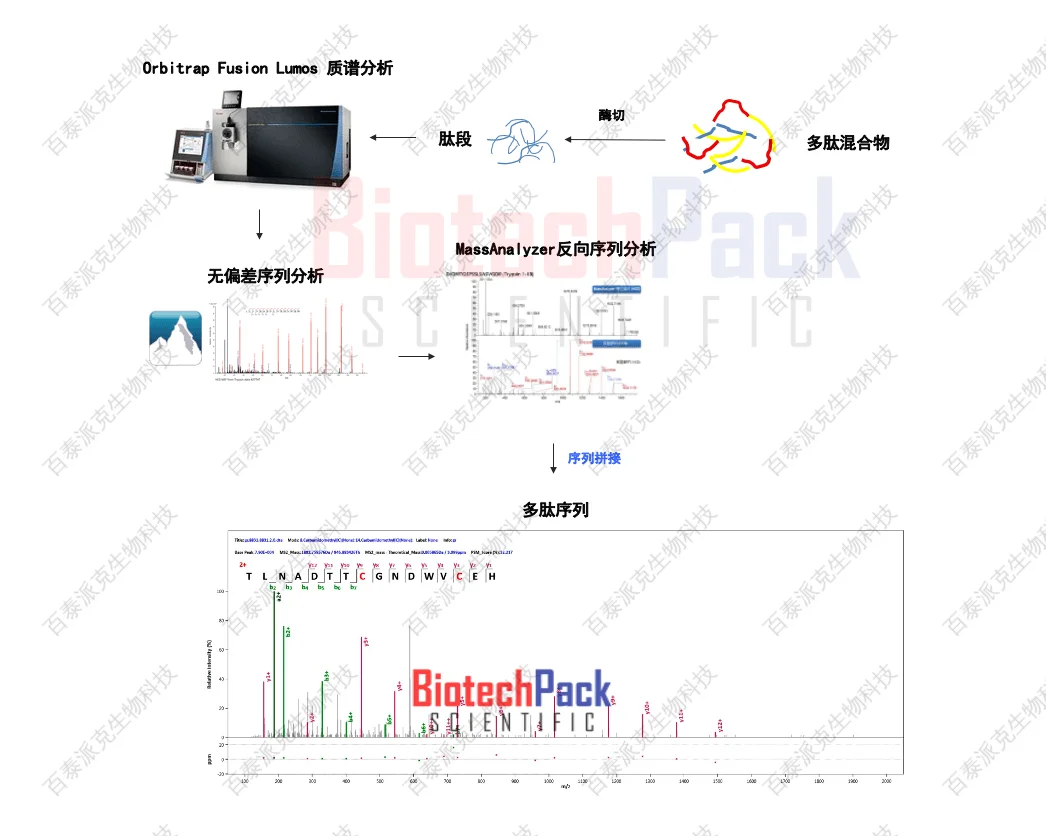
Figure 1
I. The Process of Peptide Sequence Identification
Peptide sequence identification typically includes steps such as sample preparation, mass spectrometry analysis, and data interpretation. Firstly, sample preparation is one of the critical steps, involving peptide extraction, purification, and cleavage. Next, mass spectrometry analysis is the core step, with commonly used techniques including liquid chromatography-tandem mass spectrometry (LC-MS/MS). This technique separates peptide samples and measures their mass using a mass spectrometer. Finally, by comparing with databases and interpreting data, the amino acid sequence and modification information of the peptide can be determined. These steps collectively constitute the process of peptide sequence identification.
II. Peptide Sequence Identification and Peptide Structure
The structure of peptides is the foundation of their function, and peptide sequence identification is significant for accurately assessing peptide structure. Determining the peptide sequence can reveal the order of amino acids in the peptide, further inferring its secondary, tertiary, and quaternary structures. Secondary structures include forms like α-helices and β-sheets, while tertiary structures are determined by the interactions of secondary structures. Through peptide sequence identification, we can obtain the amino acid sequence of peptides, providing an important foundation for further research and understanding of peptide structure and function.
III. Peptide Sequence Identification and Peptide Function
The function of peptides is determined by their structure, and peptide sequence identification is significant for accurately assessing peptide function. Peptide sequence identification can reveal the amino acid composition and modification patterns within a peptide, helping us understand the functional characteristics of the peptide. Different amino acid sequences and modification methods endow peptides with different functions, including bioactivity, drug activity, and molecular recognition. Through peptide sequence identification, we can obtain complete sequence information of peptides, providing a foundation for further research and application of peptide functions.
IV. The Importance of Peptide Sequence Identification in the Biopharmaceutical Field
Peptide sequence identification has broad application value in the biopharmaceutical field. In drug development and production, accurately assessing the structure and function of peptides is crucial for ensuring drug quality and safety. Peptide sequence identification can help verify the synthetic accuracy and purity of peptide drugs and ensure consistency in their structure and function. Additionally, peptide sequence identification provides a basis for safety assessment of drugs, helping to identify potential toxic sites and adverse reactions. Therefore, peptide sequence identification holds important application value in quality control and drug development in the biopharmaceutical field.
As a key technical approach, peptide sequence identification can accurately assess the structure and function of peptides, which is of great significance in peptide research and the biopharmaceutical field. Through peptide sequence identification, we can reveal the amino acid sequence and modification information of peptides, thereby inferring their structure and function. The application of peptide sequence identification in the biopharmaceutical field includes drug quality control, drug development, and safety assessment, providing important support for ensuring drug quality and safety.
Biotech Peptide - BiotechProductsCharacterization, a high-quality service provider of multi-omics mass spectrometry detection
Related Services:
Protein N/C-terminal Sequencing
Secondary Mass Spectrometry Peptide Sequencing
How to order?




