






Overview of Protein Acetylation Detection Methods: From Basics to Frontiers
Proteins are essential molecular machines in cells, regulating cellular functions and signaling pathways through various modifications. One important modification is protein acetylation, which involves the addition of an acetyl group to proteins. Protein acetylation plays a crucial role in biological processes such as gene expression regulation, cell proliferation, and metabolic regulation. To study the functions and mechanisms of protein acetylation, scientists have developed various methods for detecting protein acetylation. This article reviews the development of protein acetylation detection methods, from basic concepts to cutting-edge technologies.
I. Basic knowledge of protein acetylation
Protein acetylation refers to the transfer of acetyl groups to proteins by acetyltransferases. This modification can occur on various amino acid residues, most commonly lysine residues. Protein acetylation influences the function and stability of proteins by altering their charge, structure, and interactions.
II. Traditional methods for detecting protein acetylation
1.Immunodetection methods:Use specific antibodies to recognize acetylated proteins. Western blot and immunohistochemistry are among the most commonly used methods, offering high specificity and sensitivity, but requiring reliable antibodies.
2.Radioactive detection method:Utilize radiolabeled acetyl groups or acetylated substrates to detect acetylation reactions. Although this method has high sensitivity, its application is limited due to the hazards and complexities associated with radioactive materials.
3.High-performance liquid chromatography (HPLC):Quantify protein acetylation levels by separating and detecting acetylated amino acids in protein hydrolysates. This method requires high technical expertise and equipment support.
III. Applications of mass spectrometry
Advancements in mass spectrometry have provided new breakthroughs in the study of protein acetylation. Mass spectrometry can directly detect and identify acetylation sites in proteins, without the limitations of antibodies, and provides quantitative and locational information.
1.Precursor ion scanning method (MS/MS):Identify acetylation sites and quantify protein acetylation levels through selective ion fragmentation and fragment analysis.
2.Post-translational modification detection (PTM):Convert acetylation modifications into other detectable modifications using specific modifying enzymes and chemical reactions, expanding the detection range of protein acetylation.
3.Liquid chromatography-mass spectrometry (LC-MS/MS):Combine liquid chromatography and mass spectrometry to achieve high-throughput identification and quantification of acetylation sites.
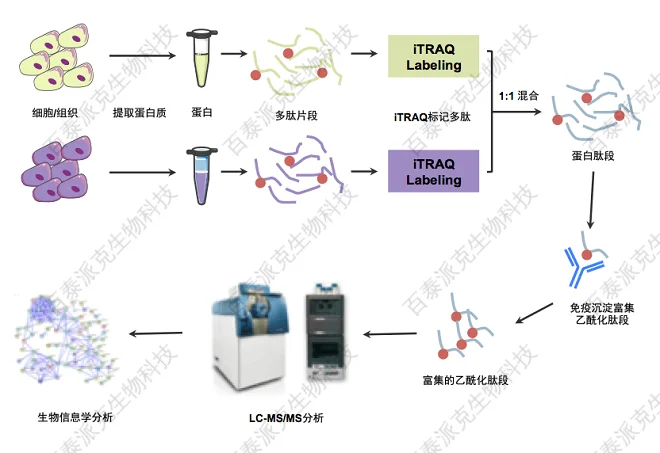
Figure 1
IV. Emerging technologies and future directions
1.High-throughput proteomics technologies:Combine mass spectrometry and proteomics approaches to enable large-scale analysis of protein acetylation, revealing the association of acetylation modifications with disease development.
2.Chemical biology methods:Utilize chemical synthesis and genetic engineering to design novel acetylation probes and sensors for real-time monitoring of protein acetylation in living cells.
3.Bioinformatics analysis:Use big data analysis and machine learning algorithms to explore patterns and functions of acetylation modifications, deepening the understanding of protein acetylation regulatory networks.
As an important form of protein modification, protein acetylation plays a significant role in cellular functions and signaling pathways. With continuous technological advancements, protein acetylation detection methods have significantly improved. Traditional methods like immunodetection and HPLC provide reliable qualitative and quantitative information, while mass spectrometry offers advantages in site identification and quantitative analysis. In the future, integrating high-throughput proteomics, chemical biology, and bioinformatics will further expand the understanding of protein acetylation and its roles in biological processes and diseases.
BioPioneer Tech--BiotechProductsCharacterization, a premium service provider for multi-omics and biological mass spectrometry detection
Related services:
Quantitative proteomics study of acetylation
Post-translational modification proteomics analysis
Histone post-translational modification analysis
Quantitative proteomics analysis
Targeted proteomics
4D proteomics
DIA quantitative proteomics
Label-free quantitative proteomics analysis
Label-based quantitative proteomics techniques - iTRAQ, TMT, SILAC
MRM/PRM quantitative proteomics analysis
How to order?




