






Protein Quantification Technology and Its Application in Clinical Research
Proteomics represents the expression of certain cells, tissues, or organs,post-translational modificationsandprotein-protein interactions, and has become an important means for us to understand the molecular mechanisms and signal transduction of human diseases and cancer. The protein levels in the human body are in a stable equilibrium state, and the accumulation of proteins usually leads to changes in biological functions, thereby causing tumors or diseases. Therefore,protein quantificationis of great significance for mechanistic research. This article provides an overview of the current popular protein quantification techniques and their applications in clinical research.
HPLC-MS/MS-based proteomics technology
The development of HPLC-MS/MS-based proteomics technology mainly depends on liquid chromatography-mass spectrometry (LC-MS) analytical equipment, sample separation and preparation techniques, identification, and bioinformatics. Currently, shotgun is the most commonly used large-scale protein identification strategy. As shown in the figure below, in a bottom-up analysis strategy, proteins are hydrolyzed into peptide mixtures by proteases, then separated by chromatography or affinity separation techniques, and finally detected by mass spectrometry for fragment ions. The spectra from mass spectrometry are matched with the theoretical digested spectra of proteins in the database and scored based on a series of indicators to achieve peptide-spectrum matching (PSM), ultimately identifying the proteome. In top-down proteomics analysis strategies, intact proteins can be directly separated and detected from samples. Compared with bottom-up methods, top-down strategies provide more preserved protein species information. These two analytical strategies have promoted proteomics research on diseases and cancer.
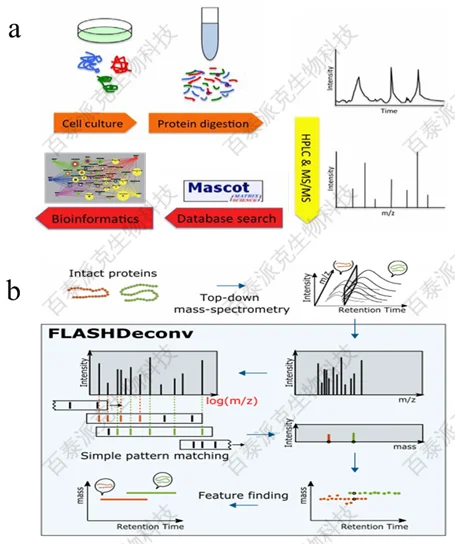
Bottom-up (a) and top-down (b) mass spectrometry-based proteomics workflows (Jeong K et al., 2020)
Common quantitative techniques in proteomics and their clinical applications
Label-free quantification(LFQ)
Label-free quantitative proteomics analysis technology has become the most widely used protein quantification strategy due to its simplicity and minimal invasiveness. This technique does not involve other biomolecules, making it convenient and economical. However, researchers can only obtain the relative quantities of proteins using label-free quantification methods. Label-free quantification is often used in clinical research to screen tumor biomarkers, usually using adjacent or normal tissues as control groups. De Oliveira and others found that MMP-7 is a promising biomarker, effectively diagnosing gastric adenocarcinoma patients through label-free quantification results. Urine E-cadherin is a marker for the early renal damage in diabetic patients. In the study by Sun et al., label-free quantification was used to systematically compare the proteomes in saliva and serum exosomes of healthy subjects and lung cancer patients, revealing potential lung cancer biomarkers.
Dermcidin, apolipoprotein D, prolactin-inducible protein, and serum albumin are the most abundant sweat-secreting proteins in targeted proteomics and label-free quantitative mass spectrometry studies, providing potential sweat biomarkers for the formation of the skin chemical barrier. Label-free quantification is also used to detect biomarkers for other diseases and tumors, such as Vps35 for Parkinson's disease, SOAT1 for hepatocellular carcinoma, GOT2 for prostate cancer, and A1AT for bladder cancer.
Stable Isotope Labeling by Amino acids in Cell culture (SILAC)
SILAC is an in vivo metabolic labeling method, which provides high accuracy and reliability for both absolute and relative protein quantification. The SILAC method adds isotopes of lysine (13C or 15N) and arginine (13C or 15N) to cell culture media lacking these amino acids, labeling proteins as light and heavy. Quantitative analysis is performed at the MS1 level detected by mass spectrometry, as shown in the figure below. Fricke et al. used SILAC to quantitatively detect expression levels of extracellular vesicles in TGFBR2-deficient colorectal cancer, identifying 48 TGFBR2-regulated proteins. SILAC strategies are often used to identify post-translational modifications (PTM) of proteins and amino acids. For example, Peng et al. found that in hepatocellular carcinoma, overexpression of RNF38 promotes TGF-β signaling pathways through ubiquitination and degradation of AHNAK. Zhang et al. quantitatively compared post-translational modifications of histones H3 and H4 in esophageal squamous cell carcinoma with different invasion abilities using SILAC, contributing to the understanding ofhistone post-translational modificationsin different invasive ESCC cell lines. With the development of SILAC technology, by labeling entire organisms and using their tissues as internal standards, SILAC-based model organism tissue quantitative proteomics has been achieved, elucidating the application of SILAC in clinical research.

SILAC workflow (Shenoy A et al., 2015)
Relative and Absolute Quantitation using Isobaric Tags (iTRAQ)
iTRAQ was developed by the American company ABI in 2004. Using iTRAQ kits, up to 8 samples can be labeled simultaneously. The iTRAQ reagent includes a reporter group, peptide reactive group, and balance group. The molecular weight of the reporter group is 113Da to 121Da, and the related balance group is 32Da to 24Da, with a total molecular weight of 145Da. iTRAQ technology can compare proteins in different samples, showing good reproducibility and high sensitivity. It can perform both qualitative and quantitative analysis simultaneously. iTRAQ technology has been applied in an increasing number of fields. In medical research, iTRAQ can analyze and identify differential proteins in tumor tissues to find biomarkers. Hjelle Sigrun illustrated the application of iTRAQ in molecular therapy targets of myeloid leukemia. Hu et al. identified two markers in liver injury, an increased membrane-bound catechol-O-methyltransferase (MB-COMT) and a decreased retinol-binding protein 4 (RBP4).
Tandem Mass Tag (TMT)
The TMT method was developed by Thermo Fisher, allowing simultaneous quantification of up to 16 samples. As shown in the figure below, TMT reagents also include reporter molecules, normalization molecules, and amine reactive groups. TMT is designed to further increase the number of samples that can be analyzed simultaneously without sacrificing protein identification and quantification quality targets, achieving higher quantification accuracy. TMT is also widely used in clinical sample research. Wu et al. applied TMT to label samples from 10 HCC patients and found plasminogen as a prognostic biomarker for HBV-associated chronic liver failure. Similar analysis strategies can be used for the discovery of biomarkers in gastric cancer, glioma, and glioblastoma.
In addition to the commonly used methods mentioned above, many other strategies can be used for protein quantification, such as Differential Gel Electrophoresis (DIGE), Isotope-Coded Affinity Tags (iCAT), and SWATH. These methods can also be used to study molecular mechanisms and biomarkers. Protein quantification technologies are crucial for finding biomarkers of human cancers, selecting drug targets, and studying mechanisms. These technologies are powerful, helping to explore mechanisms of disease occurrence and tumor progression, as well as discovering new biomarkers and clarifying clinical research.
Related Services
SWATH Quantitative Proteomics
2D-DIGE Quantitative Proteomics
MRM/PRM Quantitative Proteomics
How to order?




