






Exploring De Novo Protein Sequencing
De novo protein sequencing refers to the method of deducing the amino acid sequence of proteins or peptides directly from experimental data without relying on known DNA or protein database information. It is particularly useful for studying proteins in species without reference sequences or for exploring new variants and modifications of proteins.
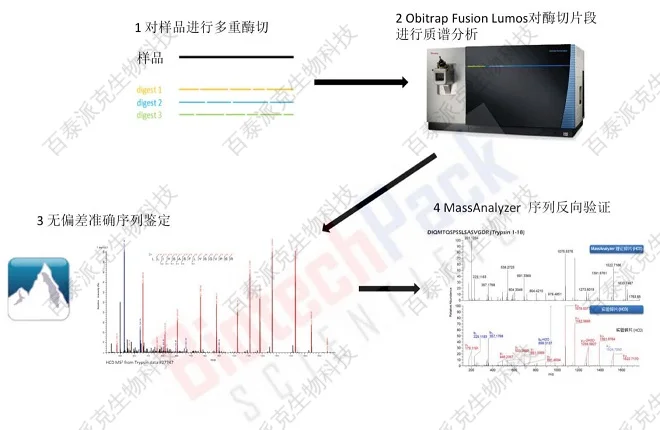
Figure 1. De novo sequencing workflow
I. Technical Principle:
De novo sequencing typically relies on mass spectrometry (MS) technology, especially tandem mass spectrometry (MS/MS), to determine the amino acid sequence by measuring the mass differences of peptide molecules under specific fragmentation. In MS/MS experiments, peptide ions are selectively subjected to collision-induced dissociation (CID), electron transfer dissociation (ETD), or electron capture dissociation (ECD), generating a series of fragment ions whose mass differences are used to infer the amino acid sequence of the original peptide.
II. Application Scenarios:
De novo sequencing is very useful for studying protein expression in species that have not yet been sequenced, or when known sequence databases are insufficient to cover all proteins in a sample. It can also be used to identify unknown variants and isoforms of proteins or detect post-translational modifications.
III. Technical Challenges:
Determining accurate amino acid sequences requires high precision and high-resolution mass spectrometry data. Moreover, the complexity of sequence inference increases significantly with peptide chain length. Additionally, some amino acids, such as leucine and isoleucine, have the same mass in mass spectrometry and thus cannot be distinguished without additional information.
IV. Software Tools:
Processing mass spectrometry data and deducing amino acid sequences from it requires specialized software and algorithms. There are various software packages available for de novo protein sequencing, such as PEAKS, Novor, and DeepNovo.
Although de novo protein sequencing is technically challenging, its application scope and accuracy have significantly improved with the continuous development of mass spectrometry technology and data analysis algorithms, making it an important tool in proteomics research.
BiotechPack, A Biopharmaceutical Characterization and Multi-Omics Mass Spectrometry (MS) Services Provider
Related Services:
N/C-terminal Protein Sequencing
N/C-terminal Sequencing for Biopharmaceuticals
N-terminal Protein Sequencing based on Edman Degradation
Full Protein Sequence Determination
Top-down Method-based Protein Sequencing
How to order?




