






Share 6 Online Tools for Protein Sequence Alignment Analysis
Some of the best tools for protein, peptide, and antibody sequence analysis and alignment. These tools are crucial for researchers in the field of macromolecules. An overview of each tool and its applications:
With the continuous development of molecular biology and bioinformatics technologies, an increasing amount of protein, peptide, and antibody sequence data is being accumulated and published. Analyzing and aligning these sequence data is crucial for understanding their structure, function, and evolution in depth, and also provides strong support for drug development and clinical diagnostics. However, analyzing and aligning protein, peptide, and antibody sequences is not a simple task, requiring the use of a range of specialized tools. These tools help analyze sequences in multiple aspects, including sequence similarity alignment, secondary structure prediction, functional region annotation, site prediction, etc. In this issue, we will share some useful tools for protein, peptide, and antibody sequence analysis and alignment.
1. AlignmentViewer
AlignmentViewer is a visualization tool for viewing and editing sequence alignment results. It has an intuitive and user-friendly graphical interface that clearly displays sequence alignment results, including match, mismatch, and insertion/deletion areas. Additionally, it supports various alignment algorithms and formats (such as FASTA, ClustalW, etc.), offering flexible parameter settings to meet different users' needs.
Applications: Mainly used for viewing, editing, and interpreting sequence alignment results. It helps researchers quickly identify similarities and differences between sequences, providing important evidence for subsequent biological analyses and research.
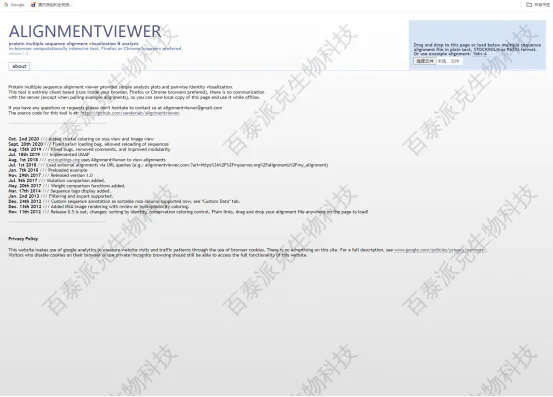
Figure 1. AlignmentViewer tool interface display
Tool link:https://alignmentviewer.org/
2. AbYsis
AbYsis is a tool specifically designed for antibody sequence analysis, featuring powerful sequence alignment, visualization, and annotation functions. AbYsis provides information on amino acid position and species-specific residue distribution, as well as frequency tables of residues at various positions in antibody sequences, highlighting 'rare residues' that seldom appear at specific positions. This assists researchers in determining feasible amino acid mutation schemes. Its sequences include 15 species such as human, mouse, rat, cynomolgus monkey, alpaca, etc. The tool can be accessed via the web and also offers a standalone version for download.
Applications: Mainly used for the analysis and research of antibody sequences. Through AbYsis, users can quickly identify key domains, variable regions, and conserved regions of antibodies, providing strong support for antibody engineering, drug design, and disease research.
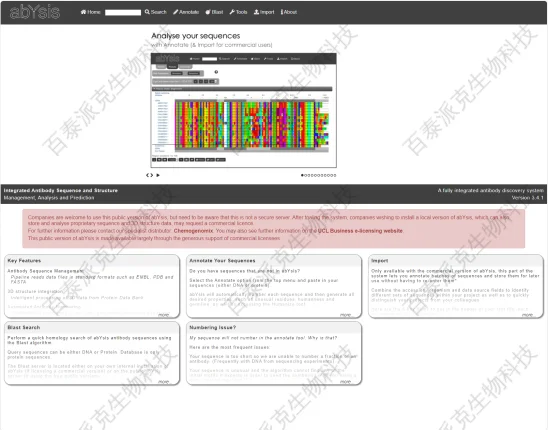
Figure 2. AbYsis tool interface display
Tool link:http://abysis.org/
3. UniProt
UniProt (Universal Protein Resource) is a comprehensive protein database that provides known protein sequences and functional information worldwide. UniProtKB (UniProt Knowledgebase) is the core component, containing annotated and classified protein sequences and functional information. It provides detailed protein annotations, including sequence features, domains, functions, subcellular localization, enzyme activity, etc.
UniProtKB is divided into three sub-databases: UniProtKB/Swiss-Prot, UniProtKB/TrEMBL, and UniProtKB/PIR. UniProtKB/Swiss-Prot is a manually annotated high-quality protein database providing rich annotation information; UniProtKB/TrEMBL is a protein database obtained through automatic annotation and prediction, with relatively lower annotation levels; UniProtKB/PIR is a protein database provided by the Protein Information Resource (PIR).
Applications: Mainly used for protein sequence, structure, and function research. It helps researchers gain a deeper understanding of protein functional mechanisms, design new drug molecules, and conduct drug screening.
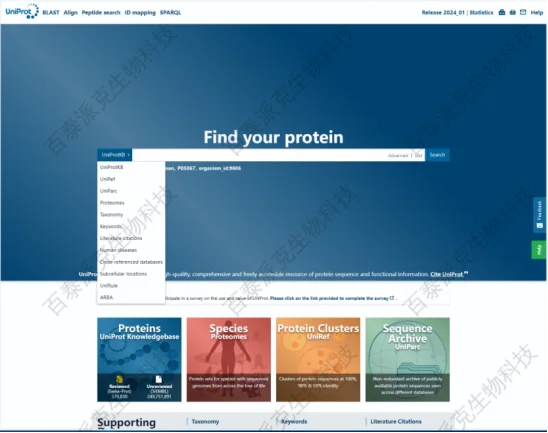
Figure 3. UniProt interface display
Tool link:https://www.uniprot.org/
4. cAb-Rep
cAb-Rep is a comprehensive antibody sequence and structure database. It integrates antibody sequence data from various sources (including published antibody structure information, patent data, and internal laboratory data), ensuring high quality and accuracy through rigorous quality control. cAb-Rep provides an intuitive and user-friendly interface, allowing users to conveniently search, browse, and download antibody sequences and related information.
Applications: cAb-Rep is mainly used for sequence analysis and comparison in antibody research. Researchers can use this tool to find antibody sequences of specific antigens, analyze antibody structural characteristics, and perform sequence alignments and clustering. This is significant for research in antibody engineering, drug design, and immunotherapy.
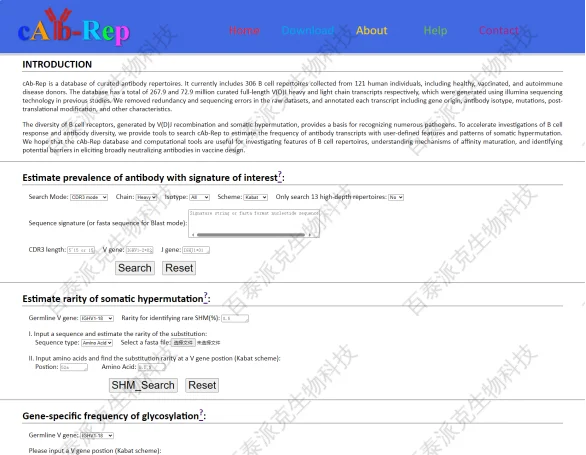
Figure 4. cAb-Rep interface display
Tool link:https://cab-rep.c2b2.columbia.edu/
5. SabDab
SabDab (Structural Antibody Database) is a database specifically collecting antibody structure data. It provides a large amount of antibody three-dimensional structure information, including atomic coordinates, structural models, and related experimental data. In addition to three-dimensional structure collection, the database also collects antigen affinity data (KD), antibody amino acid sequences, and functional annotations for each antibody. The database includes seven modules: database statistics, antibody structure search, CDR search, sequence search, orientation (VH and VL) search, nanobody search, and immunotherapy structure database.
Applications: SabDab is mainly used for the study and analysis of antibody structures. Researchers can use this tool to find three-dimensional structure information of antibodies, analyze the interaction mechanisms between antibodies and antigens, and compare structural differences between different antibodies. This is significant for understanding antibody functional mechanisms, designing new antibody drugs, and conducting structural biology research.
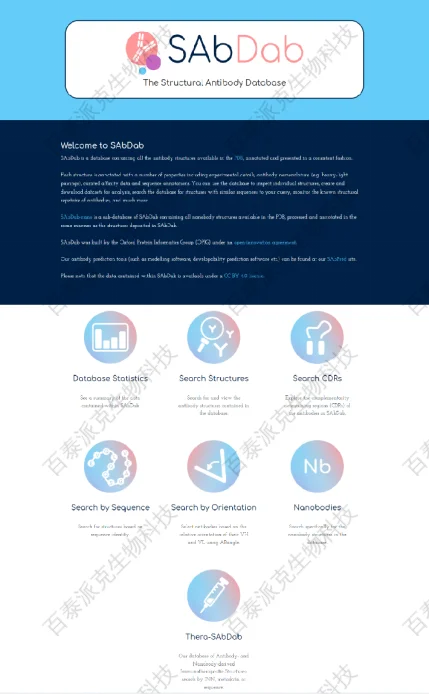
Figure 5. SabDab interface display
Tool link:http://opig.stats.ox.ac.uk/webapps/sabdab
6. SIM Alignment Tool
SIM Alignment Tool is a tool used for sequence alignment, particularly suitable for antibody sequence alignment analysis. It uses advanced alignment algorithms to efficiently align multiple antibody sequences and provides detailed alignment results and visual displays.
Applications: Mainly used for antibody sequence alignment and variation analysis. Researchers can use this tool to compare similarities and differences between different antibody sequences, identify key structural and functional regions, and analyze evolutionary relationships and variation patterns of antibodies.
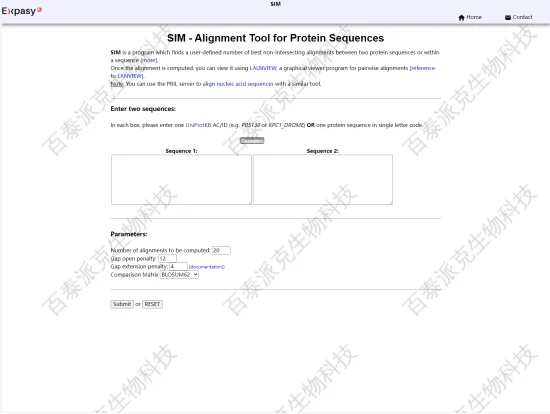
Figure 6. SIM Alignment Tool interface display
Tool link:https://web.expasy.org/sim/
That's the end of this issue's sharing. If you have any questions, feel free to leave a comment below. See you next time!
Biotyper BioTech -- A leading provider of bioproduct characterization and multiomics mass spectrometry detection services
Related services:
Protein de novo sequencing and mutation analysis
Mass spectrometry-based sequence analysis
Edman degradation-based protein N-terminal sequencing
PCR amplification-based monoclonal antibody sequencing services
Protein N/C-terminal sequencing
How to order?




