






itraq/tmt Labeling Quantitative Proteomics: Advantages and Disadvantages
Proteomics is the scientific field that studies the composition, structure, and function of all proteins within a biological organism. In biopharmaceutical research and development, understanding the impact of drugs on the proteome is crucial. iTRAQ (isobaric tags for relative and absolute quantitation) and TMT (tandem mass tag) labeling quantitative proteomics methods are among the widely used technologies today. This article will explore the advantages and disadvantages of these two methods in detail.
1. iTRAQ Labeling Quantitative Proteomics Method
The iTRAQ labeling quantitative proteomics method is a mass spectrometry-based quantitative approach. It involves digesting proteins in the sample into peptides and labeling these peptides with specific iTRAQ reagents. The labeled peptides are then analyzed in a mass spectrometer, and the abundance of the labeled ions is measured to quantify proteins across different samples.
1. Advantages
-
Multiplexing: iTRAQ reagents can label multiple samples simultaneously, allowing comparative analysis of multiple samples within the same experiment, thus improving experimental efficiency.
-
High sensitivity: iTRAQ reagents offer high sensitivity, enabling the detection of low-abundance proteins, which aids in the discovery of potential biomarkers.
-
High throughput: The iTRAQ labeling quantitative proteomics method can analyze a large number of protein samples simultaneously, making it suitable for high-throughput experimental designs.
2. Disadvantages
-
Relative quantification: The iTRAQ labeling quantitative proteomics method can only provide relative quantification between samples and cannot offer absolute quantification information.
-
Labeling bias: iTRAQ reagents may introduce labeling bias during the experiment, resulting in quantitative errors.
-
Complex data analysis: The data analysis for iTRAQ labeling quantitative proteomics is relatively complex and requires specialized bioinformatics tools for interpretation.
2. TMT Labeling Quantitative Proteomics Method
The TMT labeling quantitative proteomics method is similar to the iTRAQ method and is also a mass spectrometry-based quantitative approach. It uses TMT reagents to label peptides in samples and quantifies proteins by measuring the abundance of labeled ions in a mass spectrometer.
1. Advantages
-
High accuracy: TMT reagents provide high accuracy, offering precise quantitative results.
-
Multiplexing: TMT reagents can label multiple samples simultaneously, suitable for comparative analysis of multiple sample groups.
-
Wide dynamic range: The TMT labeling quantitative proteomics method can cover a broad range of protein concentrations.
2. Disadvantages
-
Labeling bias: TMT reagents may introduce labeling bias during the experiment, resulting in quantitative errors.
-
Higher cost: Compared to other quantitative methods, the reagent cost for TMT labeling quantitative proteomics is relatively high.
3. Conclusion
iTRAQ and TMT labeling quantitative proteomics methods play an important role in biopharmaceutical research and development. They offer advantages such as high sensitivity, high throughput, and multiplexing, aiding researchers in understanding the impact of drugs on the proteome. However, labeling bias and the complexity of data analysis are common disadvantages of these methods. When choosing which method to use, researchers need to consider experimental needs, budget, and data analysis capabilities.
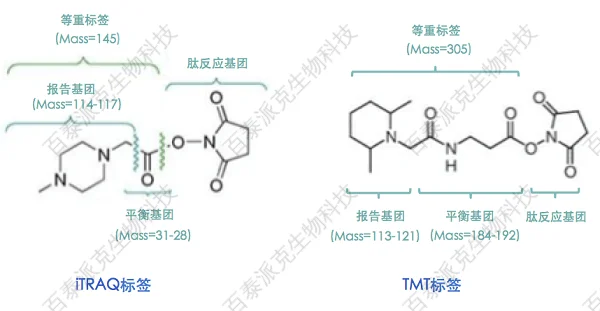
Figure 1
BiotechPack, A Biopharmaceutical Characterization and Multi-Omics Mass Spectrometry (MS) Services Provider
Related Services:
TMT/iTRAQ/MultiNotch Quantitative Proteomics Analysis
Quantitative Proteome Analysis
Label-Free Quantitative Proteome Analysis
Label-Based Protein Quantification Technologies - iTRAQ, TMT, SILAC
SILAC/Dimethyl Labeling-Based Quantitative Proteome Analysis
SWATH Quantitative Proteomics Service
2D-DIGE Quantitative Proteomics
MRM/PRM Quantitative Proteomics Analysis
Absolute Quantification Analysis (AQUA)
How to order?




