






itraq/tmt Labeling Quantitative Proteomics Technology Comparison
1. Introduction
Proteomics is the scientific field that studies the complete set of proteins within a biological organism and their functions. In biopharmaceutical research and development, understanding changes in the proteome is crucial for comprehending disease mechanisms, drug actions, and identifying new therapeutic targets. Quantitative proteomics techniques are essential tools for studying changes in protein expression levels within the proteome. This article will focus on introducing iTRAQ and TMT labeled quantitative proteomics techniques and compare the two.
2. iTRAQ Labeled Quantitative Proteomics Technique
The iTRAQ (isobaric tags for relative and absolute quantitation) labeled quantitative proteomics technique is a mass spectrometry-based quantitative method. It involves labeling peptides derived from protein digestion in different samples and then quantifying them during mass spectrometry analysis. The iTRAQ labeled peptides produce specific ion peaks in the mass spectrometer, and by measuring the intensity of these peaks, one can infer the relative abundance of proteins in different samples.
The iTRAQ labeled quantitative proteomics technique has the following advantages:
-
High throughput: iTRAQ labeling allows for the simultaneous analysis of multiple samples, increasing experimental efficiency.
-
High sensitivity: The ion peaks generated by iTRAQ labeled peptides in the mass spectrometer are strong, enabling the detection of low-abundance proteins.
-
High accuracy: The quantitative results of iTRAQ labeling are highly accurate, providing reliable data support.
However, the iTRAQ labeled quantitative proteomics technique also has some limitations:
-
Quantification error: The intensity of ion peaks generated by iTRAQ labeled peptides in the mass spectrometer can be influenced by various factors such as ionization efficiency and mass spectrometer performance, potentially leading to quantification errors.
-
Inconsistent labeling efficiency: Different peptides in samples may have different labeling efficiencies, which can introduce quantification bias.
-
High labeling cost: The price of iTRAQ labeling reagents is relatively high, making large-scale experiments costly.
3. TMT Labeled Quantitative Proteomics Technique
The TMT (tandem mass tag) labeled quantitative proteomics technique is also a mass spectrometry-based quantitative method. Similar to iTRAQ labeling, TMT labeling involves labeling peptides from different samples and quantifying them during mass spectrometry analysis. TMT labeled peptides produce different mass-to-charge ratios, and by measuring the intensity of these ratios, one can infer the relative abundance of proteins in different samples.
The TMT labeled quantitative proteomics technique has the following advantages:
-
Multiplexing capability: TMT labeling allows for the simultaneous analysis of multiple samples, increasing experimental efficiency.
-
High accuracy: The quantitative results of TMT labeling are highly accurate, providing reliable data support.
-
Consistent labeling efficiency: TMT labeling reagents have relatively stable labeling efficiency, reducing quantification bias.
However, the TMT labeled quantitative proteomics technique also has some limitations:
-
Large labeling molecules: The molecular weight of TMT labeling reagents is relatively large, which may affect the sensitivity of mass spectrometry analysis.
-
High labeling cost: The price of TMT labeling reagents is relatively high, making large-scale experiments costly.
4. Comparison of iTRAQ and TMT Labeled Quantitative Proteomics Techniques
Both iTRAQ and TMT labeled quantitative proteomics techniques are similar in principle, as they involve labeling peptides for quantitative analysis. The main differences between them are as follows:
-
Labeling efficiency: The ion peak intensity of iTRAQ labeled peptides in mass spectrometry may be affected by labeling efficiency, whereas TMT labeled peptides have relatively stable labeling efficiency, reducing quantification bias.
-
Cost: The price of iTRAQ labeling reagents is relatively lower, while TMT labeling reagents are more expensive. Therefore, for large-scale experiments, iTRAQ labeling technology is more economical.
-
Analytical throughput: iTRAQ labeling allows simultaneous analysis of multiple samples, improving experimental efficiency, while TMT labeling can analyze even more samples simultaneously, further increasing experimental efficiency.
Both iTRAQ and TMT labeled quantitative proteomics techniques are important quantitative proteomics methods. The choice of which technique to use should be based on experimental needs, budget, and the number of samples. Regardless of the choice, the development of quantitative proteomics techniques will provide more information and support for biopharmaceutical research and development, advancing drug research.
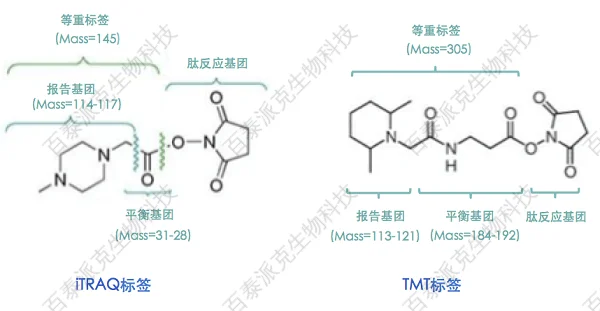
Figure 1
Biotech Enjoy Tech -- A leading service provider in biological product characterization and multi-omics mass spectrometry analysis.
Related services:
TMT/iTRAQ/MultiNotch Quantitative Proteomics Analysis
Quantitative Proteomics Analysis
Label-Free Quantitative Proteomics Analysis
Label-based Protein Quantification Techniques - iTRAQ, TMT, SILAC
SILAC/Dimethyl Labeling-based Quantitative Proteomics Analysis
SWATH Quantitative Proteomics Services
2D-DIGE Quantitative Proteomics
MRM/PRM Quantitative Proteomics Analysis
Absolute Quantification Analysis (AQUA)
How to order?




