






Precise Quantification and Diverse Samples: Advantages and Disadvantages of iTRAQ in Proteomics
1. Introduction: The Relationship between Proteomics and iTRAQ
Proteomics is an emerging discipline that studies comprehensive issues such as protein expression, modification, interaction, function, and networks. In this field, quantitative analysis of proteins is considered one of the most important techniques. Among them, iTRAQ (Isobaric Tags for Relative and Absolute Quantitation) technology has been widely used in quantitative proteomics. The main advantages of this technology lie in its flexibility and scalability, but it also has some potential drawbacks. By analyzing its strengths and weaknesses, we can better improve this technology to provide more accurate and reliable data for drug development.
2. Advantages: Accurate Quantification and Diverse Samples
2.1 Accuracy
iTRAQ encompasses established mass spectrometry values and achieves a deviation as low as one percent due to the advantages of isotopic labeling, ensuring the accuracy and comparability of its quantitative results.
2.2 Handling of Diverse Samples
iTRAQ provides researchers with the possibility of processing multiple samples simultaneously. For instance, iTRAQ 8plex can handle 8 different samples at the same time, greatly improving the efficiency of sample processing.
3. Disadvantages: Solubility and Protein Coverage
3.1 Solubility Issues
Although the use of iTRAQ has partially solved the problem of poor sample solubility, differences in solubility during sample preparation still severely affect iTRAQ labeling efficiency, thereby impacting the measurement results.
3.2 Protein Coverage
Despite the widespread application of iTRAQ, its coverage is often limited by proteins that are difficult to ionize or digest, making it challenging to accurately quantify many important disease-related proteins.
4. Conclusion: Research Goals and Technological Improvements
Whether in basic scientific research or in clinical medicine and drug development, we cannot ignore the quantitative analysis of proteins. Although iTRAQ has its unique advantages and some areas for improvement, its application in proteomics still holds great potential. Therefore, our research goals should continuously seek breakthroughs and improvements in enhancing the accuracy, sample adaptability, and protein coverage of iTRAQ. Through exploration, we aim to achieve more refined and broader protein quantitative analysis to better meet the needs of future biomedical research.
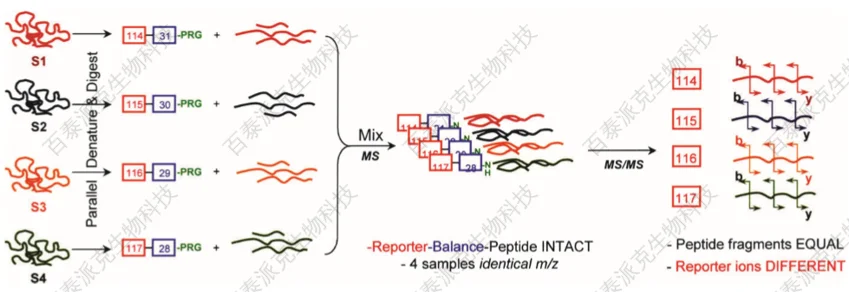
Figure 1
BiotechPack, A Biopharmaceutical Characterization and Multi-Omics Mass Spectrometry (MS) Services Provider
Related Services:
Label-based Protein Quantification Technologies - iTRAQ, TMT, SILAC
Quantitative Proteomics Analysis
Label-Free Quantitative Proteomics Analysis
TMT/iTRAQ/MultiNotch Quantitative Proteomics Analysis
SILAC/Dimethyl-labeled Quantitative Proteomics Analysis
SWATH Quantitative Proteomics Service
2D-DIGE Quantitative Proteomics
MRM/PRM Quantitative Proteomics Analysis
Absolute Quantification Analysis (AQUA)
How to order?




