






Advantages of Label Free Proteomics Analysis
Proteins are essential functional molecules in organisms, and studying their composition and expression levels is crucial for understanding physiological and pathological processes. The development of proteomics technology provides a comprehensive means to understand protein composition and function. Among these, label-free proteomics analysis, as a non-labeling method, offers numerous advantages. This article will discuss the advantages of label-free proteomics analysis in detail.
1. Advantage One: No Labeling Required
Traditional proteomics analysis methods often require the use of labeling agents to mark protein samples, such as fluorescent or isotope labels. However, these labeling agents may introduce additional variability and errors, affecting the accuracy of the results. Label-free proteomics analysis does not require labeling, directly analyzing samples and avoiding potential problems brought by labeling agents.
2. Advantage Two: High Sensitivity
Label-free proteomics analysis uses mass spectrometry to quantitatively analyze proteins in samples. Mass spectrometry is characterized by high sensitivity and high resolution, capable of detecting low-concentration proteins. Compared to other proteomics analysis methods, label-free proteomics analysis can quantify protein expression levels more accurately, especially suitable for studying low-abundance proteins.
3. Advantage Three: Broad Dynamic Range
Protein abundance in samples varies greatly, with some proteins being very low in abundance and others very high. Traditional proteomics analysis methods face certain challenges when dealing with high- and low-abundance proteins. Label-free proteomics analysis has a broad dynamic range, capable of detecting both high- and low-abundance proteins, providing more comprehensive information on protein composition.
4. Advantage Four: Versatile Sample Applicability
The composition and properties of proteins in different samples vary. Traditional proteomics analysis methods require different labeling and processing steps for different samples. In contrast, label-free proteomics analysis has strong sample applicability and can be applied to various types of samples, including cell cultures, tissue samples, and body fluids, providing convenience for extensive biological research.
5. Advantage Five: Time and Cost Efficiency
Traditional proteomics analysis methods usually require a significant amount of time and cost, including the purchase of labeling agents and complex sample processing steps. Label-free proteomics analysis does not require labeling agents, simplifying the experimental process, and saving time and cost. This makes label-free proteomics analysis an ideal choice for high-throughput protein research.
Label-free proteomics analysis offers numerous advantages, including no need for labeling agents, high sensitivity, broad dynamic range, versatile sample applicability, and time and cost efficiency. These advantages make label-free proteomics analysis an indispensable tool in biological research. Through label-free proteomics analysis, researchers can quantify protein expression levels more accurately, particularly suitable for low-abundance protein studies. Traditional proteomics analysis methods face difficulties in handling high- and low-abundance proteins, whereas label-free proteomics analysis has a broad dynamic range, capable of detecting both high- and low-abundance proteins, providing more comprehensive information on protein composition. Additionally, label-free proteomics analysis has strong sample applicability and can be applied to various types of samples, including cell cultures, tissue samples, and body fluids, providing convenience for extensive biological research without the need for different labeling and processing steps. Compared to traditional proteomics analysis methods, label-free proteomics analysis offers time and cost efficiency. Traditional methods usually require significant time and cost, including the purchase of labeling agents and complex sample processing steps. In contrast, label-free proteomics analysis does not require labeling agents, simplifies the experimental process, and saves time and cost. This makes label-free proteomics analysis an ideal choice for high-throughput protein research.
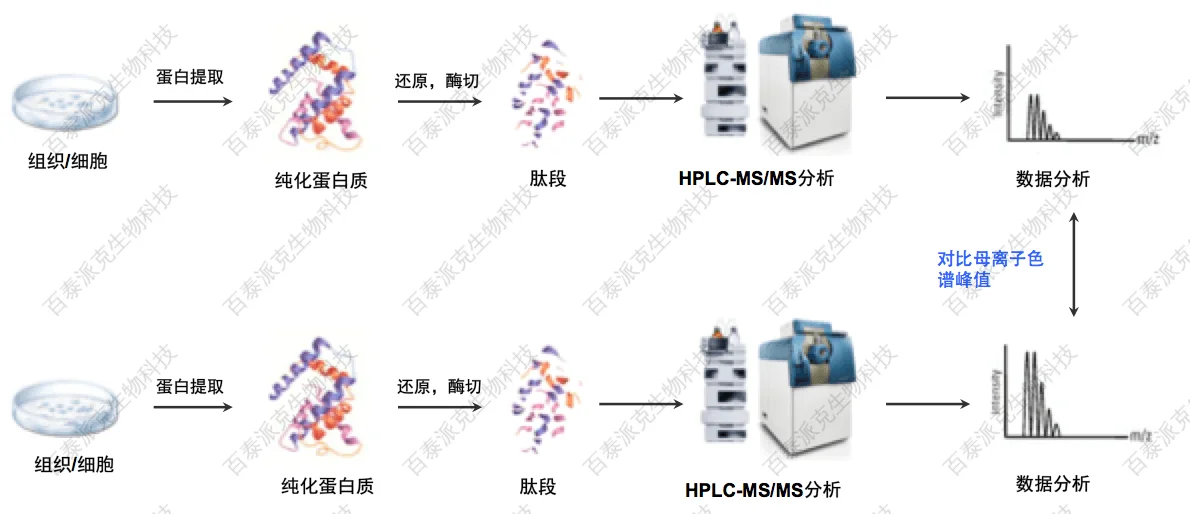
Figure 1
BiotechPack, A Biopharmaceutical Characterization and Multi-Omics Mass Spectrometry (MS) Services Provider
Related Services:
Label-Free Quantitative Proteomics Analysis
Quantitative Proteomics Analysis
Label-Based Protein Quantification Technologies - iTRAQ, TMT, SILAC
TMT/iTRAQ/MultiNotch Quantitative Proteomics Analysis
SILAC/Dimethyl Label-Based Quantitative Proteomics Analysis
SWATH Quantitative Proteomics Services
2D-DIGE Quantitative Proteomics
MRM/PRM Quantitative Proteomics Analysis
Absolute Quantification Analysis (AQUA)
Post-Translational Modification Proteomics Analysis
How to order?




