






Label-Free Quantitative Proteomics: A Comprehensive Insight into Label-Free Technology
1. Introduction
Proteins are one of the most important functional molecules in living organisms. Studying the expression levels and changes of proteins is crucial for understanding biological processes and disease mechanisms. Over the past decades, scientists have developed various proteomics technologies, one of which is label-free quantitative proteomics, also known as label-free technology. This article will elaborate on the principles, applications, and advantages of label-free technology.
2. Principles of Label-Free Quantitative Proteomics Technology
Label-free quantitative proteomics is a mass spectrometry-based method used to measure the relative abundance of proteins in a sample. Compared to traditional labeling techniques, label-free technology does not require chemical labeling of protein samples in advance, making it more convenient and flexible.
In label-free technology, proteins in the samples are first degraded into peptides by digestive enzymes. These peptides are then analyzed by a mass spectrometer to obtain their mass-to-charge (m/z) ratio and relative abundance. By comparing the relative abundance of the same peptides in different samples, differences in protein expression levels can be inferred.
3. Applications of Label-Free Quantitative Proteomics Technology
1. Biomedical Research
Label-free technology has been widely applied in biomedical research. For example, in disease research, scientists can use label-free technology to compare the differences in protein expression between healthy individuals and patients, thereby identifying biomarkers related to diseases. Moreover, label-free technology can also be used in drug discovery to help scientists evaluate the impact of drugs on protein expression.
2. Agricultural Science
Label-free technology also has important applications in agricultural science. For instance, scientists can use label-free technology to study the disease resistance and stress adaptation of crops, providing a basis for crop improvement. Additionally, label-free technology can be used to detect protein components and quality in food, ensuring food safety and quality.
3. Environmental Monitoring
Label-free technology plays an important role in environmental monitoring. Scientists can use label-free technology to study the composition and changes of proteins in water, soil, and atmosphere, thus understanding the extent and sources of environmental pollution. This is significant for environmental protection and ecological restoration.
4. Advantages of Label-Free Quantitative Proteomics Technology
Compared to traditional labeling techniques, label-free technology has the following advantages:
1. Flexibility:Label-free technology does not require prior labeling of samples, making it applicable to various sample types and experimental designs.
2. High Throughput:Label-free technology can analyze a large number of samples simultaneously, improving experimental efficiency.
3. High Sensitivity:Label-free technology can detect low-abundance proteins, aiding in the discovery of potential biomarkers.
4. Bias-Free:Since no labeling agent is required, label-free technology can avoid the influence of labels on samples, reducing experimental errors.
5. Cost-Effectiveness:Compared to labeling techniques, label-free technology is more cost-effective and economical.
5. Working Principles of Label-Free Quantitative Proteomics Technology
Label-free quantitative proteomics technology is mainly based on mass spectrometry analysis principles. First, proteins in the sample are digested into peptides by digestive enzymes. These peptides are then separated by liquid chromatography and analyzed by a mass spectrometer. The mass spectrometer ionizes the peptides and separates and detects them based on their mass-to-charge ratio. Finally, by comparing the peak areas or heights of different peptides in the sample, the relative abundance of proteins can be inferred.
6. Application Cases of Label-Free Quantitative Proteomics Technology
Label-free quantitative proteomics technology is widely used in biomedical research and drug development. Below are some application cases:
1. Cancer Research
Label-free quantitative proteomics technology can help scientists study the mechanisms of cancer development and identify therapeutic targets. By comparing the differences in protein expression between cancer cells and normal cells, cancer-related biomarkers can be discovered, providing a basis for early diagnosis and treatment of cancer.
2. Drug Development
Label-free quantitative proteomics technology can be used to evaluate the impact of drugs on protein expression. Scientists can understand the regulatory effects of drugs on specific proteins by comparing protein expression differences between drug-treated and control groups, thereby optimizing drug development and design.
3. Disease Diagnosis
Label-free quantitative proteomics technology can help scientists identify biomarkers related to diseases. By comparing the differences in protein expression between healthy individuals and patients, disease-related proteins can be identified, improving early diagnosis and treatment outcomes.
7. Conclusion
Label-free quantitative proteomics technology is a powerful tool that can help scientists delve into protein expression and regulation mechanisms. It has widespread applications in biomedical research, drug development, agricultural science, and environmental monitoring. Through label-free quantitative proteomics technology, we can better understand the complexity of biological systems and provide new ideas and methods for disease diagnosis and treatment. In the future, with continuous technological developments and innovations, label-free quantitative proteomics technology will demonstrate its enormous potential and application value in more fields.
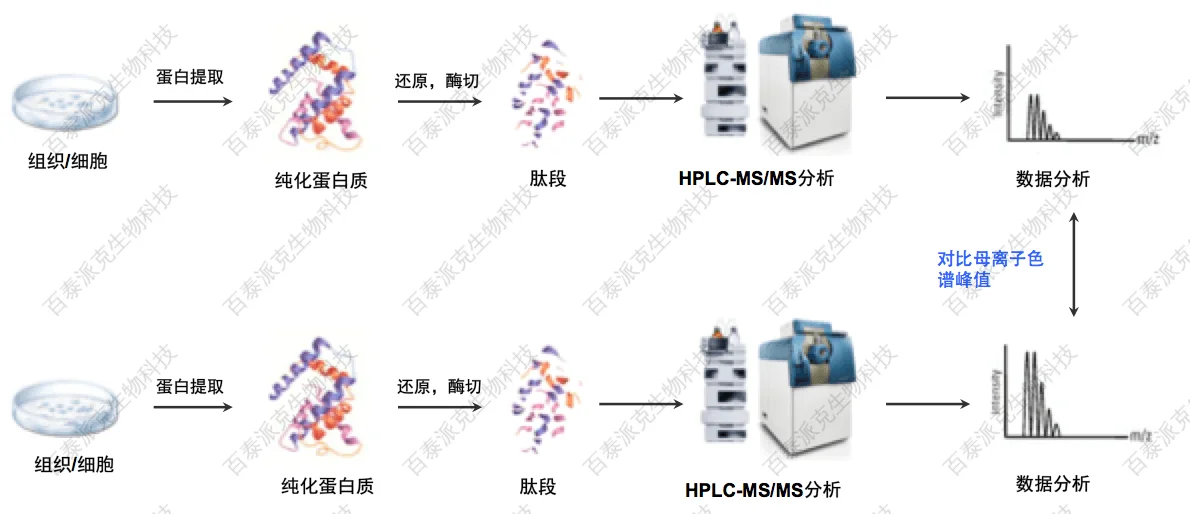
Figure 1
BiotechPack, A Biopharmaceutical Characterization and Multi-Omics Mass Spectrometry (MS) Services Provider
Related Services:
Label-Free Based Quantitative Proteomics Analysis
Quantitative Proteomics Analysis
Label-Based Proteomics Quantification Techniques - iTRAQ, TMT, SILAC
TMT/iTRAQ/MultiNotch Quantitative Proteomics Analysis
SILAC/Dimethyl Label-Based Quantitative Proteomics Analysis
SWATH Quantitative Proteomics Service
2D-DIGE Quantitative Proteomics
MRM/PRM Quantitative Proteomics Analysis
Absolute Quantification Analysis (AQUA)
Post-Translational Modification Proteomics Analysis
How to order?




