






Label-free quantification application
1. Introduction
In the field of biopharmaceutical research, understanding quantitative information about proteins is crucial for comprehending cellular processes and disease mechanisms. Traditional protein quantification methods require the use of labeling molecules, such as fluorescent dyes or isotope labels, to mark protein samples. However, these labeling methods may introduce biases or interferences, limiting their application in biopharmaceutical research. In recent years, label-free quantification technology has emerged, providing researchers with a more accurate and flexible method for protein quantification.
2. Principles of Label-Free Quantification
Label-free quantification is based on mass spectrometry principles, inferring the relative abundance of proteins by measuring the intensity of peptide feature peaks in protein samples. This method does not require the use of any labeling molecules, thereby avoiding the biases and interferences introduced by labeling. Label-free quantification primarily includes two methods: library-based quantification and peak area-based quantification.
1. Library-Based Quantification
The library-based quantification method determines the relative abundance of proteins in the sample by comparing it to known protein spectra. This method requires the establishment of a database containing known protein spectra, and the sample spectra are compared against this database. Through comparative analysis, the relative abundance of proteins in the sample can be determined.
2. Peak Area-Based Quantification
The peak area-based quantification method infers the relative abundance of proteins by measuring the area of peptide feature peaks in protein samples. This method uses a mass spectrometer to measure the intensity of peptide feature peaks and calculates the peak area. By comparing the peak areas of peptide features in different samples, the relative abundance of proteins can be determined.
3. Advantages of Label-Free Quantification
Compared to traditional labeling quantification methods, label-free quantification has the following advantages:
1. High Sensitivity
Label-free quantification technology uses mass spectrometry analysis, characterized by high sensitivity and high resolution. It can detect low-abundance proteins and provide accurate quantification results.
2. High Accuracy
Label-free quantification technology avoids the biases and interferences introduced by labeling, providing more accurate quantification results. It can accurately measure the relative abundance of proteins, helping researchers better understand cellular processes and disease mechanisms.
3. Flexibility
Label-free quantification technology does not require the use of specific labeling molecules, offering greater flexibility. Researchers can choose suitable mass spectrometry analysis methods based on experimental needs to achieve more precise quantification.
4. Applications of Label-Free Quantification
Label-free quantification technology has wide applications in biopharmaceutical research. The following are some common application areas:
1. Proteomics Research
Label-free quantification technology can be used in proteomics research to help researchers understand protein expression and regulation in cells. By comparing the relative abundance of proteins in different samples, disease-related protein biomarkers can be identified, providing a basis for early diagnosis and treatment of diseases.
2. Drug Development
Label-free quantification technology can be used in drug development for evaluating drug efficacy and studying drug metabolism. By measuring the relative abundance of protein binding and metabolites in the body, the efficacy and safety of drugs can be assessed.
3. Biomarker Discovery
Label-free quantification technology can be used in the discovery and validation of biomarkers. By comparing the relative abundance of proteins in disease and normal tissues, disease-related protein biomarkers can be identified, providing new targets for disease diagnosis and treatment.
5. Conclusion
As an emerging protein quantification method, label-free quantification technology has broad application prospects in biopharmaceutical research. It not only offers high sensitivity and accuracy but also flexibility and reliability. With ongoing technological advancements and improvements, label-free quantification technology will provide more possibilities for biopharmaceutical research, driving scientific progress and innovation.
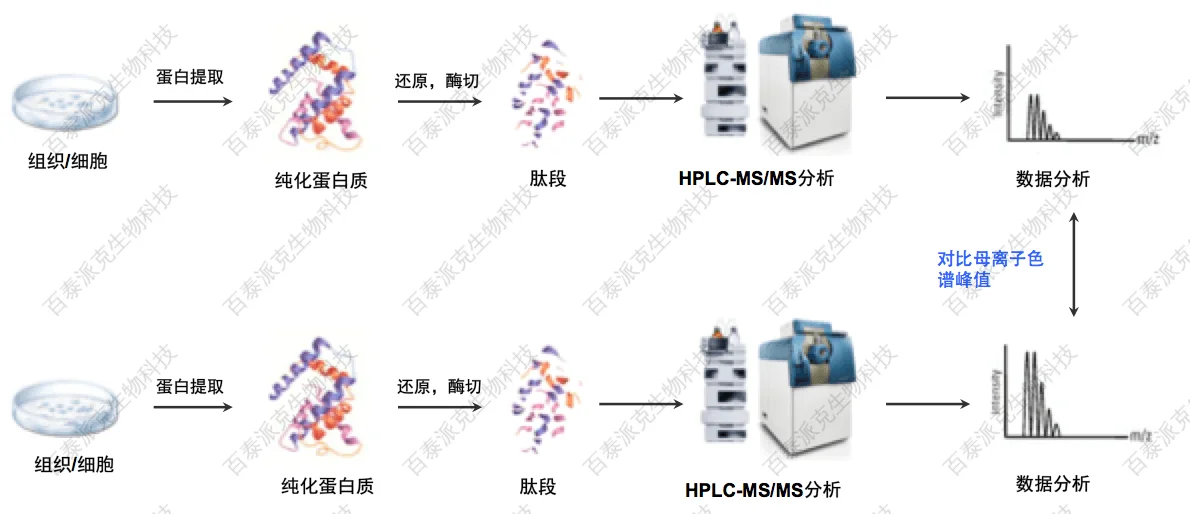
Figure 1
BiotechPack, A Biopharmaceutical Characterization and Multi-Omics Mass Spectrometry (MS) Services Provider
Related Services:
Label-Free Quantitative Proteomics Analysis
Quantitative Proteomics Analysis
Label-Based Protein Quantification Technologies - iTRAQ, TMT, SILAC
TMT/iTRAQ/MultiNotch Quantitative Proteomics Analysis
SILAC/Dimethyl Label-Based Quantitative Proteomics Analysis
SWATH Quantitative Proteomics Service
2D-DIGE Quantitative Proteomics
MRM/PRM Quantitative Proteomics Analysis
Absolute Quantification Analysis (AQUA)
Post-Translational Modification Proteomics Analysis
How to order?




