






Tandem Mass Tags (TMT) Quantitative Proteomics
Tandem Mass Tags (TMT) quantitative proteomics is an advanced mass spectrometry technique used to simultaneously quantify protein expression in multiple samples. This method is particularly suitable for comparative quantification of proteins in complex biological samples and holds significant importance in disease mechanism research, biomarker discovery, and drug mechanism analysis.
What is TMT?
TMT is a mature stable isotope labeling reagent developed by Thermo Fisher Scientific. TMT quantification falls under the isobaric labeling quantification methods, and it is currently one of the most widely used methods. The mass tagging reagents in a set consist of an amine-reactive NHS-ester group (amine-reactive group), a spacer arm (balancer group), and a mass reporter group. Based on the principle of isotopes, different isotope tags are attached to the N-terminus or lysine residues of peptides, particularly at pH 8.5, to label peptides from different sources. In specific kit combinations, three groups ensure a constant total molecular weight through different numbers and combinations of 13C and 15N isotopes at different positions, leading to a single isotopic mass difference of 6 mDa in the reporter group, which can be accurately quantified using high-resolution mass spectrometry (MS), thus distinguishing the peptide sources after labeling.
Importantly, TMT kits currently include TMT 6-plex, TMT 10-plex, TMT 11-plex, TMTPro 16-plex, and TMTPro 18-plex. It can be used to label up to 18 different samples. For each sample, unique reporter masses in the low mass region (i.e., 126-135 Da) of MS/MS spectra are used to measure the relative protein expression levels during peptide fragmentation. It provides multiplex functionality for relative quantitative proteomics analysis. This TMT labeling technology has been widely applied in studies of differential expression proteomics and disease protein biomarker discovery.
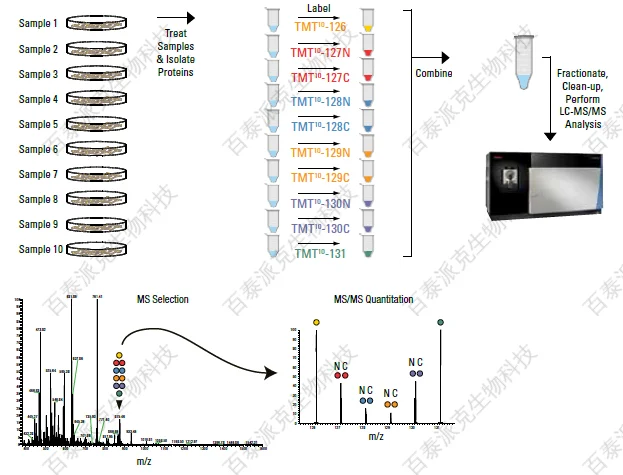
Figure 1
Principle of TMT-based proteomics
In the MS1 spectrum, peaks appear for the same peptide segments from different labeled samples because the same peptide segments in different samples labeled with TMT reagents exhibit the same mass-to-charge ratio.
In MS2, chemical bonds between the reporter group, balancer group, and reactive group break, releasing the TMT reporter group and balancer group. Neutral loss occurs in the balancer group, and MS detects and records the reporter group. The ion peaks of the TMT reporter are generated in the low mass region of the MS2 spectrum, and their intensity reflects the relative expression information of peptides in different samples. Additionally, the mass-to-charge ratio of peptide fragment ion peaks in MS2 reflects the sequence information of the peptide. Through database searching, qualitative and relative quantitative information about proteins can be obtained from these raw data.
Advantages of TMT technology
- Broad coverage: TMT kits are compatible with samples from various sources, including cells, plant and animal tissues, bacteria, blood, subcellular protein fractions, and more.
- High adaptability: Also applicable for PTMs and IP-MS analysis.
- High specificity:TMT labeling efficiency > 99%
Biotage Biotechnology - Characterization of biological products, high-quality service provider for multi-omics mass spectrometry analysis
Related services:
Quantitative proteomics analysis
Label-free quantitative proteomics analysis
Label-based protein quantification techniques - iTRAQ, TMT, SILAC
TMT/iTRAQ/MultiNotch quantitative proteomics analysis
SILAC/Dimethyl labeling-based quantitative proteomics analysis
SWATH quantitative proteomics services
2D-DIGE quantitative proteomics
MRM/PRM quantitative proteomics analysis
Absolute quantification analysis (AQUA)
Post-translational modification proteomics analysis
How to order?




