






Application and Development of MRM Technology in Protein Analysis
As the importance of proteins in biomedical research and biopharmaceutical development becomes increasingly prominent, the demand for protein analysis is also becoming more urgent. In the field of proteomics research, one widely applied technique that has garnered attention is MRM (Multiple Reaction Monitoring) technology. This article will provide a detailed introduction to MRM technology and discuss its applications and developments in protein analysis.
1. Principles of MRM Technology
MRM technology is a quantitative method based on mass spectrometry, used to detect and quantify specific peptides of target proteins. It is based on the selectivity and sensitivity of the mass spectrometer towards peptides, achieving quantification of target proteins by selecting and monitoring specific transition reactions. MRM technology typically involves two stages: precursor ion selection and selected reaction monitoring. By optimizing the parameter settings for these two stages, the accuracy and sensitivity of protein quantification can be improved.
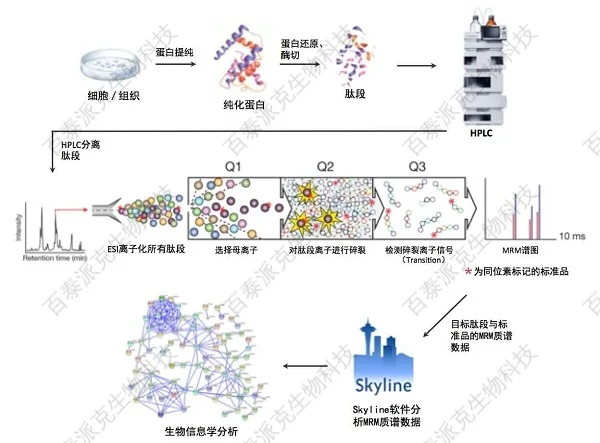
Figure 1
2. Applications of MRM Technology in Protein Analysis
MRM technology has extensive applications in protein analysis. Firstly, it can be used for protein quantification, including determining protein expression levels, post-translational modifications, and subcellular localization. Secondly, MRM technology can be used in the study of protein interactions, including quantification of protein complexes and analysis of structural characteristics. Furthermore, this technology can be applied in the screening of disease biomarkers and quality control in biopharmaceutical development. These applications make MRM technology an essential tool in proteomics research and biopharmaceutical development.
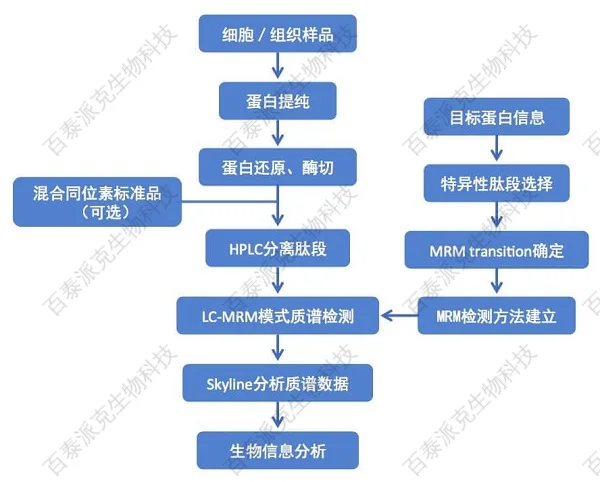
Figure 2
3. Future Prospects of MRM Technology
With continuous technological advancements, MRM technology has a broad future in protein analysis. Future directions include improving the sensitivity and resolution of the technology to enable more accurate detection and quantification of proteins. Additionally, integrating and analyzing multi-omics data is expected to provide a more comprehensive understanding of proteomics and a more precise evaluation of biopharmaceutical development. These advancements will bring more breakthroughs and progress to protein research and the biomedical field.
In summary, MRM technology has significant applications and development potential in protein analysis. Through quantitative methods based on mass spectrometry, this technology can accurately detect and quantify specific peptides of target proteins, providing an effective tool for proteomics research and biopharmaceutical development. With continuous technological advancements, MRM technology is expected to achieve more breakthroughs in protein analysis, promoting progress in biomedical research and biopharmaceutical development.
Bio-Techne Corporation - Characterization of Biologics, High-Quality Multi-Omics Mass Spectrometry Services
Related Services:
MRM/PRM Quantitative Proteomics Analysis
High-Resolution Mass Spectrometry Molecular Weight Identification
MALDI TOF Molecular Weight Analysis
Molecular Weight Determination
Molecular Weight Determination of Protein Complexes and Protein-Small Molecule Complexes
Quantitative Proteome Analysis
Tag-Based Protein Quantification Techniques - iTRAQ, TMT, SILAC
TMT/iTRAQ/MultiNotch Quantitative Proteomics Analysis
SILAC/Dimethyl Label-Based Quantitative Proteome Analysis
SWATH Quantitative Proteomics Service
DIA Quantitative Proteomics
2D-DIGE Quantitative Proteomics
Absolute Quantification Analysis (AQUA)
Post-Translational Modification Proteome Analysis
Phosphorylation Quantitative Proteomics Research
Proteomics Bioinformatics Analysis
How to order?




