






Proteomics DIA Applications: Bridging Quantitative Analysis to Functional Research
In the field of biopharmaceuticals, protein quantification is one of the key research contents. Proteomics DIA technology, as a new mass spectrometry technology, is characterized by high throughput, high sensitivity, and high accuracy, and is gradually becoming an important tool for protein quantification research. This article will introduce the principles and applications of proteomics DIA in detail, exploring its potential and breakthroughs in quantitative analysis and functional research.
1.Principles of Proteomics DIA
Proteomics DIA technology is a mass spectrometry technology based on a data-independent acquisition mode. Unlike the traditional data-dependent acquisition (DDA) mode, DIA technology can simultaneously acquire mass spectrometry data of all ion fragments, enabling comprehensive and high-throughput protein quantification.
The basic principle of proteomics DIA is to use preset ion windows for data acquisition during mass spectrometry analysis, covering all possible ion fragments. In this way, specific fragments of the target protein can be detected and quantified regardless of whether they are in the preset window. This comprehensiveness and high throughput make proteomics DIA a powerful tool for quantitative analysis and functional research.
2.Applications of Proteomics DIA
2.1 High-throughput Protein Quantification
Proteomics DIA technology can achieve high-throughput quantitative analysis of large-scale samples. By combining bioinformatics tools and statistical methods, proteomics DIA data can be processed and analyzed to achieve high-precision and reliable protein quantification.
The high-throughput nature of proteomics DIA stems from its comprehensiveness. Traditional mass spectrometry technology usually selects specific ion fragments for detection during quantification, while DIA technology can simultaneously detect all possible ion fragments, thus covering more proteins and achieving more comprehensive quantification.
2.2 Functional Research and Biological Process Analysis
Proteomics DIA technology can not only perform protein quantification but also reveal important biological processes such as protein interactions, signaling pathways, and functional regulation. By analyzing DIA data, one can study protein-protein interaction relationships, explore the regulatory mechanisms of protein signaling pathways, and gain a deeper understanding of the mechanism of action of biopharmaceuticals.
Proteomics DIA technology can reveal the expression levels and trends of proteins through quantitative analysis, further investigating protein interaction networks and signaling pathways. By integrating with functional annotation databases and biological pathway databases, the functions and regulatory mechanisms of proteins can be inferred, further analyzing biological processes.
3.Advantages and Breakthroughs of Proteomics DIA
3.1 Comprehensiveness and High Sensitivity
Proteomics DIA technology can simultaneously detect and quantify a large number of proteins, including low-abundance proteins. Its comprehensiveness allows for the discovery of more potential biomarkers and provides more accurate quantification results. At the same time, DIA technology has high sensitivity, capable of detecting low-abundance proteins, which helps to reveal subtle changes in biological processes.
3.2 Data Reproducibility and Comparability
Proteomics DIA technology has high data reproducibility and comparability, ensuring the reliability and reproducibility of experimental results. This provides strong support for data comparison and result verification between different experiments. Moreover, DIA technology uses the same ion windows for data acquisition, making data from different samples comparable, facilitating differential analysis and comprehensive comparison.
Proteomics DIA technology has great potential in protein quantification and functional research. Its high-throughput quantification capability and functional research advantages in revealing biological processes provide important application prospects in the biopharmaceutical field. With the continuous development and improvement of technology, proteomics DIA will provide more precise and comprehensive data support for us to deeply understand protein interaction networks and biological functions.
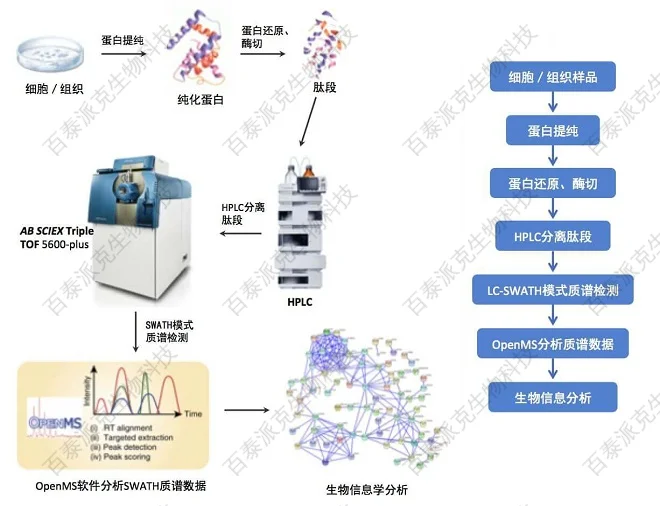
Figure 1
Biotech Co., Ltd. - BiologicalProductsCharacterization, a high-quality service provider for multi-omics biological mass spectrometry detection
Related Services:
Quantitative Proteome Analysis
SWATH Quantitative Proteomics Service
Label-Free Based Quantitative Proteome Analysis
Label-based Protein Quantification Techniques - iTRAQ, TMT, SILAC
TMT/iTRAQ/MultiNotch Quantitative Proteomics Analysis
2D-DIGE Quantitative Proteomics
MRM/PRM Quantitative Proteomics Analysis
Absolute Quantification Analysis (AQUA)
Post-translational Modification Proteome Analysis
Proteomics Bioinformatics Analysis
How to order?




