






Atmospheric Pressure Chemical Ionization
Atmospheric pressure chemical ionization (APCI) is a new ionization method mainly used as an interfacing technology in high-performance liquid chromatography and mass spectrometry analysis. APCI features a wide ionization range, high sensitivity, and high selectivity. It matches the high separation capability of liquid chromatography, making LC-APCI-MS a standard analytical technique in the fields of biological and environmental chemistry.
Principle of Atmospheric Pressure Chemical Ionization
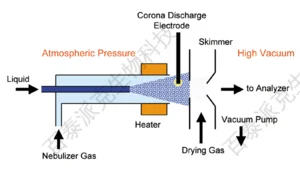
Schematic diagram of APCI
With the aid of gas, solvent and sample flow through the injector. The solvent and sample are evaporated by a heater in the injector and ejected from the injector outlet. At the injector outlet, a corona discharge from an electrical needle ionizes the solvent. The solvent ions react with the sample molecules, causing sample ionization.
The ionization process of atmospheric pressure chemical ionization is quite similar to traditional chemical ionization. The difference is that conventional chemical ionization involves electron bombardment of the solvent under vacuum to ionize it, while APCI ionizes the sample at atmospheric pressure through corona discharge. APCI is primarily used for analyzing samples with good thermal stability. Compared to electrospray ionization, APCI has the advantage of a wider range of compatible mobile phases.
Advantages and Disadvantages of Atmospheric Pressure Chemical Ionization
APCI produces singly charged ions, and the resulting molecular mass spectrum can be directly observed. In other words, APCI does not have the issue of signal overlap and reduced mass spectrum resolution due to multi-charged ions. APCI requires the sample to be vaporized, making it suitable for analyzing compounds with good thermal stability and low proton affinity. In terms of flow rate, APCI can accommodate higher flow rates than ESI.
Additionally, APCI is not suitable for analyzing biomacromolecules because it cannot produce a series of multi-charged ions. APCI generates few fragment ions, thus providing limited structural information.
Applications of Atmospheric Pressure Chemical Ionization
APCI significantly reduces sample contamination in mass spectrometers, facilitating the application of tandem mass spectrometry. The mass range of APCI source mass spectrometry can reach 25000 (m/z), greatly exceeding the mass analysis range of conventional quadrupole and ion trap mass spectrometers, allowing LC-APCI-MS/MS to analyze non-covalent complexes.
Determination of Harmful Substances in TobaccoAPCI combined with high-performance liquid chromatography and mass spectrometry plays an important role in measuring harmful substances in tobacco. HPCL-APCI-MS/MS demonstrates excellent detection capability for carbonyl compounds and glycosides in tobacco. For detecting solanesol in tobacco, the method has a detection limit of 0.4μg/L. Using liquid chromatography-tandem quadrupole mass spectrometry in APCI mode, the content of heterocyclic amines in 8 cigarette samples was measured with detection limits of 0.042-2.8ng/stick and recovery rates of 68%-108%.
Analyzing Ceramides in the Human Stratum CorneumCeramides are essential for maintaining the skin's barrier function. Many skin diseases are known to be associated with ceramide profiles. The combined use of APCI mass spectrometry and normal-phase chromatography to obtain mass spectra of nine known ceramides helps us understand underlying molecular mechanisms for developing new diagnostic approaches. For example, mass spectra from patients with severe skin diseases, such as atopic dermatitis and psoriasis, can be compared to those from healthy controls.
Classification and Prediction of Cheese MaturityAPCI mass spectrometry combined with gas chromatography-mass spectrometry is used to study the presence of volatile compounds in cheeses of different maturity levels. This technique can accurately predict the age of cheese based on characteristics of different maturation stages, with a success rate of 70%. In addition to predicting maturity, the analysis results, combined with chemometrics, provide a quick and detailed analysis of volatile components in cheese, laying the foundation for quality assessment and accelerated product development.
Analysis of Drugs and Their MetabolitesThe singly charged products formed by APCI are more sensitive than those from electrospray, thermospray, and ion beam sources, making the analysis of drugs and their metabolites simpler and faster. APCI can provide quantitative analysis results for eight phthalate derivatives in human urine within 8 minutes. Additionally, APCI can quickly and sensitively analyze flavonoids, sulfonamides, and pentafluorobenzene derivatives.
LC-APCI/MS is characterized by simplicity of operation, high sensitivity, and clear signals. It has broad applications in pharmaceuticals, environmental science, chemistry, and agriculture. With further development and optimization, APCI will be used for various applications.
This article briefly introduces an ionization method, atmospheric pressure chemical ionization, to help you better understand mass spectrometry. BGI Biotechnology has a professional mass spectrometry analysis platform equipped with state-of-the-art instruments. By using mass spectrometry, BGI Biotechnology can provide various services to meet different needs, including:
Proteomics Services
Metabolomics Services
Glycomics Analysis Services
How to order?




