






Comparison of Five Common Quantitative Proteomics Analysis Methods
Proteomics refers to the complete set of proteins expressed by an organism. Proteomics, in essence, involves studying protein characteristics on a large scale, including expression levels, post-translational modifications, and protein-protein interactions. This provides a comprehensive understanding of processes such as disease occurrence and cell metabolism at the protein level. The emergence and advancement of biomass spectrometry technology have provided more reliable and broader dynamic range research methods for quantitative proteomics analysis.
Currently, there are five mainstream quantitative proteomics methods: Label-free, iTRAQ, SILAC, MRM (MRMHR), and SWATH.
I. Label-free
Label-free quantitative proteomics does not require specific labeling of comparative samples. It only compares chromatographic mass spectrometry response signals of specific protein peptides between different samples to determine changes in protein expression levels. It is commonly used to analyze mass spectrometry data generated from large-scale protein identification and quantification.
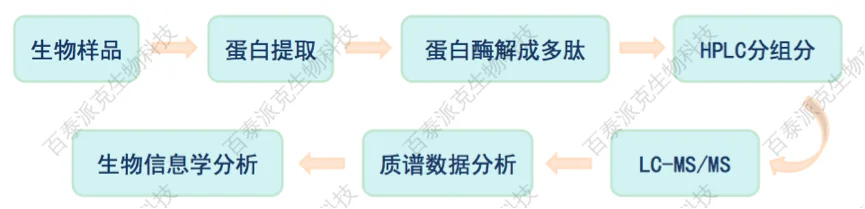
Label Free Analysis Workflow
The label-free quantification method is simple to operate and can quantify total protein differences in any sample. However, it requires high stability and reproducibility in experimental operations and is less accurate than labeled quantification. Therefore, label-free technology is suitable for large sample quantification comparisons and experimental designs that cannot be achieved by labeled quantification.
II. iTRAQ
Isobaric tags for relative and absolute quantification (iTRAQ) technology is a relative and absolute quantification technique developed by AB SCIEX. It uses multiple isotopic reagents to label the N-terminus or lysine side chain groups of protein peptides, allowing simultaneous comparison of up to eight samples' protein expression levels through high-precision tandem mass spectrometry analysis. It is a commonly used high-throughput screening technology in quantitative proteomics in recent years.
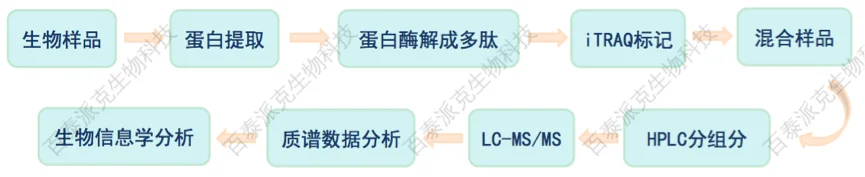
iTRAQ Analysis Workflow
iTRAQ quantification is independent of the sample, can detect low-abundance proteins, and is accurate in quantification. It can analyze eight samples simultaneously, making it suitable for studying protein expression level differences in tissue samples under different pathological conditions or developmental stages.
III. SILAC
SILAC, or Stable Isotope Labeling by Amino Acids in Cell Culture, involves adding light, medium, or heavy stable isotope-labeled essential amino acids (lysine and arginine) to cell culture media. Through normal cell metabolism, the newly synthesized proteins are tagged with stable isotopes. Proteins of each type are mixed equally, digested, and analyzed by mass spectrometry. Relative quantification is achieved by comparing the area of isotope peaks in the first-level mass spectrum, and peptide sequences are identified through second-level spectrum analysis.
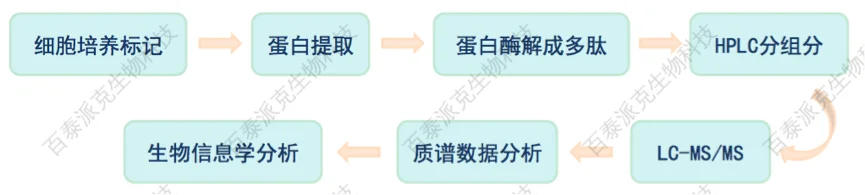
SILAC Analysis Workflow
SILAC is an in vivo labeling technique, more closely reflecting the true state of the sample, with a labeling efficiency of up to 100% and stable labeling effects. It is suitable for whole-cell protein analysis and the identification and quantification of membrane proteins, requiring only tens of micrograms of protein per sample.
IV. MRM
MRM is a data acquisition method based on known or assumed information to set mass spectrometry detection rules. It records signals for ions that meet the rules, eliminating interference from many ions that do not meet the rules, thereby obtaining mass spectrometry information. It is part of targeted proteomics. The key is to first detect specific precursor ions and perform collision-induced dissociation only on selected specific precursor ions, removing interference from other fragment ions, and collecting mass spectrometry signals only for selected specific ions.
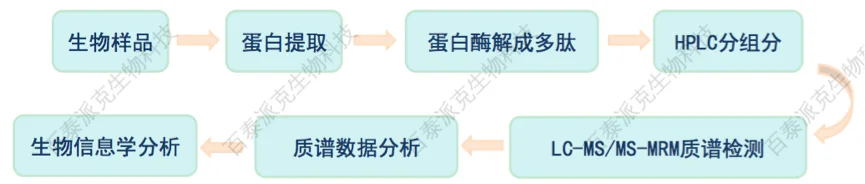
MRM Analysis Workflow
MRMHR technology uses two stages of ion selection to eliminate a large number of interfering ions, reducing the chemical background of the mass spectrometry. This significantly improves the signal-to-noise ratio of the target analyte, achieving high sensitivity detection with good reproducibility and accuracy. It is particularly suitable for validating protein expression differences in known protein sequences and can detect low-abundance proteins, but an MRM experiment can only detect about 20 target proteins at a time.
V. SWATH
SWATH is a new mass spectrometry acquisition mode technology jointly launched by Dr. Ruedi Aebersold and his team at the Swiss Federal Institute of Technology Zurich and AB-SCIEX in 2012. It is an extension of MS/MSALL technology. Compared to traditional shotgun technology, the SWATH acquisition mode allows ultra-fast scanning of all peptide precursor ions within a scanning range and performs secondary fragmentation to obtain complete peptide information. It is a truly panoramic, high-throughput mass spectrometry technology.

SWATH Analysis Workflow
How to choose the appropriate quantitative proteomics analysis method?
The iTRAQ quantitative proteomics method is quite popular because it does not rely on the sample and can perform differential quantification of total proteins in any sample with accuracy. Although Label-free also does not limit the sample, its quantification accuracy is difficult to guarantee. SILAC is for cell-level protein quantification, while quantifying tissue is more challenging, and SILAC culture costs are high, making it unsuitable for commercialization. MRM and SWATH are both related to targeted proteomics, but SWATH can quantify thousands of proteins with very high accuracy and throughput, far exceeding MRM. SWATH performs very well for subcellular structures, bacteria, fungi, and cell secretions, but SWATH is relatively more expensive.
How to order?




